What IFRS S1 and S2 require, where they apply and how the climate data you already report under the ESRS can answer ISSB-based requests.
easy4pro editorial team·Last reviewed: ·13 min read
Key takeaways
The ISSB issued IFRS S1 (general requirements) and IFRS S2 (climate) in June 2023. They are mandatory only where a jurisdiction adopts them. The EU has not: companies in the CSRD scope report under the ESRS.
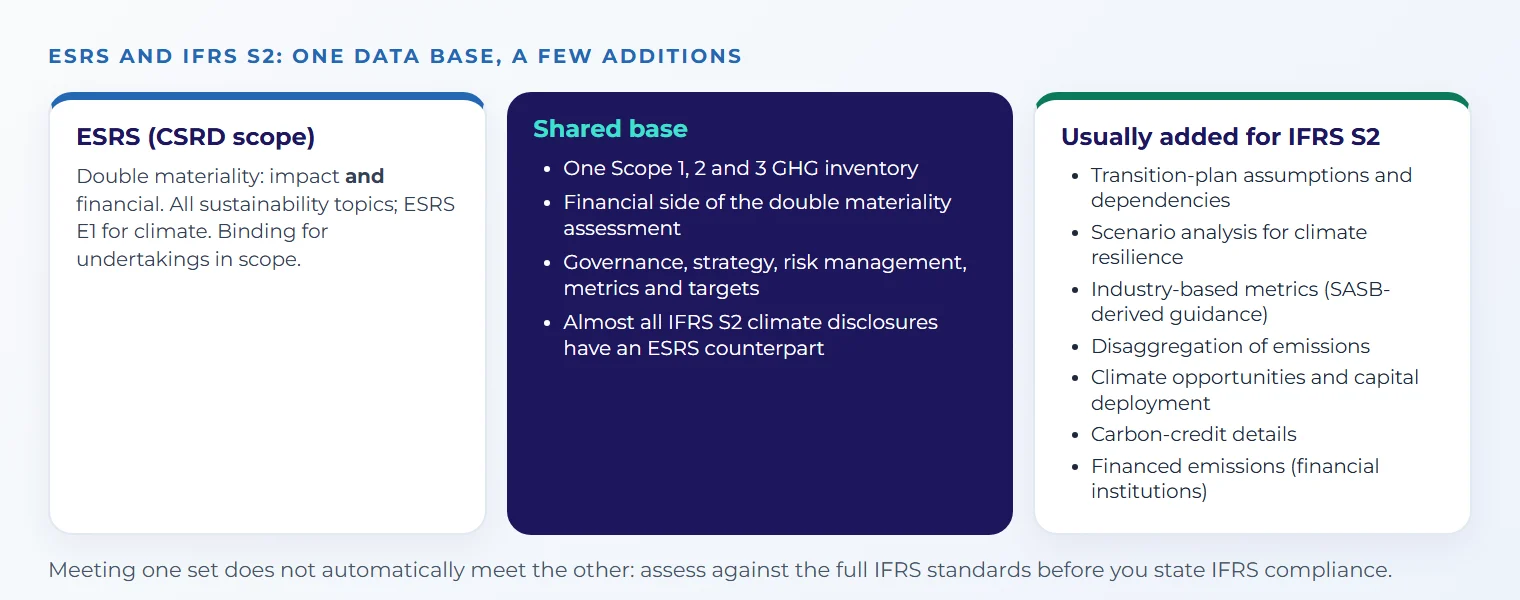
The two sets were built to work together. The IFRS Foundation and EFRAG find a high degree of alignment in the climate disclosures, and almost all IFRS S2 climate disclosures have a counterpart in the ESRS. Meeting one set does not automatically meet the other.
One greenhouse gas inventory and the financial-materiality side of your double materiality assessment are the shared base for both.
The usual additions for IFRS S2 are transition-plan assumptions, scenario analysis, industry-based metrics, emissions disaggregation, climate opportunities, capital deployment, carbon-credit details and, for financial institutions, financed emissions.
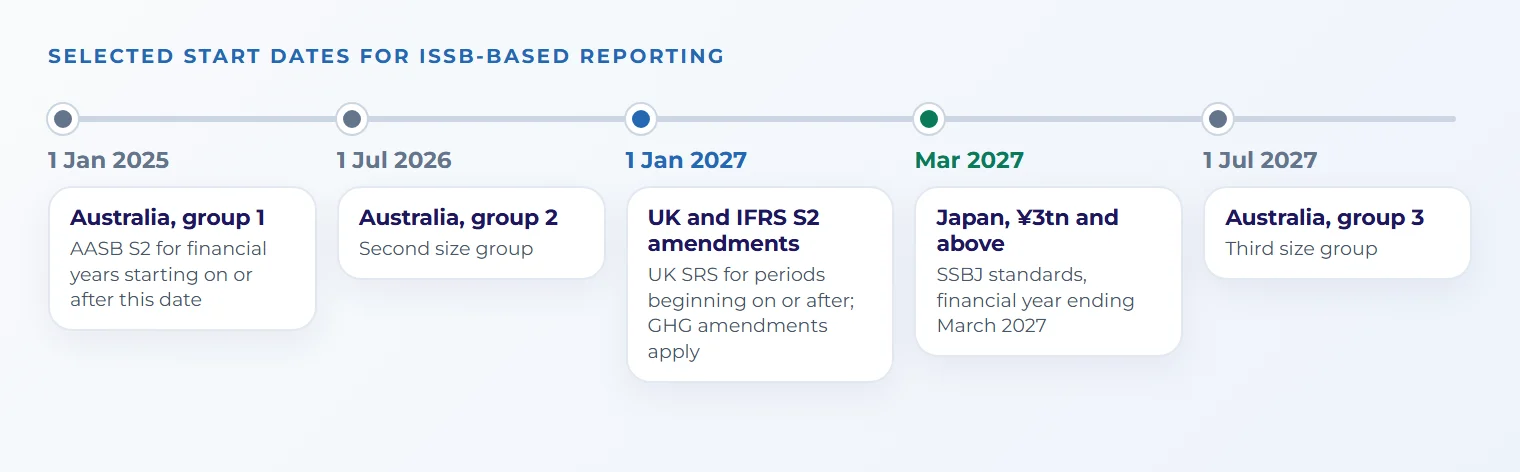
Targeted amendments to the greenhouse gas disclosures in IFRS S2 apply to annual periods beginning on or after 1 January 2027; earlier application is permitted.
A parent company, a bank or an investor asks for your climate data “in IFRS S2 format”. Do you have to start from scratch? Usually not. If you report climate under the ESRS, most of what IFRS S2 asks for is already in your data. You mainly need to add a few items and check boundaries and reliefs.
IFRS S1 and IFRS S2 are the global baseline standards of the International Sustainability Standards Board (ISSB), part of the IFRS Foundation. They are not part of EU law. Companies in the scope of the CSRD (Directive (EU) 2022/2464) report under the ESRS, in the version of Delegated Regulation (EU) 2023/2772 or, from financial year 2027, the revised ESRS in Delegated Regulation (EU) 2026/1563. Companies in the EU meet the ISSB standards indirectly: through group parents, foreign listings, banks and investors. This guide answers three questions: what IFRS S1 and S2 require, where they apply, and how to reuse your ESRS work.
What IFRS S1 and S2 cover
IFRS S1 sets the general requirements. Companies disclose the sustainability-related risks and opportunities that could affect their prospects, meaning their cash flows, access to finance or cost of capital over the short, medium or long term. Disclosures follow four areas known from the TCFD recommendations: governance, strategy, risk management, and metrics and targets. They are published together with the financial statements and cover the same reporting period.
IFRS S2 applies this structure to climate. It asks, among other things, for:
physical risks (such as heat or flooding) and transition risks (such as carbon prices or new rules),
the climate resilience of the strategy, assessed with scenario analysis using an approach that fits the company’s circumstances,
Scope 1, 2 and 3 greenhouse gas emissions, measured under the GHG Protocol Corporate Standard (2004) unless a jurisdiction requires another method,
industry-based metrics, for which the ISSB refers to guidance derived from the SASB Standards,
climate targets and progress towards them.
Both standards were issued in June 2023 and apply to annual periods beginning on or after 1 January 2024, once a jurisdiction adopts them. They offered first-year reliefs: reporting on climate only, no comparative figures, reporting after the financial statements, and Scope 3 emissions from the second year. The reliefs apply only in the first annual reporting period in which a company applies the standards, so check what your local rules still allow.
How IFRS S1 and S2 connect to the ESRS
The ISSB and EFRAG worked together while writing their standards, and the joint interoperability guidance of May 2024 shows where the two sets meet. Four links matter in practice:
Climate disclosures. Almost all IFRS S2 climate disclosures appear in the ESRS, and each ESRS E1 requirement either matches an ISSB requirement or covers it and adds more (see this Linklaters summary of the guidance).
Financial materiality. A matter that is financially material under the ISSB standards is expected to be financially material under the ESRS as well, and vice versa. The ESRS add impact materiality on top. The financial side of your double materiality assessment therefore holds the ISSB answer.
Shared structure. According to EY, both sets share principles, structure and terminology and rest on fair presentation, so a company can start from either one.
ESRS as a source for other topics. For matters beyond climate, IFRS S1 lets companies consider the ESRS as a source of guidance for identifying material information. This is a bridge, not a substitute for the ESRS requirements.
For climate, the table shows where your ESRS data already helps and what to check or add for IFRS S2.
IFRS S2 topic
What your ESRS data gives you
What to check or add
Transition plan
ESRS E1 transition plan disclosures, where you have a plan
Key assumptions and dependencies that E1 does not already capture
Climate resilience and scenario analysis
ESRS E1 disclosures on resilience. The revised ESRS no longer make scenario analysis mandatory and allow scenarios developed for other purposes (Grant Thornton)
IFRS S2 requires climate scenario analysis to assess resilience, using an approach that fits your circumstances (IFRS factsheet). Without a scenario analysis, an ESRS report leaves a gap.
Scope 1, 2 and 3 emissions
The ESRS E1 greenhouse gas inventory
Organisational boundary: the revised ESRS start from financial control but allow operational control or equity share, and keep their own rules for leased assets and joint arrangements. Add the disaggregation of emissions that IFRS S2 requires.
Anticipated financial effects
ESRS disclosures on the financial effects of risks and opportunities
IFRS S2 asks for quantitative and qualitative information and allows qualitative-only disclosure in limited cases (IFRS comparison with TCFD). The revised ESRS add transitional reliefs and omission rules, so an ESRS report may contain less than IFRS S2 expects.
Industry-based metrics
Little: the ESRS use SASB only as guidance for entity-specific topics
Check the SASB-based industry guidance and add the metrics for your industry
Climate opportunities, capital deployment, carbon credits
No direct counterpart in the 2023 ESRS
Add the IFRS S2 disclosures on opportunities, capital deployment and the use of carbon credits
Financed emissions
No direct counterpart; relevant mainly for financial institutions
Banks, insurers and asset managers add financed emissions (see the amendments below)
The table draws on the joint guidance, which refers to the 2023 ESRS, and on a 2026 analysis of the revised ESRS by EY. Check the mapping for the ESRS version you apply. EFRAG has said it will update the guidance for the revised ESRS.
One data base for both: the shared climate base of ESRS and IFRS S2, and the items usually added for IFRS S2.
One point matters for every claim you make: applying one set of standards does not automatically mean you comply with the other. The revised ESRS do not create an automatic equivalence with IFRS S1 and S2 (comparison by the Belgian Institute of Registered Auditors). A single report is possible, but you must add the disclosures that differ, and you should assess it against the full IFRS standards before you state IFRS compliance.
Where the ISSB standards apply
The IFRS Foundation counts nearly 50 jurisdictions on the way to using the ISSB standards. Companies in 13 of them apply the standards for financial year 2025, and six more follow from financial year 2026. Rules differ: some are mandatory, some comply or explain, many carry local adjustments. Three examples:
Jurisdiction
Standard and rule
Who
From
United Kingdom
UK SRS S1 and S2, the UK versions of the ISSB standards; FCA listing rules on a comply or explain basis (PS26/19)
Listed companies in the FCA rules
Accounting periods beginning on or after 1 January 2027; first reports in 2028; reliefs for Scope 3 and non-climate (S1) disclosures
Australia
AASB S2, based on IFRS S2, mandatory under the Corporations Act (Treasury guidance)
Large entities in three size groups
Financial years starting on or after 1 January 2025 (group 1), 1 July 2026 (group 2) and 1 July 2027 (group 3)
Japan
SSBJ standards published in March 2025, based on the ISSB standards (IFRS Foundation profile)
Companies on the Tokyo Stock Exchange Prime Market, phased by market capitalisation
Financial year ending March 2027 for ¥3tn and above (average market capitalisation); March 2028 for ¥1tn and above; March 2029 for ¥500bn and above, a timing the FSA may still revisit
Selected start dates from the table above, together with the IFRS S2 greenhouse gas amendments.
In the EU, companies in the CSRD scope report under the ESRS. After Omnibus I the scope is set at more than 1,000 employees and more than €450m net turnover (Directive (EU) 2026/470, national transposition deadline 19 March 2027). Ask four questions to see whether ISSB-based requests reach you:
Is your parent company in a jurisdiction that has adopted the ISSB standards? Then expect requests for data in that structure. The parent applies the standards; you supply the data.
Are your shares or bonds listed outside the EU? Then check the reporting rules of the exchange.
Do investors or banks ask for ISSB-structured data? Then answer from your ESRS or voluntary-standard data with a mapping table.
Are you in the CSRD scope and also serve international investors? Then the ESRS stay binding, and ISSB claims need a mapping and the additions above.
A Tyrolean machinery maker with 380 employees and €90m turnover is a subsidiary of a UK-listed group. It is far below the CSRD thresholds and has no ESRS duty of its own. The group, however, reports under UK SRS S1 and S2 for accounting periods beginning on or after 1 January 2027 and asks every subsidiary for Scope 1, 2 and 3 emissions, climate risks and transition actions. The subsidiary does not apply the standards itself: the obligation sits with the parent. Its task is to deliver consistent data. It builds one greenhouse gas inventory under the GHG Protocol, documents which climate risks could affect cash flows, access to finance or cost of capital, and sends both in the group's template.
Six steps get you from ESRS data to an ISSB-ready data set:
Clarify the need. Who asks for ISSB disclosures – the group, a stock exchange, a bank or an investor – in what form and by when?
Document financial materiality. Record which risks and opportunities could affect cash flows, access to finance or the cost of capital. One integrated double materiality assessment can serve both standards.
Build a mapping table. For each data point, note which disclosure it serves (ESRS, IFRS S2, customer questionnaire) and whether it is covered, to be added or not applicable. Your data point list just needs one more column.
Close the gaps. Work through the additions in the table above. Check the SASB-based industry guidance for your industry. For climate resilience, start with a documented scenario analysis that fits your circumstances.
Check reliefs and local rules. Reliefs differ in scope, timing and conditions, so a relief under one standard may not satisfy the other. Check what your regulator or group allows.
What this means for you: collect once, map twice. The data is the same. Only the structure, the boundary and a few extra items change.
What is changing next
IFRS S2 greenhouse gas amendments. On 11 December 2025 the ISSB issued targeted amendments, effective for annual periods beginning on or after 1 January 2027, with earlier application permitted. Companies may limit Scope 3 category 15 to financed emissions as IFRS S2 defines them. They may use classification systems other than GICS to disaggregate financed emissions. The relief to use a measurement method other than the GHG Protocol is clarified for cases where a jurisdiction requires it. The changes matter most for financial institutions and for companies in jurisdictions with their own methods.
Revised ESRS.Delegated Regulation (EU) 2026/1563 applies to financial years starting on or after 1 January 2027, with an option for financial year 2026. It moves closer to the ISSB standards through fair presentation, a choice of GHG boundary approach (financial control, operational control or equity share), and reliefs for anticipated financial effects. Scenario analysis is no longer mandatory, which widens one gap to IFRS S2. The revised ESRS do not create a direct compliance pathway to the ISSB standards.
ESRS-40a for non-EU groups. In July 2026 EFRAG opened a consultation on ESRS for certain non-EU undertakings under Article 40a of the Accounting Directive, closing on 31 October 2026. It asks, among other things, whether groups that already report under IFRS-based standards can reuse that report. EFRAG expects to submit its advice in January 2027, and reporting is planned for financial years starting on or after 1 January 2028. This is an exposure draft, not law.
ISSB work programme. On 22 October 2026 the ISSB published an exposure draft of an IFRS Practice Statement on nature-related disclosures, open for comment until 19 February 2027 (XBRL International). Amendments to the SASB Standards are also in progress. Neither is final, and neither changes the climate requirements above.
Whether you apply IFRS S1 and S2 yourself or only supply data depends on your group structure and your investors and lenders. Clarify it early – then ESRS, VSME and ISSB requests can all be answered from one set of data.
How FIESDA can help with IFRS S1 and S2 reporting
Answering an IFRS S2 request from ESRS data is mostly a mapping job. FIESDA’s IFRS S1 and S2 reporting software holds IFRS and ESRS templates side by side, each with integrated guidance on the disclosure requirements. You store a figure such as Scope 1 emissions once and reference it in both reports, and the AI chatbot answers questions on IFRS, ESRS and the GHG Protocol. Treat its answers as a starting point: you still check the mapping, the reporting boundary and the IFRS S2 additions.
Frequently asked questions
Are IFRS S1 and S2 mandatory in Austria or the EU?
No. The EU has not adopted them. Companies in the CSRD scope report under the ESRS. The ISSB standards become binding only where a jurisdiction adopts them, so they reach EU companies through foreign parents, listings and investors.
If I report under the ESRS, do I comply with IFRS S2?
Not automatically. The climate disclosures overlap strongly, but you must add items such as scenario analysis, industry-based metrics and transition-plan assumptions, and check the GHG boundary.
Do I need a double materiality assessment for IFRS S1 and S2?
No. The ISSB standards use financial materiality only. If you also report under the ESRS, run one assessment and use its financial side for the ISSB.
Is IFRS S2 the same as the TCFD recommendations?
No, but they are related. IFRS S1 structures disclosures along the four TCFD areas: governance, strategy, risk management, and metrics and targets. In the UK, PS26/19 replaces the FCA’s TCFD-aligned listing rules with UK SRS for accounting periods beginning on or after 1 January 2027.
Does the CSRD value-chain cap limit ISSB data requests?
The cap applies only to information gathered for a CSRD sustainability statement (see our guide to the voluntary standard). It does not limit requests made for other purposes, such as a group report under UK SRS.
How to assess the physical and transition climate risks of your sites – with scenarios, free hazard data and a simple scoring scheme that fits ESRS E1 and IFRS S2.
Which revised ESRS datapoints apply to you, how materiality, reliefs and phase-ins filter them, and how to use EFRAG’s Excel list and prepare for XBRL tagging.
How to plan and report your climate transition under the revised ESRS E1-1, the voluntary standard (VSME) and IFRS S2, and what Omnibus I changed for transition plans.