How to run a double materiality assessment under the ESRS: who needs one, how to assess impacts, risks and opportunities, set thresholds and document for assurance.
easy4pro editorial team·Last reviewed: ·15 min read
Key takeaways
The double materiality assessment (DMA) decides what an undertaking reports on under the ESRS – it is the foundation of the whole sustainability statement.
A matter is material if it is material from the impact perspective, the financial perspective, or both – and only material information is reported.
Impacts, risks and opportunities (IROs) cover the value chain, but you may use reasonable, supportable information and need not assess every conceivable impact.
The ESRS set criteria, not a procedure: you must describe your method, assumptions and thresholds, and assurance providers examine that process.
Which sustainability topics belong in your report? Under the European Sustainability Reporting Standards (ESRS), the answer comes from a double materiality assessment (DMA). It is the most important decision in the whole report: miss a matter and it is missing from the statement; classify too much as material and you pay for data nobody needs.
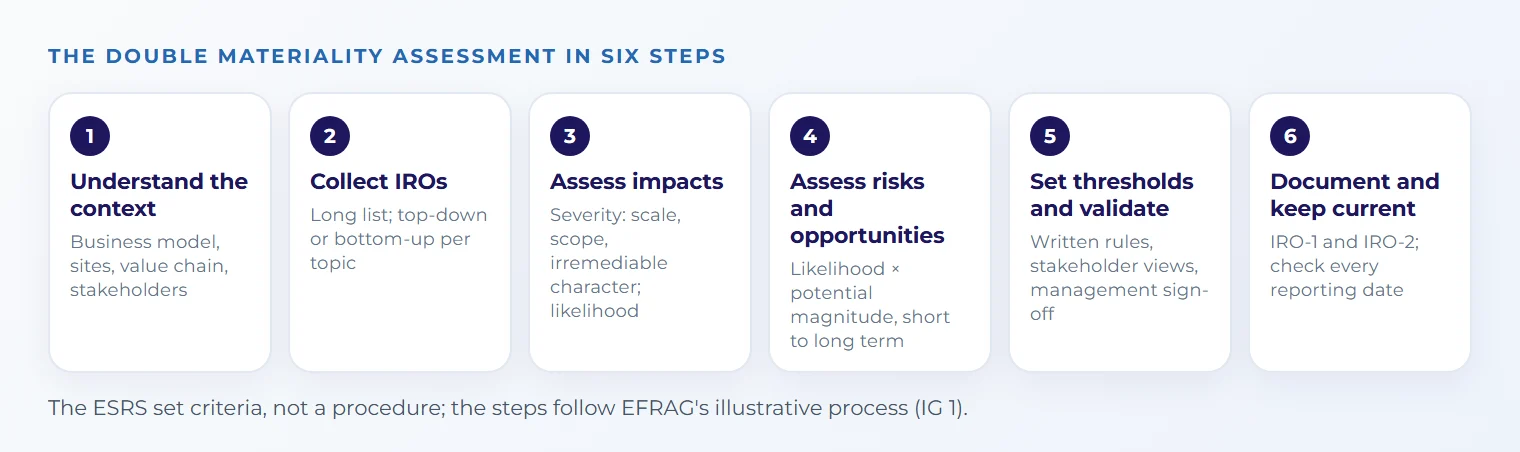
This guide answers four questions: who has to run a DMA, which version of the ESRS applies, how to do it in six steps, and what assurance providers expect to see. The ESRS set the criteria, not a procedure. The six steps follow the illustrative process in EFRAG’s non-authoritative Implementation Guidance IG 1 on the materiality assessment (understand the context, identify impacts, risks and opportunities, assess, report), which EFRAG published in May 2024 for the original ESRS. Where the guidance and the ESRS differ, the ESRS prevail.
The six steps of a double materiality assessment, following EFRAG's illustrative process.
Who needs one, and under which rules?
A DMA is a legal requirement for undertakings that must publish a sustainability statement under the CSRD. Quick check:
Your situation
Do you need a DMA?
EU undertaking, or EU parent of a group, with more than 1,000 employees (average over the financial year) and more than €450m net turnover
Yes. Directive (EU) 2026/470 narrowed the CSRD scope to undertakings that meet both tests. Member States must transpose it by 19 March 2027, so check your national law for the exact start date. For undertakings that did not report before, the revised ESRS refer to financial years starting on or after 1 January 2027 (revised ESRS 1, paragraph 122).
Non-EU group with more than €450m net turnover in the EU (for two consecutive years) and an EU subsidiary or branch with more than €200m net turnover in the preceding financial year
Yes, if these conditions are met. National transposition fixes the details.
Below these thresholds, including most SMEs
No legal duty under the CSRD. A simplified DMA is still useful for strategy and for answering customer questions. The VSME does not require one (it works on an “if applicable” basis).
Which version of the ESRS applies? The revised ESRS (Delegated Regulation (EU) 2026/1563) apply to financial years starting on or after 1 January 2027 and have been in force since 10 November 2026. For financial years starting in 2026, undertakings can choose the existing ESRS (Delegated Regulation (EU) 2023/2772, as last amended by Delegated Regulation (EU) 2025/1416), the existing ESRS with selected reliefs from the revision, or the revised ESRS in full – and must say which they used. Two of those reliefs concern the DMA: the top-down approach (paragraph 27 of the revised ESRS 1) and the undue cost or effort and value chain provisions (paragraphs 32–33).
What this means for you: if you report for a financial year starting in 2026, decide early which route you take. The revised rules let you start from your business model instead of assessing every impact, but you still have to describe your method (see Step 6). The paragraph numbers in this guide refer to the revised ESRS 1; if you apply the existing ESRS for a financial year starting in 2026, check the wording in that version.
Two perspectives, one result
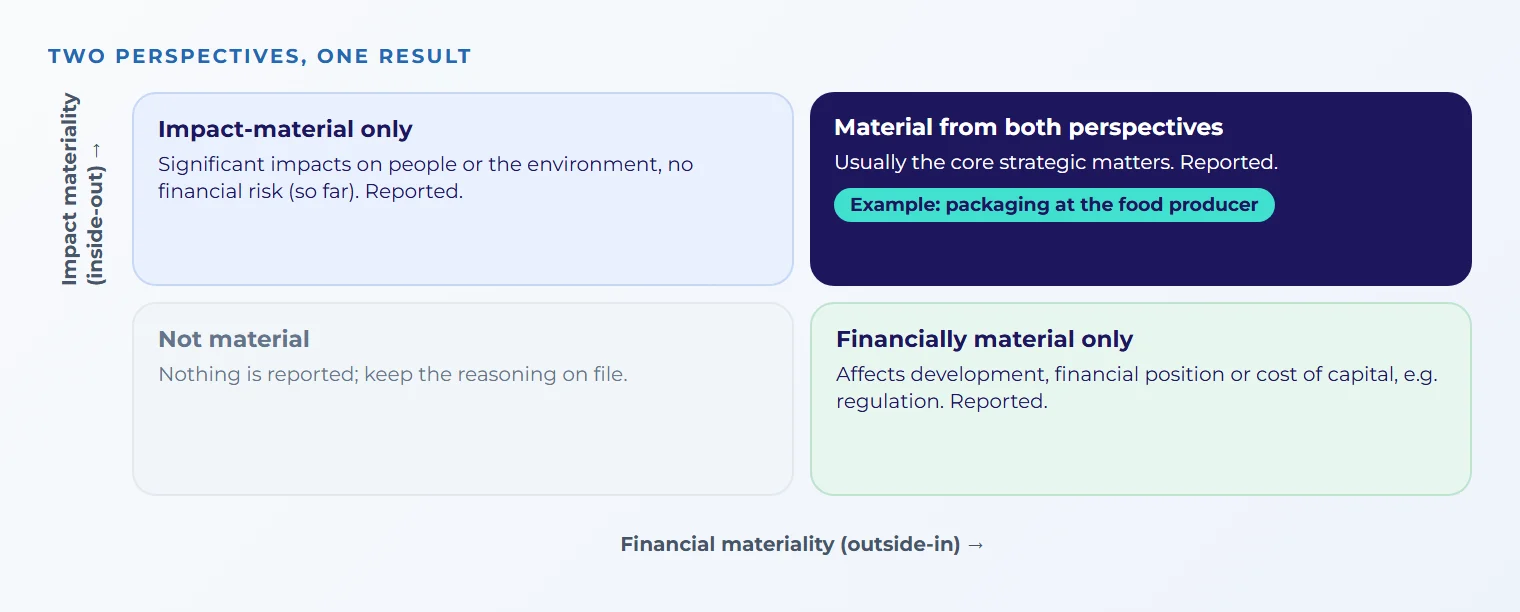
Double materiality looks at every sustainability matter from two directions:
Impact materiality (inside-out): what actual or potential, positive or negative impacts does the company have on people and the environment?
Financial materiality (outside-in): what risks and opportunities does the matter create for the company’s development, financial position or cost of capital?
A matter is material as soon as it is material from at least one of the two perspectives.
Impact-material onlyThe company significantly affects people or the environment without a financial risk (so far). Information on the matter is reported.
Material from both perspectivesSignificant impacts and financial relevance – this is usually where the core strategic matters are.
Not materialNeither significant impacts nor financial relevance. Nothing is reported on the matter; keep the reasoning on file.
Financially material onlyThe matter affects the company financially, for example through regulation or market shifts. Information on the matter is reported.
Material does not mean “report everything”. A material topic triggers only the information that relates to its material impacts, risks and opportunities (revised ESRS 1, paragraphs 26 and 30), and an undertaking must not disclose prescribed datapoints that are not material, with limited exceptions (paragraph 24). The result is often drawn as a “materiality matrix”. That chart presents the outcome; it is not the assessment itself.
A matter is material if it is material from the impact perspective, the financial perspective, or both.
Example (fictional)
A food producer with 2,200 employees and €780m net turnover assesses packaging. Impact view: high volumes of single-use plastic packaging create waste and use resources (an actual negative impact, scored on scale, scope and irremediable character). Financial view: stricter recyclability requirements could force investment in new packaging lines (a risk, scored on likelihood and potential magnitude). Result: material from both perspectives, so the matter belongs in the strategy, targets and report. The full path from context to result follows in the worked example after Step 6.
Step 1: Understand the context
Describe the business model, products, sites and the upstream and downstream value chain. Record which stakeholders are affected – employees, suppliers, customers, local communities – and who uses the information in the report, such as banks and investors. Gather what already exists: risk registers and the results of any due diligence process, for example under Directive (EU) 2024/1760 (CSDDD). These are key inputs, because stakeholder engagement carried out in due diligence feeds the assessment (revised ESRS 1, paragraph 42).
What this means for you: write the context down on one or two pages. It is the evidence behind every top-down conclusion in Step 2.
Step 2: Collect impacts, risks and opportunities
Draw up a long list of possible impacts, risks and opportunities (IROs). Start from the ESRS topics – climate, pollution, water, biodiversity, circular economy, own workforce, workers in the value chain, affected communities, consumers and business conduct – and add sector-specific matters. Phrase IROs concretely (“emissions from our own truck fleet”) rather than abstractly (“climate”). Start with impacts, then check for risks and opportunities that are not linked to impacts, such as physical climate risks (paragraph 36).
Then choose your route. You may combine the two:
Top-down: conclude that a topic is material or not material from your strategy, business model, sectors, geographies and value chain, without further assessment. If the answer is not evident, assess the topic specifically (paragraph 27).
Bottom-up: assess individual impacts, risks and opportunities (paragraph 28).
You use reasonable and supportable information that is available without undue cost or effort. You do not have to assess every possible impact; focus on the areas where material impacts are likely (paragraph 32).
Step 3: Assess impacts
Negative impacts are assessed by their severity: scale, scope and irremediable character. For potential impacts, likelihood is added. Positive impacts are assessed by scale and scope and, if potential, likelihood. For potential human-rights impacts, severity takes precedence over likelihood (paragraphs 39–41).
Two rules affect the result. Actual impacts are assessed as they occurred in the year, and remediation carried out during the reporting period is not taken into account. For potential negative impacts, only policies and actions that are already implemented count, and only if they can reasonably be assumed to reduce severity or likelihood (paragraph 43). Positive impacts are assessed on their own and not netted against negative ones (paragraph 44).
Step 4: Assess risks and opportunities
For the financial perspective, estimate the likelihood and the potential magnitude of financial effects. Information is material where a topic triggers, or could reasonably be expected to trigger, material financial effects. These can come from impacts, from dependencies on natural or social resources and from other factors (paragraphs 47–50). Look at the short, medium and long term. Unless you justify a different definition, the short term is the period of your financial statements, the medium term runs up to five years after it and the long term is beyond five years (paragraphs 79–81). Where possible, use your existing risk-management processes so that the results are consistent.
Step 5: Set thresholds and validate the result
Define when an IRO counts as material, and justify it. The ESRS do not prescribe a score. You choose your own thresholds and method, and you describe them in the report (IRO-1). Have the result sense-checked by the relevant departments, take account of affected stakeholders’ views and have management sign it off. Engagement with affected stakeholders in your ongoing due diligence is a key input (paragraph 42). Management sign-off is good governance and makes the result easier to defend.
What this means for you: a short written rule for each threshold (“severity of 4 or more on our 5-point scale”) is easier to defend than a long score table without reasons. The worked example after Step 6 shows a complete set.
Step 6: Document and keep it current
Document the method, sources, assessments, thresholds and decisions so that a third party can follow them. You also have to disclose the process in the sustainability statement: ESRS 2 disclosure requirement IRO-1 asks for the key methodologies, inputs and assumptions, the qualitative considerations or quantitative thresholds, how impacts are assessed and prioritised, how due diligence and stakeholder consultation informed the assessment, significant changes to the process and when it was last updated. IRO-2 asks for the list of material IROs and the disclosure requirements you applied. Avoid boilerplate. If climate change is not material and you therefore omit all ESRS E1 disclosure requirements, you must disclose the basis for that conclusion (IRO-2, paragraph 37(b)).
At each reporting date, consider whether significant changes in the business, the value chain or the method affect earlier conclusions, and update the assessment if they do (paragraph 34). Check every year; redo only what changed.
Assurance is at limited-assurance level only, and the assurance opinion covers, among other things, the process the undertaking carried out to identify the information it reports (Article 34(1), second subparagraph, point (aa) of Directive 2013/34/EU, as amended by the CSRD and Directive (EU) 2026/470). An undocumented assessment is therefore a problem for the whole report, not just for one chapter.
How FIESDA can help with double materiality assessment
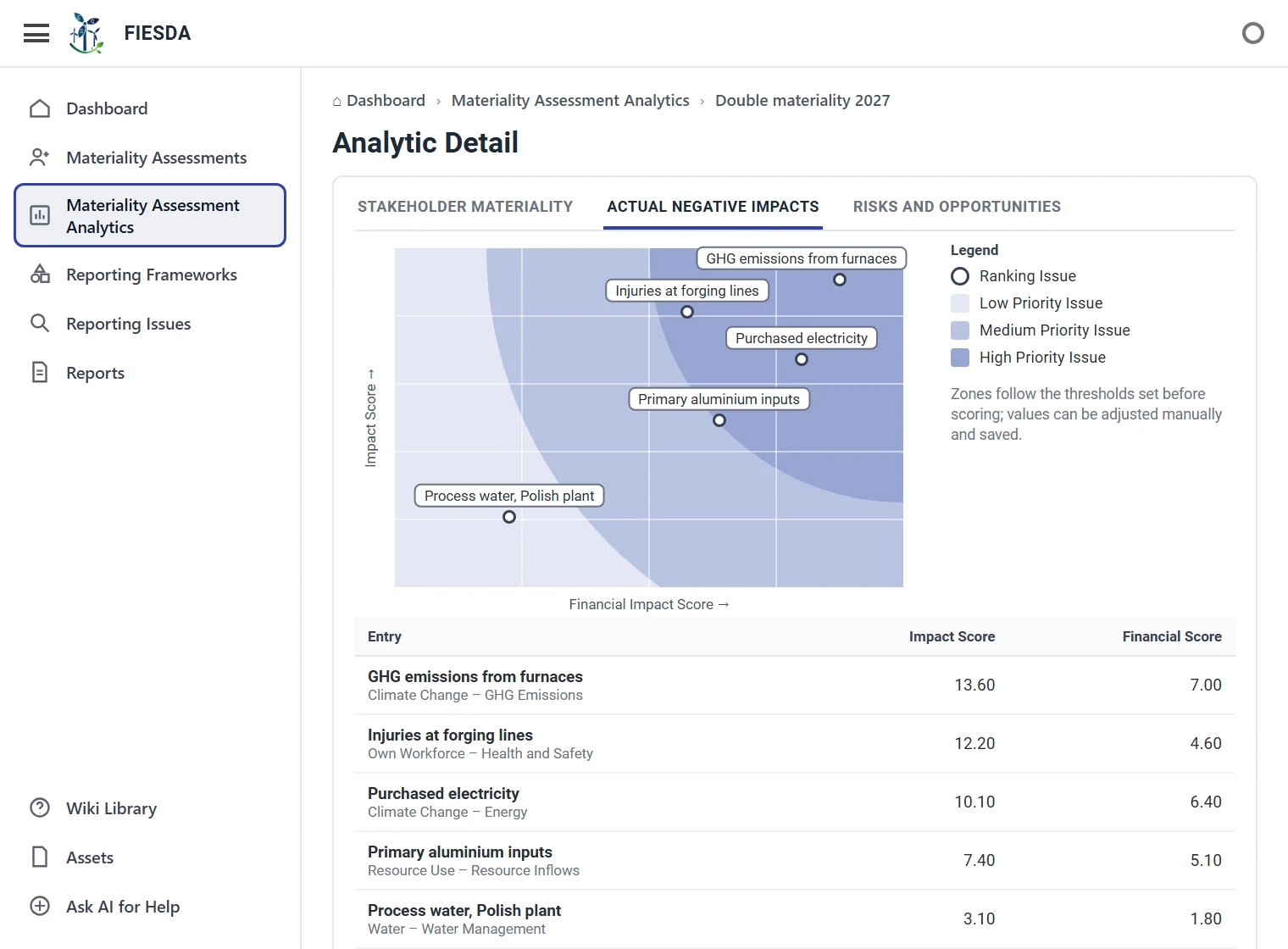
A double materiality assessment is only as good as the stakeholder views behind it. FIESDA’s double materiality assessment software keeps stakeholders and groups in a register and sends them ranking-and-scoring assessments and questionnaires by email link, with guidance you write for participants. They can add impacts you missed and attach evidence. Scores and comments are consolidated automatically and filterable by stakeholder group, then scored with ESRS-aligned templates and plotted on adjustable matrices. You still choose the method, scales and thresholds and own the conclusions.
Illustration of a materiality matrix in FIESDA: scored impacts plotted against priority zones, with the ranking entry table below (example data).
Worked example: a manufacturer, from context to result
Example (fictional)
Alder Components GmbH makes forged and cast steel and aluminium parts for vehicle and machinery manufacturers. It has 3,400 employees, €1.1bn net turnover and three plants (two in Germany, one in Poland), so it is within the CSRD thresholds. It prepares its sustainability statement under the revised ESRS (Delegated Regulation (EU) 2026/1563). The sustainability team leads, with finance, procurement, HR and plant managers as co-assessors.
Step 1 – Context. Business model: build-to-order components for about 40 industrial customers. Sites: three plants with melting, forging and machining. Value chain: steel and aluminium purchased from mills and smelters in the EU and Asia; customers install the parts in vehicles and machines. Users: banks, customers’ procurement teams and investors in its bonds. Inputs collected: risk register, supplier spend by country and commodity, plant accident records, energy invoices and the notes of its human-rights risk screening.
Step 2 – Route. Alder works top-down where the answer is evident and bottom-up for the rest (revised ESRS 1, paragraphs 27 and 28). Climate change is concluded material at topic level, because melting and forging are energy-intensive. Affected communities are concluded not material at topic level: all plants are in established industrial zones, there are no complaints on file, and the supplier screening shows no sensitive sites among its main suppliers. Both conclusions are written down with their reasoning. Water gets a short bottom-up check because the screening could not rule it out.
Thresholds (Step 5), agreed before scoring. Alder uses 1–5 scales and applies its own rules; the ESRS do not fix them:
Negative impacts: severity is the highest of scale, scope and irremediable character. An actual impact is material at severity 4 or more. A potential impact is material if severity × likelihood is 12 or more. For potential human-rights impacts, severity of 4 or more is enough on its own (paragraph 40).
Risks and opportunities: likelihood × magnitude of 12 or more in the short, medium or long term. Magnitude is anchored to annual EBITDA: 3 means about 2–5%, 5 means more than 10%.
Steps 3 and 4 – Assessment. Only implemented measures that reduce severity or likelihood are counted for potential impacts (paragraph 43). Value-chain scores rest on sector and country data, not on questionnaires to every supplier (paragraph 33).
Topic and IRO
Type
Assessment
Outcome
Climate (E1): greenhouse gas emissions from furnaces and purchased electricity
Actual negative impact
Scale 5, scope 4, irremediable 5 → severity 5
Material
Climate (E1): rising energy and carbon costs for melting and forging
Risk
Likelihood 4 × magnitude 4 (medium term) = 16
Material
Resource use (E5): growing customer demand for recycled aluminium
Opportunity
Likelihood 4 × magnitude 4 = 16
Material
Own workforce (S1): serious injuries at forging and casting lines
Potential negative impact
Severity 5; likelihood 3 after counting implemented safety systems → 15
Material
Workers in the value chain (S2): forced labour risk at smelters and mills in higher-risk countries
Potential negative human-rights impact
Severity 5, likelihood 2 (sector and country data)
Material (severity rule)
Own workforce (S1): shortage of skilled machinists
Risk
Likelihood 4 × magnitude 3 = 12
Material
Water (E3): process water use at the Polish plant
Actual negative impact
Severity 2 (closed-loop cooling, no water-stressed site)
Not material
Validation (Step 5). Plant managers and the heads of procurement and HR check the scores in two workshops. Alder takes account of the views of employee representatives and of the findings of its human-rights risk screening (paragraph 42), and also draws on customer questionnaires. The management board signs off the result.
Step 6 – Result and documentation. Material: climate change, own workforce (health and safety, skills), workers in the value chain and resource use. Not material: affected communities and water; nothing is reported on them (paragraph 24), and the reasoning stays on file. For each material topic, Alder reports only the information linked to its material IROs (paragraphs 26 and 30). In the sustainability statement, IRO-1 describes the process, inputs, assumptions and the thresholds above, and IRO-2 lists the material IROs. The next year, Alder checks whether significant changes occurred. It acquires a plating plant in Poland, which could change the pollution and water topics, so it updates those two and leaves the rest as they are (paragraph 34).
What this means for you: copy the sequence, not the numbers. Write the context down, choose top-down or bottom-up per topic, fix your thresholds before you score, record every exception and update only what changed.
Common mistakes
Survey instead of assessment: a stakeholder survey provides important input but does not replace assessing severity and likelihood.
Forgetting the value chain: many material impacts occur at suppliers or in the use phase of products. You can assess them with sector or regional data.
Thresholds without justification: an arbitrary cut-off is hard to defend, and you have to describe your thresholds and method in the report.
Reporting “just in case”: non-material datapoints must not be disclosed, and adding them dilutes the report.
A one-off exercise: significant changes in the business or value chain trigger an update.
No link to strategy: material matters should show up in targets and actions – more on this in the guide Making ESG targets measurable.
Frequently asked questions
Do SMEs need a double materiality assessment?
Not under the CSRD unless they meet the thresholds above. The VSME is voluntary and does not require a DMA, but a simplified assessment helps you choose which disclosures to include. If a customer asks you for data, see our guide on the voluntary standard and the VSME.
Do I have to repeat the DMA every year?
Not in full. At each reporting date you consider whether significant changes affect earlier conclusions and update the assessment if they do (paragraph 34). You also disclose when it was last updated.
Can I start top-down?
Yes. If your strategy, business model, sectors, geographies and value chain make a topic clearly material or clearly not material, you may conclude without further assessment (paragraph 27). For financial year 2026 this is available as a relief on top of the existing ESRS.
Do I need data from every supplier?
No. You may assess upstream and downstream impacts without direct input from value chain actors, using regional or sector averages or generally available information (paragraph 33).
Do I need scores and thresholds?
The ESRS do not prescribe a scoring method, so you choose your own approach. Whatever you use, including your thresholds, you must describe it in the report (IRO-1).
What if climate change is not material?
If you omit all ESRS E1 disclosure requirements on that basis, you must disclose why climate change is not material (ESRS 2, IRO-2, paragraph 37(b)).
Which revised ESRS datapoints apply to you, how materiality, reliefs and phase-ins filter them, and how to use EFRAG’s Excel list and prepare for XBRL tagging.
How to plan and report your climate transition under the revised ESRS E1-1, the voluntary standard (VSME) and IFRS S2, and what Omnibus I changed for transition plans.