What the voluntary standard (VS, formerly VSME) and the value-chain cap mean for SMEs and suppliers – and how to answer ESG data requests efficiently.
easy4pro editorial team·Last reviewed: ·9 min read
Key takeaways
The voluntary standard (VS) is the EU's sustainability reporting standard for companies outside the CSRD. It is the legal successor to the VSME, the standard EFRAG developed and the Commission recommended in 2025 as Recommendation (EU) 2025/1710.
The VS is set out in Delegated Regulation (EU) 2026/1560, which entered into force on 24 September 2026. It builds on the VSME with minimal changes: fewer datapoints, aligned with the revised ESRS, and the same two modules.
It is voluntary. Its second job is the value-chain cap: for financial years starting on or after 1 January 2027, CSRD reporting companies may generally not require undertakings with up to 1,000 employees to provide more than the VS datapoints listed in its Annex II for the CSRD report.
One report under the VS can answer many customer and bank questionnaires at once. A VSME report is a sound starting point, but check it against the VS before you describe it as one.
Your largest customer sends a 200-question ESG form with a two-week deadline. The bank wants emissions data. A tender asks for evidence. Every request looks different, and each one takes time. Three questions follow: do you have to answer all of it, what is the “VSME” people keep mentioning, and is it now called “VS”? This guide answers all three. Short version: VSME and VS are the same standard under two names, and from 2027 the VS also sets a legal ceiling on what CSRD reporting customers may ask of you.
Example (fictional)
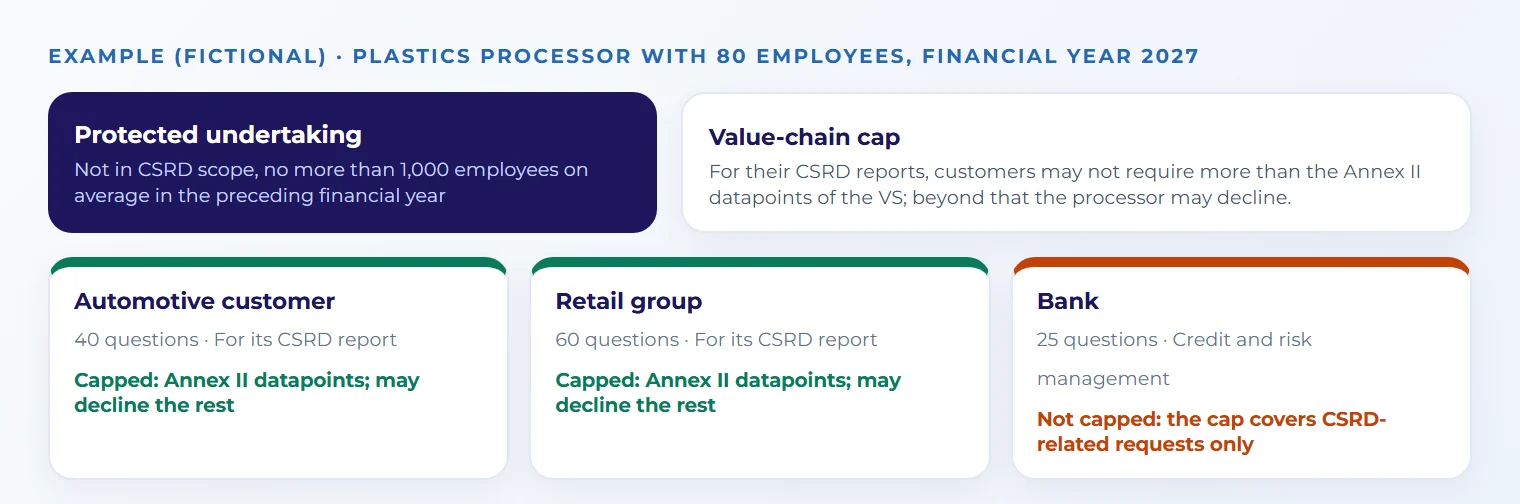
A plastics processor with 80 employees receives three questionnaires in one quarter of financial year 2027: 40 questions from an automotive customer, 25 from its bank and 60 from a retail group. Both customers are CSRD reporters, and both want the data for their own sustainability statements. Because the processor has no more than 1,000 employees, it is a protected undertaking: it can decline anything beyond the Annex II datapoints of the VS, and it should be told which extra items are requested and that it may refuse them. The bank’s 25 questions are different. The cap only covers information gathered for CSRD reporting, so it does not automatically limit them, although the Regulation encourages financial institutions to keep their requests within the VS. One VS report therefore answers most of the 125 questions at once, and the cap gives the processor a basis to push back on the rest.
From VSME to VS: how the standard evolved
The VSME (Voluntary Sustainability Reporting Standard for non-listed SMEs) was developed by EFRAG and handed to the European Commission in December 2024. The Commission adopted it on 30 July 2025 as Recommendation (EU) 2025/1710, published in the Official Journal on 5 August 2025. A recommendation is not binding. It was an interim offer: a common format that SMEs could use to answer data requests from customers, banks and investors, until a formal delegated act was in place.
That delegated act is now in force. The Commission adopted it as the voluntary standard, which EFRAG and the market abbreviate to VS. It is based on the VSME as originally adopted. Delegated Regulation (EU) 2026/1560 states that the Recommendation stops producing legal effects once the Regulation enters into force. If you read “VSME” in older articles, questionnaires or software, it usually means the same standard.
Term
What it is
Status
VSME
EFRAG’s Voluntary Sustainability Reporting Standard for non-listed SMEs, as published in Recommendation (EU) 2025/1710
Superseded; the Recommendation ceases to have legal effect from 24 September 2026
VS (voluntary standard)
The EU delegated-act version, Delegated Regulation (EU) 2026/1560, for undertakings outside the CSRD
In force since 24 September 2026
Value-chain cap
The upper limit on what CSRD reporters may require from protected undertakings; its datapoints are listed in Annex II of the VS
Applies to financial years starting on or after 1 January 2027
Revised ESRS
Mandatory standards for CSRD reporters, Delegated Regulation (EU) 2026/1563. Not the same as the VS
Apply from financial year 2027; options for financial year 2026
The VS keeps the VSME’s two-module structure:
a Basic Module with fundamental disclosures, for example on energy use and greenhouse gas emissions, pollution, water, waste, the workforce, health and safety, pay and corruption cases, and
a Comprehensive Module with additional disclosures that banks and larger business partners in particular often ask for.
What changed from the VSME is limited. The Commission aligned the content with the revised ESRS, which reduces the number of datapoints, clarified how the value-chain cap works, and made certain demanding environmental datapoints voluntary for undertakings with 10 employees or fewer. EFRAG has updated its non-mandatory guidance, which was previously part of the Recommendation, and plans an updated digital template for November 2026.
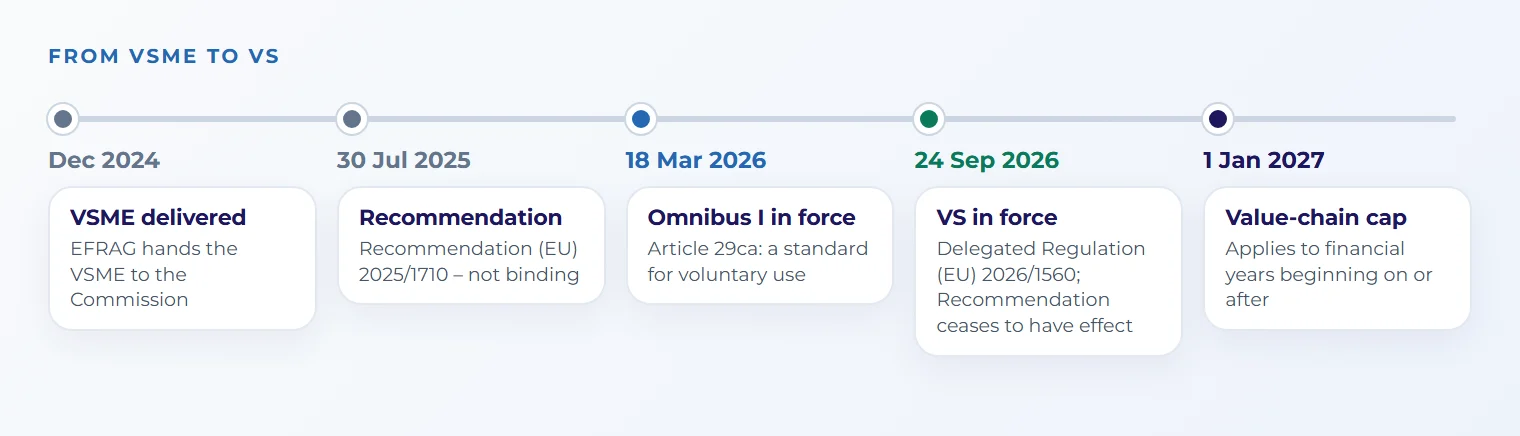
Key dates: December 2024, EFRAG delivers the VSME to the Commission. 30 July 2025, Commission adopts Recommendation (EU) 2025/1710. 18 March 2026, Directive (EU) 2026/470 (Omnibus I) enters into force. 3 July 2026, Commission adopts the VS. 21 September 2026, publication in the Official Journal. 24 September 2026, entry into force. 1 January 2027, the value-chain cap starts to apply to financial years beginning on or after that date.
From the VSME Recommendation to the voluntary standard and the value-chain cap.
The voluntary standard: the legal framework
Directive (EU) 2026/470 (Omnibus I) added Article 29ca to the Accounting Directive 2013/34/EU. It obliges the Commission to adopt, by delegated act, a sustainability reporting standard for voluntary use by undertakings with no more than 1,000 employees. Delegated Regulation (EU) 2026/1560 does that. Published in the Official Journal on 21 September 2026, it entered into force three days later, on 24 September 2026.
Who may use it. Any undertaking that is not subject to mandatory reporting under Articles 19a and 29a of the Accounting Directive may report under the VS voluntarily. Since the CSRD now generally covers only companies with more than 1,000 employees and more than €450m net turnover (non-EU groups are tested on their EU turnover), this can include listed companies below those thresholds. The cap protects undertakings with no more than 1,000 employees on average in the preceding financial year.
Two functions. The VS gives smaller companies a simple, standardised format for voluntary reporting, which can help with sustainable finance and with tracking their own performance. It also acts as the value-chain cap. Reporting under the VS does not require assurance.
What this means for you: if a customer or bank asks for a “VSME report”, you can usually answer with a VS report. Tell them which version you used, because some questionnaires still use the old name.
The value-chain cap: protection against excessive requests
The value-chain cap applies to financial years starting on or after 1 January 2027. It protects undertakings that had an average of no more than 1,000 employees in the preceding financial year. For its own sustainability statement, a CSRD reporter may not require such a company to provide anything beyond the datapoints listed in Annex II of the VS. Annex II distinguishes between undertakings with more than 10 employees and those with 10 or fewer.
The cap works in practice like this: protected undertakings have a statutory right to decline requests that go beyond Annex II. A reporting company that needs more should tell the supplier which additional information it wants and that the supplier may refuse. Voluntary exchange of information commonly shared within a sector is not prohibited.
What Annex II covers. Annex II, titled “List of disclosures covered by the value chain cap”, picks selected datapoints from both modules and has separate columns for undertakings with more than 10 employees and those with 10 or fewer. From the Basic Module it includes general undertaking information, total energy consumption, estimated gross greenhouse gas emissions, water withdrawal, waste and circular-economy principles, employees by contract type and gender, work-related accidents, pay relative to the minimum wage, collective bargaining coverage and training hours. From the Comprehensive Module it includes products, markets and business relationships, employee turnover, a code of conduct or human rights policy, a complaints mechanism and confirmed incidents in the own workforce and the value chain. Check the Annex itself to see which items apply to your size group.
Two limits are worth knowing:
The cap only covers information gathered for the requesting company’s CSRD reporting.
It does not restrict requests needed to meet other EU or national legislation, under the conditions that legislation sets – for example due diligence obligations in the supply chain or requirements for banks. Contractual obligations that stay within the VS limits are not affected either.
Quick check – where do you stand?
Your company
What applies
EU company with more than 1,000 employees and more than €450m net turnover
In CSRD scope, report under the revised ESRS; the VS is not for you
Not in CSRD scope, up to 1,000 employees (average, preceding financial year)
VS available; protected by the value-chain cap from financial year 2027
Not in CSRD scope, more than 1,000 employees
VS may be used voluntarily; not protected by the cap
The plastics processor from the example: the two CSRD-related questionnaires are capped at the Annex II datapoints; the bank's request is not.
How to approach it in practice
Collect the requests. List every ESG request from the last twelve months – who asked what, and why?
Sort them by legal basis. Mark which requests feed a customer’s CSRD report (capped) and which come from banks, supply-chain due diligence or contracts (not capped).
Build the data foundation. Start with the Basic Module. Energy and emissions data usually take the most effort, so plan the most time for them.
Report once, reuse often. Prepare one report under the VS and refer to it in questionnaires instead of answering every request separately.
Point to the cap from 2027. If a CSRD-reporting customer asks for more than Annex II for its CSRD report, you can politely refer to the value-chain cap.
Update every year. Keeping the data current all year, instead of gathering it once a year, saves most of the work for the next report.
How FIESDA can help with VSME reporting
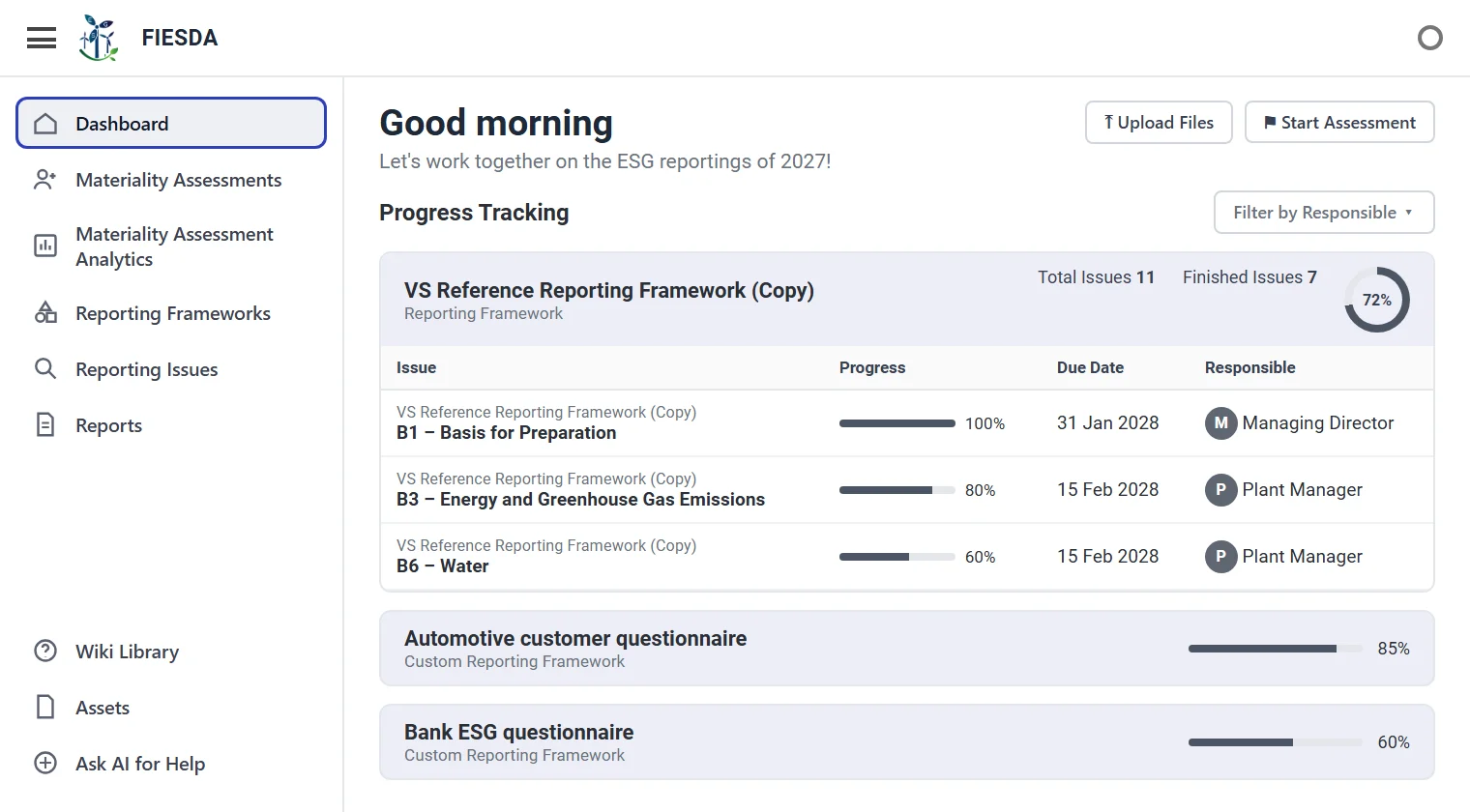
One VSME report only saves time if it is easy to keep current. FIESDA’s VSME reporting software includes an editable voluntary-standard template with guidance on each disclosure. You save figures once and reuse them in customer or bank questionnaires set up as custom frameworks. If a partner wants a machine-readable file, you can tag and validate the report in FIESDA before export. Tagging stays optional for the voluntary standard, and you decide what to disclose.
Illustration of the FIESDA dashboard: the VS framework and two questionnaires set up as custom frameworks, tracked side by side (example data).
Frequently asked questions
Is the VS the same as the VSME?
Largely yes. The VS is based on the VSME as originally adopted, with fewer datapoints aligned to the revised ESRS and a clarified value-chain cap. “VSME” is the older name; the market now says VS.
Do I have to publish a sustainability report as an SME now?
No. Neither the VSME nor the VS is mandatory, and no assurance is required. In practice a report often pays off, because it bundles recurring requests and helps with financing and tenders.
What if my customer still asks for more?
Before financial year 2027 the cap does not apply yet. After that it depends on the purpose: for the customer’s CSRD report, Annex II is the upper limit; for other legal obligations or contracts they may ask for more.
Is a 2025 VSME report still useful?
Yes, as a foundation. Because the VS builds on the VSME with minimal changes, much of the data carries over. Compare it with the VS datapoints and EFRAG’s updated guidance before you call it a VS report.
Does the cap protect me from my bank?
Not automatically. The cap only covers information gathered for CSRD reporting. The Regulation does encourage financial institutions to limit requests to undertakings with up to 1,000 employees to what the VS specifies.
Which revised ESRS datapoints apply to you, how materiality, reliefs and phase-ins filter them, and how to use EFRAG’s Excel list and prepare for XBRL tagging.
How to plan and report your climate transition under the revised ESRS E1-1, the voluntary standard (VSME) and IFRS S2, and what Omnibus I changed for transition plans.