How to build a GHG inventory under the GHG Protocol: boundaries, Scope 1 to 3, emission factors for Austria and what the revised ESRS and the VS require.
easy4pro editorial team·Last reviewed: ·11 min read
Key takeaways
The GHG Protocol splits emissions into Scope 1 (direct), Scope 2 (purchased energy) and Scope 3 (value chain, 15 categories).
Scope 2 needs two figures – location-based and market-based – wherever contractual instruments such as guarantees of origin exist, as in Austria.
The revised European Sustainability Reporting Standards (ESRS) ask for Scope 1, both Scope 2 figures and every significant Scope 3 category; the voluntary standard (VS) for Scope 1 and location-based Scope 2.
Document every emission factor and assumption – that is what makes years comparable and the inventory auditable.
Banks, customers and the ESRS all ask for the same thing first: your greenhouse gas (GHG) inventory. It is built on the GHG Protocol Corporate Standard, with the Scope 2 Guidance and the Scope 3 Standard. This guide shows how to set boundaries, calculate each scope, choose emission factors and meet the ESRS and VS requirements.
Scope 1, 2 and 3 at a glance
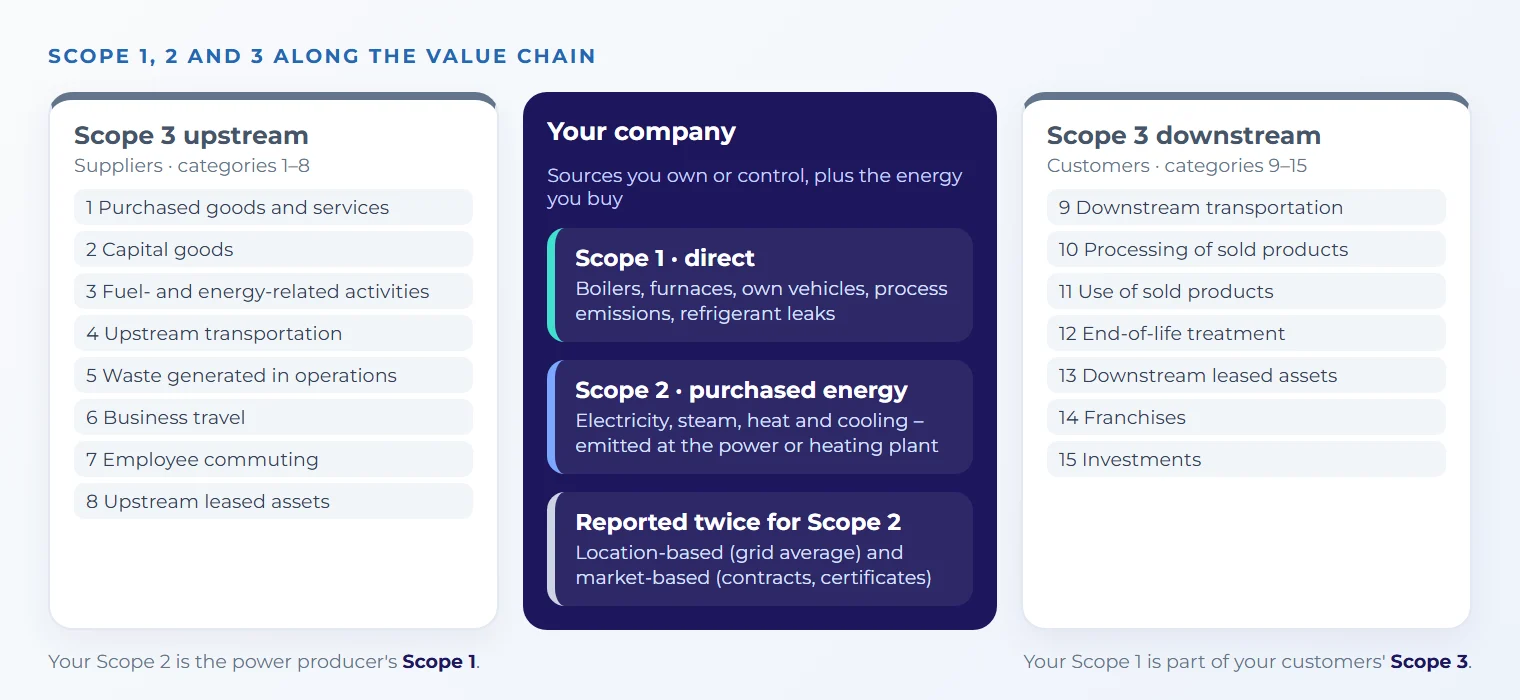
The GHG Protocol sorts emissions by who owns or controls the source. Direct emissions come from sources owned or controlled by your company. Indirect emissions are a consequence of your activities but occur at sources owned or controlled by another company. You control your direct emissions; you can only influence your indirect ones.
Scope 1 – direct emissions: emissions from operations owned or controlled by the reporting company – your boilers, furnaces, vehicles, production processes and cooling equipment.
Scope 2 – indirect emissions from purchased energy: emissions from the generation of purchased or acquired electricity, steam, heating or cooling that your company consumes. They physically occur at the power or heating plant, not at your site.
Scope 3 – other indirect emissions: all indirect emissions not included in Scope 2 that occur in your value chain – upstream at suppliers and downstream at customers, during product use and at end of life.
Which gases: the inventory covers the seven greenhouse gases under the UN climate convention (UNFCCC): carbon dioxide (CO2), methane (CH4), nitrous oxide (N2O), hydrofluorocarbons (HFCs), perfluorocarbons (PFCs), sulphur hexafluoride (SF6) and nitrogen trifluoride (NF3). All are converted into CO2 equivalent (CO2e).
What is mandatory under the GHG Protocol: the Corporate Standard requires Scope 1 and Scope 2; Scope 3 is optional there. Companies reporting in conformance with the Scope 3 Standard must account for all 15 Scope 3 categories and disclose and justify any exclusions. The ESRS and the VS set their own rules (see below).
Five accounting principles: every GHG Protocol inventory must meet them.
Relevance: the inventory reflects the company’s emissions and serves the decisions of its users.
Completeness: all emission sources within the chosen boundary are covered; exclusions are disclosed and justified.
Consistency: methods and boundaries stay the same over time so years can be compared; changes are documented.
Transparency: data sources, assumptions and methods are disclosed in a factual, neutral way.
Accuracy: figures are neither systematically over nor under actual emissions, and uncertainty is reduced as far as practicable.
Scope
What it includes
Typical data sources
Scope 1
Fuels burned in facilities and vehicles you own or control; process emissions; refrigerant leaks
Fuel invoices, fuel cards, refrigerant service logs
Scope 2
Generation of the electricity, steam, heat and cooling you buy
Energy invoices, supplier’s electricity label
Scope 3
All other indirect emissions, upstream and downstream
Accounts payable, supplier data, travel and logistics data
Upstream emissions from producing the fuels and electricity you use are not Scope 1 or 2: they belong in Scope 3, category 3.
The scopes are defined so that one company does not count the same emissions twice: your Scope 2 is the power producer’s Scope 1, and your Scope 1 is part of your customers’ Scope 3.
Scope 1, 2 and 3 along the value chain: sources you own or control, the energy you buy, and the 15 Scope 3 categories upstream and downstream.
Step 1: Set the boundaries
Organisational boundary: choose one of the GHG Protocol’s consolidation approaches – equity share, financial control or operational control – and apply it consistently. Under ESRS E1, the default is financial control, as in the consolidated financial statements; equity share or operational control may be used instead (application requirement (AR) 19). Scope 1 and 2 are split between the consolidated group and other emissions (paragraph 30(c)).
Operational boundary: list every site, building, vehicle pool and installation, including leased ones.
Base year and recalculation: pick a recent, representative base year. Recalculate it for significant structural changes (acquisitions, divestments), method changes or errors – not for organic growth. The Science Based Targets initiative’s SBTi Corporate Net-Zero Standard V2.0 uses a 5% significance threshold. More in the guide on CO₂ reduction targets.
Mobile combustion: fuel used by vehicles you own or control.
Process emissions: e.g. from chemical reactions in production.
Fugitive emissions: mainly refrigerant leaks.
Formula: activity data × emission factor, e.g. litres of diesel × kilograms of CO2 equivalent (kg CO2e) per litre. For refrigerants: kilograms refilled × global warming potential (GWP). From biomass, only methane and nitrous oxide count in Scope 1; biogenic CO2 is reported separately (ESRS E1, paragraph 31).
Step 3: Scope 2 – purchased energy
Under the GHG Protocol Scope 2 Guidance, Scope 2 covers purchased or acquired electricity, steam, heat and cooling. Companies operating in markets with contractual instruments report two figures (“dual reporting”); where no such instruments exist, the location-based figure alone is enough:
Location-based method: reflects the average emissions intensity of the grids on which your energy consumption occurs. It uses statistical grid-average factors – regional or sub-national where available, otherwise national. For Austria, the Umweltbundesamt publishes factors in report REP-0888; use only the direct part (the upstream part is Scope 3, category 3). The report itself calls its factors only conditionally suitable for corporate GHG reporting, so document your choice.
Market-based method: reflects emissions from the electricity you have purposefully chosen (or your lack of choice). You use the emission factor of the contractual instruments you hold – in Austria, your supplier’s electricity label (CO2 in g/kWh, based on guarantees of origin), monitored by E-Control. Without contract data, use a residual-mix factor.
Market-based data hierarchy: use the most precise source available, in this order:
Energy attribute certificates – in the EU, guarantees of origin.
Direct contracts with generators, such as power purchase agreements (PPAs).
Supplier-specific emission rates, such as your supplier’s electricity label.
Residual mix – the grid mix after attributes already claimed by others are removed.
Grid average – only where none of the above is available.
Certificates and contracts count only if they meet the Scope 2 Guidance’s Scope 2 Quality Criteria. A residual mix is preferred over the grid average because the grid average still contains renewable electricity that other buyers have already claimed, which would count it twice.
Location-based
Market-based
What it shows
Average emissions of the grid where you consume electricity
Emissions of the electricity you have contracted
Emission factor
Grid average (regional, then national)
Certificates, contracts or supplier rate; otherwise residual mix
Effect of a green tariff
None
Falls, down to 0 kg CO2e/kWh with fully certified renewable supply
When to report
Always
In addition, wherever contractual instruments exist (e.g. Austria and the rest of the EU)
In the worked example below, the same 1,500,000 kWh give 225 tCO2e location-based and 0 tCO2e market-based.
The GHG Protocol is revising Scope 2 within a consolidated standard with ISO (ISO 14064-1): consultation in the second quarter of 2027, publication planned for the fourth quarter of 2028 (Standard Development Plan). Until then, the 2015 guidance applies.
Start with spend, then refine: screen all 15 categories with spend-based factors (kg CO2e per euro), justify any exclusions, then move significant categories to quantity and supplier data. Under ESRS E1, significant categories are updated yearly and the full Scope 3 inventory at least every three years (AR 24).
SME suppliers: the value-chain cap in the VS (Annex II) limits what ESRS reporters may request for their own reporting. For climate it covers energy consumption and estimated Scope 1 and 2 emissions – not Scope 3.
Step 5: Emission factors and documentation
Convert all gases into tonnes of CO2 equivalent (tCO2e) with 100-year GWP values from the latest IPCC assessment report (ESRS E1, AR 20). Factor sources: supplier-specific values first, then Austrian factors (REP-0888) or the UK Government conversion factors – the latter only where they fit your country, never for Austrian grid electricity.
Keep a factor register with source and version, unit, scope, the sites it applies to, the GWP set and a change log. It is the first thing an assurance engagement asks for.
Worked example: from invoices to tCO2e
Example (fictional)
An Austrian food wholesaler with 120 employees, financial year 2026. Factors are illustrative round numbers, not values to copy.
Source
Activity data
Factor (illustrative)
Result
Natural gas, heating
600,000 kWh
0.20 kg CO2e/kWh
120 tCO2e
Diesel, truck fleet
150,000 litres
2.6 kg CO2e/litre
390 tCO2e
Refrigerant top-ups
20 kg
GWP 2,000
40 tCO2e
Scope 1 total
550 tCO2e
Electricity, location-based
1,500,000 kWh
0.15 kg CO2e/kWh
225 tCO2e
Electricity, market-based (label 0 g/kWh)
1,500,000 kWh
0 kg CO2e/kWh
0 tCO2e
Purchased goods (category 1, spend-based)
€40m
0.5 kg CO2e/€
20,000 tCO2e
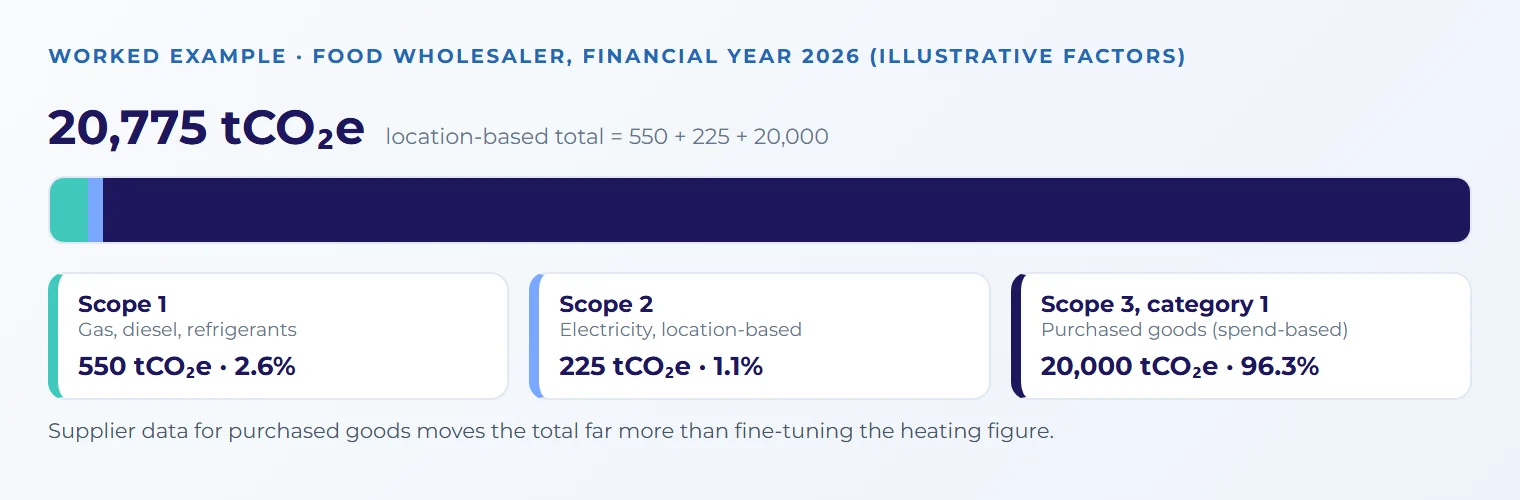
Result: location-based total 550 + 225 + 20,000 = 20,775 tCO2e; purchased goods make up about 96%. Supplier data for category 1 matters far more than fine-tuning the heating figure.
Worked example: purchased goods (Scope 3, category 1) make up about 96% of the location-based total (illustrative factors).
What the ESRS and the voluntary standard require
The revised ESRS (Delegated Regulation (EU) 2026/1563) apply to financial years beginning on or after 1 January 2027. Companies outside the Corporate Sustainability Reporting Directive (CSRD) can use the VS (Delegated Regulation (EU) 2026/1560); the act calls it “sustainability reporting standards for voluntary use”, while “VSME” is EFRAG’s earlier draft name.
Item
Revised ESRS, E1-8 (if climate is material)
VS, basic module B3
Scope 1
Gross, incl. EU ETS share
Required (voluntary up to 10 employees)
Scope 2
Location- and market-based
Location-based
Scope 3
Every significant category
Optional
Biogenic CO2
Separately from Scope 1
–
The most common mistakes
Leaving out Scope 3 – often the largest share (96% in the example).
Only one Scope 2 figure where two are required.
Life-cycle factors in Scope 2, double-counting category 3.
Biogenic CO2 inside Scope 1.
Netting carbon credits against gross emissions (ESRS E1, AR 20).
Changing factors without a note or a base-year check.
How ECOMON helps you manage your GHG inventory
ECOMON simplifies GHG inventory management: your Scope 1, 2 and 3 figures become KPIs you update, store and steer in one place.
Scope KPIs, with or without targets: track fuel, energy and emissions per site, including location- and market-based Scope 2, rolled up to group level; add target ranges and benchmarks when ready.
One documented data store: each value keeps its date, comment and supporting file (invoice, emission-factor source), with version history.
Automated updates: pull energy and fuel data from existing systems through scheduled no-code workflows.
Notifications: reminders when updates are due; alerts when a value breaches its target or benchmark.
OKRs for reductions: link key results to emissions KPIs, with owners, deadlines and automatic progress tracking.
For the ESRS or VS report itself, see FIESDA, easy4pro’s AI-powered ESG reporting platform. Contact us for a demo.
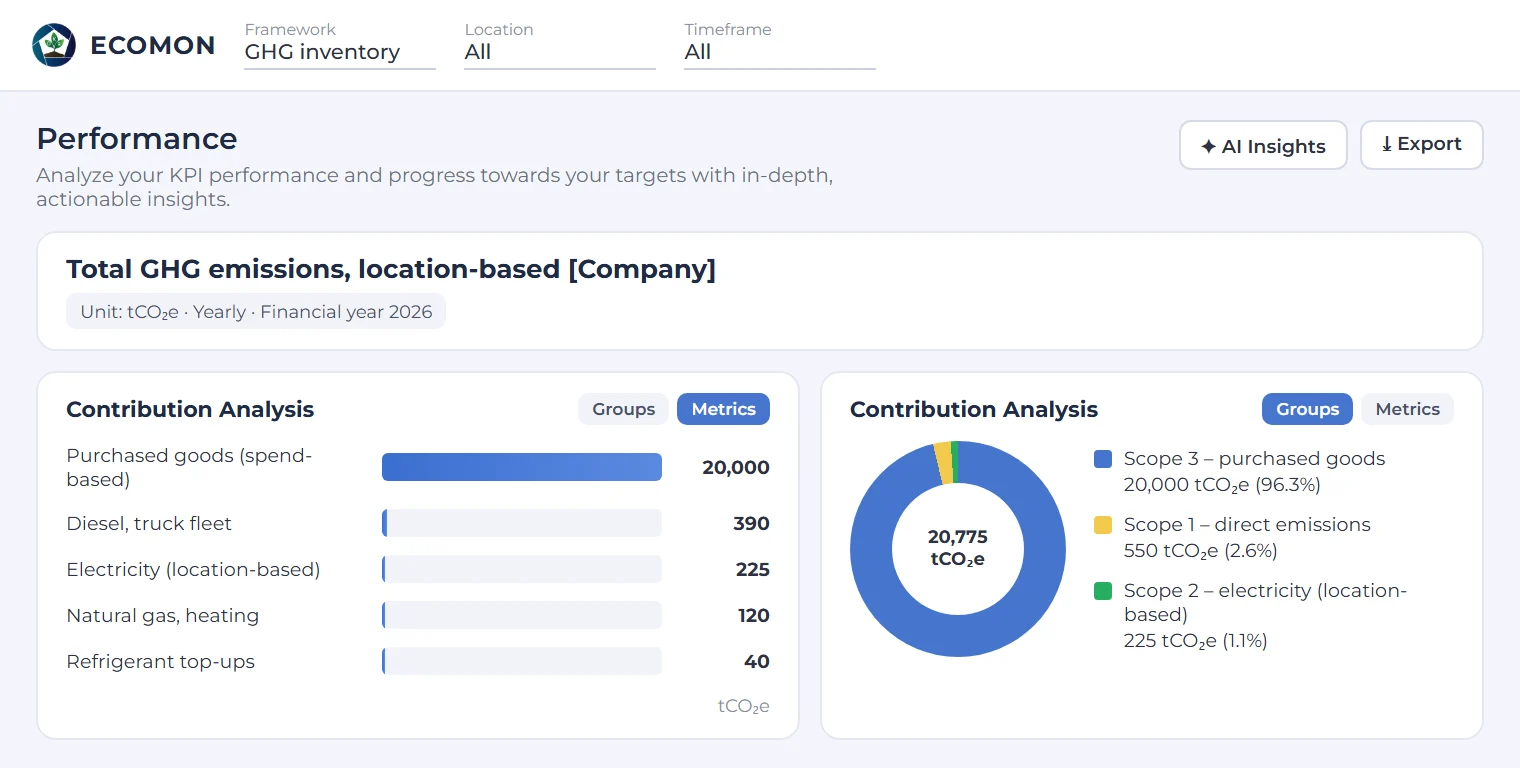
Illustration of an ECOMON performance view for the worked example: contribution by metric and by scope (example data).
Frequently asked questions
What is the Objectives and Key Results (OKR) system?
A goal-setting system created by Andy Grove at Intel and popularised by John Doerr: each quarter you set a few qualitative objectives, each with around three measurable key results, for example “diesel per 100 km down 6%”.
Location-based or market-based Scope 2 – what is the difference?
Location-based uses the grid average; market-based uses the factor of the electricity you contracted. With a renewable tariff, only the market-based figure falls.
Do SMEs have to report Scope 3?
Not under the VS, where it is optional. ESRS reporters must cover significant Scope 3 categories but face the value-chain cap when requesting supplier data.
Is a corporate carbon footprint the same as a GHG inventory?
Yes, in practice. A product carbon footprint is different: it covers one product’s life cycle.
Can we subtract carbon credits?
Not from gross emissions; under ESRS they are disclosed separately (E1-9).
How to screen the 15 Scope 3 categories, collect supplier data within the EU value-chain cap and turn Scope 3 into KPIs that each site owns and tracks.
How to calculate water withdrawal, discharge and consumption, waste volumes and recovery rates under ESRS E3, ESRS E5 and the voluntary standard, with examples.
How to identify which of your sites are in areas with water stress under ESRS E3, document the result and reduce your sensitivity with efficiency measures.