How to plan and report your climate transition under the revised ESRS E1-1, the voluntary standard (VSME) and IFRS S2, and what Omnibus I changed for transition plans.
easy4pro editorial team·Last reviewed: ·21 min read
Key takeaways
Neither the CSRD framework nor the CSDDD now requires a company to have a climate transition plan. Directive (EU) 2026/470 (Omnibus I) removed the duty to adopt and put one into effect from the CSDDD – but reporting on a plan, if you have one, stays. Sector rules, for example for banks, may differ.
Under the revised ESRS E1-1 (Delegated Regulation (EU) 2026/1563), undertakings must either describe their plan or say that they have none and whether and when they expect to adopt one.
The VSME / voluntary standard asks for greenhouse gas (GHG) reduction targets only if you have set them. Disclosing a transition plan is optional, but high-climate-impact undertakings without one must say whether and when they will adopt one.
IFRS S2 asks for plan information only if a plan exists, and puts the focus on assumptions, dependencies and resourcing. One well-built plan can feed all three frameworks.
A bank asks for your decarbonisation plan. A customer needs your targets for its CSRD report. A parent company wants IFRS S2 data. Three requests, three vocabularies – “transition plan”, “C3”, “paragraph 14” – and one question underneath: what do we have to say about how we will cut emissions?
This guide answers that question for the three frameworks readers meet most often: the revised ESRS (informally “ESRS 2.0” or “simplified ESRS”), the VSME / voluntary standard for companies outside the CSRD, and IFRS S2. It shows where they agree, where they differ, what changed for transition plans after the CSRD Omnibus, and how to build one plan that serves all three. The EU context is the binding objective of climate neutrality by 2050 in the European Climate Law – the yardstick many plans are measured against.
Short version: the reporting rules now ask you to be transparent about your plan, not to have one. Transparency is still demanding, because a plan that is described must be credible.
Quick check: which framework applies to you?
Find your row. If more than one fits, for example an EU subsidiary of a group that reports under IFRS S2, you will need to map one plan to both.
Your situation
Framework
What it asks about a transition plan
In CSRD scope: on average more than 1,000 employees and more than €450m net turnover (group level for parents)
Revised ESRS, topical standard E1
Describe your plan, or say you have none and whether and when you expect to adopt one – where climate change is material
Outside the CSRD and asked for data by customers, banks or investors
GHG targets if set; plan disclosure optional, but high-climate-impact undertakings without a plan say whether and when they will adopt one
Reporting under IFRS S2 because your jurisdiction requires it or you apply it voluntarily
IFRS S2, paragraph 14
Information about your plan if you have one, including assumptions and dependencies
What this means for you: the CSRD thresholds come from Directive (EU) 2026/470, which amends the CSRD; member states must transpose them by 19 March 2027. The revised ESRS apply to financial years starting on or after 1 January 2027. For financial year 2026, undertakings may keep the existing ESRS, keep them with selected reliefs, or apply the revised standards in full – and must state which they used.
What a climate transition plan is (and is not)
A climate transition plan is the part of your strategy that explains how you will cut emissions: targets, actions, money and responsibilities in one connected story. The revised ESRS describe it as setting out how the undertaking intends to transform its strategy and business model to be compatible with the transition to a sustainable economy (ESRS E1, AR 1). IFRS S2 describes it as an aspect of the overall strategy that lays out targets, actions or resources for the move to a lower-carbon economy (IFRS Foundation guidance, June 2025). Both definitions say the same thing: a target alone is not a plan.
Several similar terms cause confusion:
Term
What it means
Not to be confused with
Net-zero or GHG reduction target
The destination, with a base year and target year. One building block of a plan.
The plan itself
Climate transition plan (ESRS E1-1, IFRS S2)
Strategy-level plan covering targets, levers, actions, funding, assumptions and progress
A policy or a list of projects
CapEx plan (EU Taxonomy)
A plan to expand Taxonomy-aligned activities or make eligible activities aligned, used for the Taxonomy CapEx KPI
A full transition plan
“ESRS 2.0”
Informal name for the revised ESRS
ESRS 2 General disclosures, a standard that exists in both versions
Key features – GHG reduction targets, decarbonisation levers, key actions, investments and funding needed, approval by the administrative, management and supervisory bodies, how the plan fits your overall strategy, and whether and how your strategy and business model are, or will be, compatible with limiting warming to 1.5°C and with EU climate neutrality by 2050.
CapEx in coal, oil and gas – amounts invested in the period, if you have such activities.
Assumptions and dependencies – what the plan relies on, such as technology deployment, workforce availability or your ability to change the value chain.
Locked-in emissions – a qualitative assessment of how emissions locked in by key physical assets and products could jeopardise the plan and drive transition risk.
Progress – resources deployed, actions taken and GHG reductions achieved or expected.
If you have no plan with these key features, say so and state whether, and if so when, you expect to adopt one (paragraph 13).
Targets not compatible with 1.5°C. The standard allows targets that are not compatible with 1.5°C. If yours are not, you must say so, compare your target values with the relevant reference values and describe how you considered future developments (AR 2(a)). This transparency rule was added in the Commission’s final text; EFRAG’s December 2025 advice (as compared by IBR-IRE) had asked for a statement on whether targets are science-based and compatible with 1.5°C. In practice: do not imply Paris alignment you cannot show.
Other practical points from the application requirements:
The plan can be stand-alone or part of a broader plan; if it also covers adaptation, say so.
Cross-refer to other disclosures (E1-5, E1-6, ESRS 2) instead of repeating them.
Funding can be given as an indicative range and limited to approved and announced actions. Detailed internal management information is not required.
What changed from the original ESRS
Item
Original ESRS (2023)
Revised ESRS (2026)
Core duty
Disclose the plan (para 14); if none, say whether and when you will adopt one (para 17)
Same logic: key features (para 12), no-plan statement (para 13)
1.5°C
Explain how GHG targets are compatible with 1.5°C (para 16(a))
Explain where targets are not compatible (AR 2(a))
Funding
Quantify investments and funding, with reference to Taxonomy-aligned CapEx KPIs and CapEx plans (16(c)); explain Taxonomy alignment plans (16(e))
Investments and funding as part of key features; indicative range allowed
Fossil-fuel CapEx
Significant CapEx in coal, oil and gas (16(f))
CapEx in coal, oil and gas, if applicable (12(b))
Paris-aligned Benchmarks
State whether excluded (16(g))
Not in the revised E1-1 text*
Assumptions and dependencies
No separate item
New item (12(c)), aligned with IFRS S2
Progress
16(j)
12(e), with detail in AR 5
*Based on the revised E1-1 text in the Official Journal (Delegated Regulation (EU) 2026/1563, Annex I) and on EFRAG’s ESRS Knowledge Hub; original wording from the 2023 version. EFRAG says it further aligned E1-1 with IFRS S2 and deleted several datapoints (factsheets).
What this means for you: if your current plan was written for the original E1-1, expect to drop the Taxonomy and benchmark details, add an explicit assumptions-and-dependencies section and be ready to explain any gap to 1.5°C.
VSME and the voluntary standard (C3)
The answer first: outside the CSRD, GHG targets are disclosed only if you have set them, disclosing a transition plan is optional, and nothing forces a small company to draft a full plan. Undertakings in high-climate-impact sectors without a plan must say whether and when they will adopt one.
The starting point was the VSME, published as Recommendation (EU) 2025/1710. It has since been turned into law as the voluntary standard, Delegated Regulation (EU) 2026/1560, in force since 24 September 2026 and applying to financial years beginning on or after 1 January 2027. The Commission kept changes to the VSME to a minimum, mainly to align it with the revised ESRS (Linklaters). It has a Basic Module (B1–B11) and a Comprehensive Module (C1–C9); the Comprehensive Module may only be applied after the Basic Module (Garrigues). Transition information sits in the Comprehensive Module, disclosure C3 – GHG reduction targets and climate transition.
absolute GHG reduction targets for Scopes 1 and 2 and, where applicable, Scope 3, each with a base year, a target year and planned actions;
an optional transition plan disclosure: if you have adopted a plan you may provide information about it; if you are in a high-climate-impact sector (NACE Sections A to H and M) and have no plan, you must say whether and when you will adopt one (C3, paragraphs 54–55 of the Official Journal text). Targets are voluntary for undertakings with 10 employees or fewer (paragraph 53).
What EFRAG’s supporting guide adds (not mandatory; EFRAG):
Setting targets is presented as good practice, not a requirement; if you set targets, they must be disclosed.
Companies outside the high-impact sectors, such as service businesses, are not expected to draft or disclose a transition plan.
A summarised plan is enough if readers can assess the GHG reductions, the timeline and the financial implications.
Your emissions data from the Basic Module (B3, energy and GHG emissions) is the baseline for any C3 target. If you already have a 2025 VSME report, it is a sound foundation; see our guide on the voluntary standard and VSME for the conversion.
What this means for you: if a bank or customer asks for your “transition plan” and you are an SME, answer with C3: a dated target, the three or four actions that deliver it and a rough cost. C3 is set out in Annex I of the Regulation; check its exact wording before you publish.
IFRS S2: transition plan information
The answer first: IFRS S2 does not require you to have a transition plan or to publish one. If you have a plan, it requires information about it, with a clear focus on assumptions and dependencies (IFRS Foundation guidance).
IFRS S2 is an ISSB standard, not EU law. It applies where a jurisdiction requires it or where an entity chooses to apply it. Paragraph 14 asks how you have responded, and plan to respond, to climate-related risks and opportunities in your strategy and decision-making. That includes:
current and anticipated changes to the business model, including resource allocation;
current and anticipated direct mitigation and adaptation efforts;
current and anticipated indirect efforts, such as engagement with customers and suppliers;
any transition plan you have, including key assumptions and dependencies;
how you plan to achieve climate-related targets, including GHG targets.
You must also explain how you are resourcing, and plan to resource, these activities, and report progress against plans disclosed in earlier periods (IFRS S2 briefing).
No formal plan? The IFRS guidance describes two cases. With a strategic climate goal but no formal plan, you disclose how you implement that goal and manage transition and physical risks. With a formal plan, you say so and disclose its assumptions and dependencies, plus other information on how you will reach the goal. IFRS S2 does not require alignment with 1.5°C; that appears only as an example of a jurisdiction-specific requirement.
December 2025 amendments. On 11 December 2025 the ISSB amended the GHG emissions requirements of IFRS S2, for example allowing entities to limit Scope 3 category 15 reporting to financed emissions and giving relief from the GHG Protocol where a jurisdiction mandates another method (IFRS Foundation, EY). They apply to annual periods beginning on or after 1 January 2027, with early application permitted. They change how you measure emissions, not what paragraph 14 asks about your plan.
What this means for you: a plan built for the revised ESRS already holds most of what IFRS S2 asks. Check that it states resourcing and the link to the business model in investor language.
ESRS, VSME and IFRS S2 side by side
All three frameworks ask the same core questions: where are you going, how will you get there, what will it cost and what are you relying on? They differ in legal force, audience and depth.
No. Describe it, or say you have none and whether and when you will adopt one
No. Targets if set; plan disclosure optional; a no-plan statement for high-climate-impact sectors
No. Information about it if you have one
GHG targets
Part of the key features
Absolute Scope 1–2 (and 3 where applicable) targets with base year, target year and actions
Explain how you plan to achieve them
1.5°C
Not mandated; explain where targets are not compatible
No explicit 1.5°C statement identified in the sources reviewed
Not required; only an example of a jurisdiction-specific rule
Assumptions and dependencies
Explicit element
Not a separate element identified
Explicit element
Funding and resources
Investments and funding needed; indicative range allowed
Summary of financial implications (EFRAG guide)
How the activities are and will be resourced
ESRS-only items
Coal, oil and gas CapEx; locked-in emissions
–
–
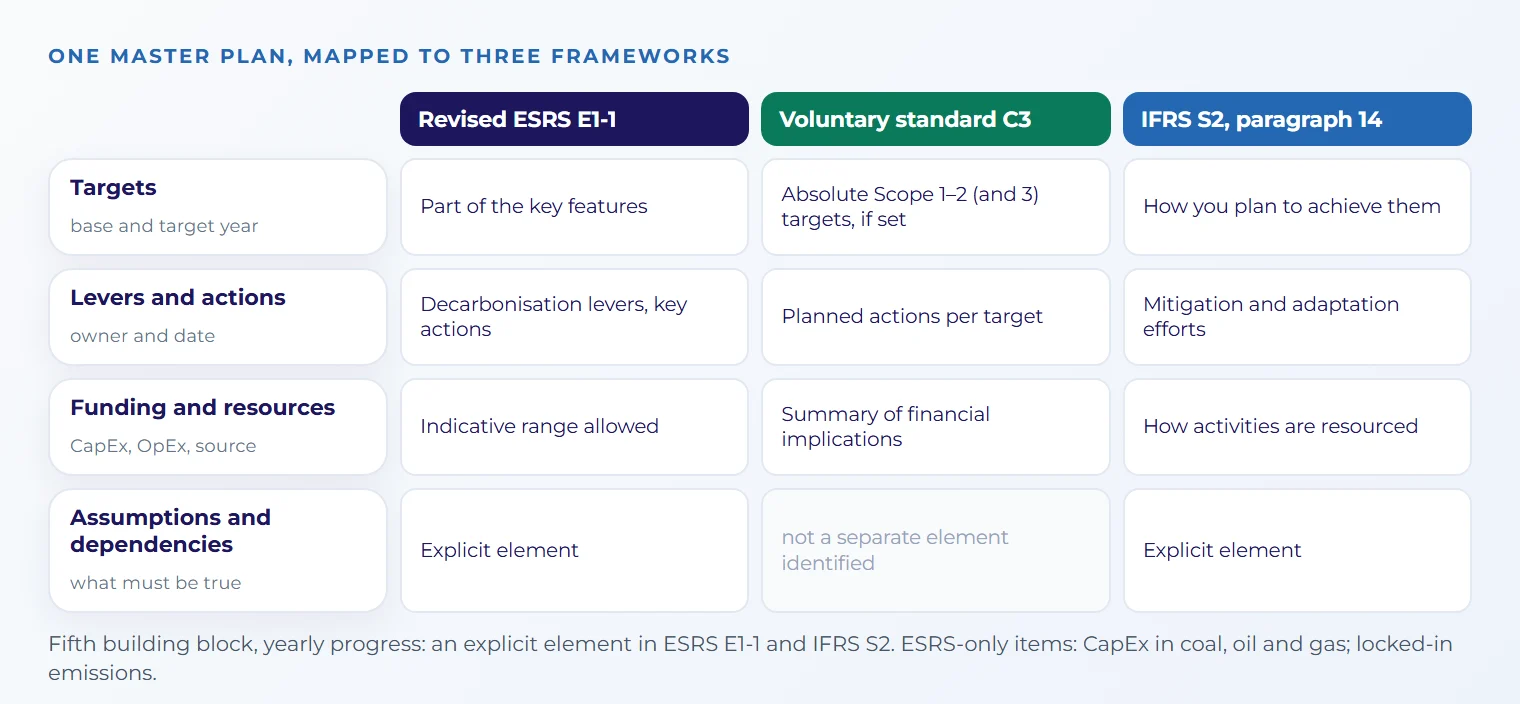
Build once, map three ways. Five building blocks serve all frameworks: (1) targets with base and target year, (2) levers and actions, (3) funding and resources, (4) assumptions and dependencies, (5) yearly progress. Write them once in a single plan, then lift the parts each framework needs.
Build once, map three ways: the building blocks of one master plan and where each framework asks for them.
Key dates
Date
What happened or applies
30 July 2025
Commission publishes the VSME as Recommendation (EU) 2025/1710
11 December 2025
ISSB issues amendments to the GHG requirements of IFRS S2
26 February 2026
Omnibus I Directive (EU) 2026/470 published; in force 18 March 2026
3 July 2026
Commission adopts the revised ESRS and the voluntary standard
21 September 2026
Both published in the Official Journal; voluntary standard in force 24 September, revised ESRS in force 10 November 2026
1 January 2027
Revised ESRS apply (financial years starting on or after); IFRS S2 GHG amendments apply (periods starting on or after)
19 March 2027
Member-state deadline to transpose the CSRD changes
26 July 2028 / 26 July 2029
CSDDD transposition deadline / start of application
What happened to the CSDDD transition plan duty
The answer first: the duty to implement a plan is gone; the duty to report on one remains. This is the most common confusion in the topic, because two laws were involved.
Reporting is not risk-free. Some legal commentators argue that a plan you describe publicly can become de facto binding, because inaccurate or misleading statements can attract liability under national law (Oxford Business Law Blog). Describe only what you can support.
The reform is contested. NGOs argue the deletion may conflict with EU law (ClientEarth). For planning purposes, treat the current law as settled but watch for legal challenges.
The CSDDD now applies to companies with more than 5,000 employees and more than €1.5bn net turnover, with transposition due on 26 July 2028 and application from 26 July 2029. The Commission is to assess by 26 July 2031 whether the CSRD and CSDDD thresholds should change.
What this means for you: a customer in CSDDD scope can no longer rely on the Directive to demand a plan from you. It may still ask for one as part of its own CSRD reporting or credit and procurement terms. For CSRD-driven requests, companies with up to 1,000 employees on average are protected by the value-chain cap from financial years starting on or after 1 January 2027 (see our guide on the voluntary standard for who is covered).
Building a transition plan in seven steps
A plan that survives questions from auditors, banks and investors is specific, costed and owned. These seven steps work for all three frameworks.
Pick the frameworks and the reporting year. Use the quick check above. If you are in CSRD scope, decide which ESRS version you apply for financial year 2026 and state it.
Build the baseline. Measure Scope 1 and 2, and Scope 3 where it is material, for a fixed base year using the GHG Protocol. The revised ESRS allow alternatives to the financial control approach for the reporting boundary, within the limits of ESRS 1.
Set targets. Give each target a base year, a target year (EFRAG’s guide encourages 2030) and the scopes it covers. Compare it with a recognised 1.5°C pathway, and state any gap. See our guide on setting CO₂ reduction targets.
Map levers and actions. Group measures into levers such as energy efficiency, electrification, fuel switching, renewable energy, product change and supply-chain decarbonisation. Quantify each lever’s expected reduction and name an owner and a date.
Cost it and fund it. Put CapEx and OpEx next to each action and name the funding source. Separate what the board has approved from what is still an ambition. The ESRS let you limit funding disclosure to approved and announced actions.
State assumptions, dependencies and locked-in emissions. What must be true for the plan to work (power prices, grid capacity, technology readiness, regulation)? Which existing assets will keep emitting for years?
Approve, embed and track. Have the management and supervisory bodies approve the plan, link it to the budget and review progress at least yearly. Tracking ESG metrics through the year makes the progress disclosure a by-product, and OKRs keep the actions on schedule.
Example (fictional)
Alpenmetall GmbH makes industrial valves in Bavaria, with 1,350 employees and €520m net turnover. Under the Omnibus thresholds it is in CSRD scope (more than 1,000 employees and more than €450m), so it expects to publish its first sustainability statement for financial year 2027, assuming national transposition on time.
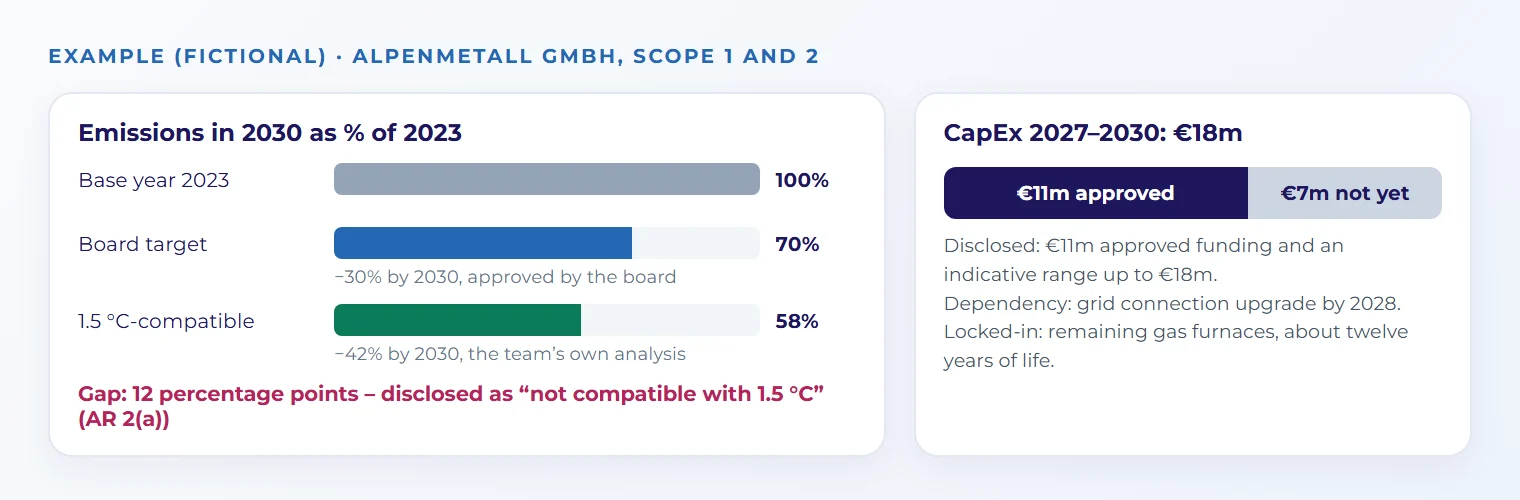
Its board has approved a target of −30% in Scope 1 and 2 emissions by 2030 against 2023. The sustainability team’s own analysis shows that a 1.5°C-compatible path would need −42%. The plan relies on electrifying two gas-fired heat-treatment furnaces, a renewable power purchase agreement and heat recovery. It budgets €18m of CapEx for 2027–2030, of which €11m is approved. It depends on the network operator upgrading the grid connection by 2028 and assumes stable power prices. Remaining gas furnaces with about twelve years of life are its main locked-in emissions.
Under E1-1, Alpenmetall describes all five elements. It states that its target is not compatible with 1.5°C, compares it with the reference values and explains how it considered future developments, here a planned target review in 2028. It discloses the €11m approved funding and an indicative range up to €18m. It makes no “Paris-aligned” claim. When its lender asks for IFRS S2-style information, the same plan is re-cut around resourcing, assumptions and dependencies – no new analysis needed.
The Alpenmetall example: a −30% board target against a −42% 1.5 °C-compatible path, and €11m of €18m CapEx approved.
Example (fictional)
A plastics processor with 80 employees is outside the CSRD. A bank questionnaire asks for its transition plan. Manufacturing is one of the high-climate-impact sectors in EFRAG’s C3 guide, so the company answers with C3: Scope 1 and 2 −25% by 2030 against 2025, three actions (compressed-air leak repair, rooftop solar, a heat pump) and a one-page cost summary of about €0.9m. That is enough to let the bank assess reductions, timeline and financial implications.
How FIESDA can help with transition plan reporting
The seven steps give you one master plan; the harder part is reporting it consistently in each framework. FIESDA’s ESRS, VSME and IFRS reporting software lets you save targets, levers and funding figures once as referenced disclosures and reuse them in each report, so the versions do not drift apart. The AI chatbot can draft a first E1-1 or C3 disclosure from your uploaded plan, which a person then reviews. You still decide what the plan says and who approves it.
Common mistakes
A target presented as a plan. “Net zero by 2050” says where you are going, not how. Reviewers look for levers, actions, money and owners.
Implying Paris alignment. If your targets do not match 1.5°C, the revised ESRS require you to say so. IFRS S2 and the voluntary standard do not shield you from misleading wording either.
Listing only what is approved as if it were the whole plan. Say clearly what is approved, what is announced and what is ambition.
Forgetting dependencies. Plans that rely on grid capacity, supplier changes or technology that does not exist yet need those dependencies named.
Ignoring locked-in emissions. Long-lived gas boilers, furnaces or vehicle fleets can undo a target; assess them.
Writing three plans. Keep one master plan and map it to each framework. Separate versions drift apart.
Treating the CSDDD change as the end of the topic. The implementation duty is gone, but reporting duties, lender questionnaires and customer requests remain.
Frequently asked questions
Do I have to have a climate transition plan?
No. Neither the revised ESRS, the voluntary standard nor IFRS S2 requires you to have one, and the CSDDD duty was removed by Directive (EU) 2026/470. Under ESRS E1-1 you must still say that you have none and whether and when you expect to adopt one.
Does my plan have to be aligned with 1.5°C?
Not necessarily. The revised ESRS allow targets that are not compatible with 1.5°C but require transparency: if your targets are not compatible with 1.5°C, you must say so and explain how they compare with reference values. IFRS S2 does not require alignment either.
Is a net-zero target the same as a transition plan?
No. A target is the destination. A plan adds levers, actions, funding, assumptions, dependencies and governance.
Do I need a plan for a VSME or voluntary-standard report?
Not as such. C3 asks for GHG reduction targets if you have set them, makes plan disclosure optional, and requires high-climate-impact undertakings without a plan to say whether and when they will adopt one. EFRAG’s guide says a summary is enough and that service companies are not expected to draft one.
Can one plan serve ESRS and IFRS S2?
Largely yes. Both ask for targets, actions, resourcing, assumptions and dependencies, and progress. EFRAG aligned the revised E1-1 more closely with IFRS S2. ESRS adds items such as coal, oil and gas CapEx and locked-in emissions.
My customer asks for my transition plan. Must I answer?
Not because of the CSDDD. For information the customer needs for its own CSRD report, the value-chain cap limits what it can ask from smaller companies from financial years starting on or after 1 January 2027. Requests under other laws, or in contracts and credit terms, are not covered by the cap.
What the revised ESRS require on policies, actions, targets and metrics (GDR-P, GDR-A, GDR-M, GDR-T), and how to link your material topics to the numbers you report.
How to structure the sustainability statement under the ESRS, write it clearly and in a balanced way, and link it to the management report and financial statements.
Which revised ESRS datapoints apply to you, how materiality, reliefs and phase-ins filter them, and how to use EFRAG’s Excel list and prepare for XBRL tagging.