Which revised ESRS datapoints apply to you, how materiality, reliefs and phase-ins filter them, and how to use EFRAG’s Excel list and prepare for XBRL tagging.
easy4pro editorial team·Last reviewed: ·15 min read
Key takeaways
The revised ESRS (Delegated Regulation (EU) 2026/1563) were adopted on 3 July 2026 and published in the Official Journal on 21 September 2026. According to Article 3, they enter into force on 10 November 2026 and apply to financial years starting on or after 1 January 2027. For financial year 2026 (Article 2), undertakings already reporting choose between the existing ESRS, the existing ESRS with listed reliefs, or the revised ESRS, and must state which version they applied.
The Commission says the revision cuts mandatory datapoints by over 60% and total datapoints by over 70%. EFRAG’s secretariat puts the final text at approximately 300 datapoints. Your own list is shorter or longer depending on your double materiality assessment, because every datapoint is subject to the materiality filter.
Do not start from a blank page. EFRAG’s Excel list of ESRS datapoints gives you a ready-made register of what to collect.
XBRL tagging of ESRS reports is not yet mandatory. EFRAG plans to submit its final taxonomy to ESMA and the Commission by the end of 2026; binding rules will follow through the European Single Electronic Format (ESEF).
From financial year 2027, companies reporting under the CSRD work with a much shorter list of ESRS datapoints. But the list is not the same for everyone: materiality, conditions, reliefs and phase-ins decide which datapoints end up in your report. This guide shows which disclosure requirements and datapoints apply to you, how to use EFRAG’s Excel list of datapoints to structure your report, and where XBRL comes in. Companies outside the CSRD that answer data requests have their own list; see our companion guide on Voluntary Standard datapoints.
Which framework applies to you?
The answer depends on whether you fall under the CSRD and how many employees you have. Use the table to place yourself.
Your situation
Framework
What it means for you
EU undertaking with more than 1,000 employees (average) and more than €450m net turnover; parent companies on a consolidated basis
Member states must transpose the changes by 19 March 2027, so check national law. Undertakings not reporting before report for financial years starting on or after 1 January 2027.
Already reporting under the existing ESRS (financial years starting 1 January 2024 to 31 December 2026, “wave one”)
Existing or revised ESRS for financial year 2026; revised ESRS from financial year 2027
Choose one of three options for financial year 2026 and name the version in your sustainability statement (see below). Member states may exempt some wave-one undertakings that fall below the new thresholds for financial years 2025 and 2026, so check national law.
Non-EU group with more than €450m net turnover in the EU in each of the last two financial years
Non-EU reporting under Article 40a, with an EU subsidiary or branch above €200m net turnover
The directive sets these thresholds; check the application dates in the text and in national law.
What this means for you: if you are in one of the CSRD rows, read on. If you are outside the CSRD, you can skip to the companion guide.
How revised ESRS datapoints work
The revised ESRS keep the architecture of the original set: two cross-cutting standards (ESRS 1 General requirements and ESRS 2 General disclosures) and ten topical standards (E1 to E5, S1 to S4 and G1). Each disclosure requirement (DR) consists of one or more datapoints. The text is in the annexes of Delegated Regulation (EU) 2026/1563, which replaces Annexes I and II of Delegated Regulation (EU) 2023/2772. EFRAG publishes it as an interactive text on its ESRS Knowledge Hub.
Three rules decide which datapoints you report
Materiality filters the datapoints. ESRS 1 says you must not disclose a DR or datapoint that is not material (paragraph 24). Applying ESRS 2 is a required step (paragraph 29(a)), and its DRs are described as fundamental and likely to produce material information for every undertaking. EFRAG’s explanatory note to its draft datapoint list adds that the 2026 standards contain no datapoints that apply regardless of materiality.
Policies, actions and targets come once, in ESRS 2. For each material topic you apply the general disclosure requirements for policies, actions, metrics and targets (GDR-P, GDR-A, GDR-M, GDR-T) plus the topical DRs (paragraph 29(b)). They replace the minimum disclosure requirements (MDRs) of the 2023 ESRS. The policy, action and target datapoints apply only where you have adopted a policy, action or target.
Conditions and disaggregations. Some datapoints apply only in a stated circumstance, such as “where applicable”. In EFRAG’s list, disaggregations marked as mandatory must be reported and the others are optional.
The revised standards contain no voluntary datapoints. EFRAG’s technical advice described the result as a 61% reduction of datapoints that are required if material and the deletion of all voluntary disclosures. In July 2026 EFRAG’s secretariat reported that the final text results in approximately 300 datapoints, a slightly greater reduction than first estimated, per its briefing to the Sustainability Reporting Board. The Commission states over 60% for mandatory datapoints and more than 70% for the total.
Reliefs in ESRS 1
Relief
What it allows
ESRS 1 reference
Undue cost or effort
Use all reasonable and supportable information available without undue cost or effort; reassessed each period
Paragraphs 93 to 95
Value-chain estimates
Use estimates such as sector averages, spend-based data or proxies
Paragraphs 33 and 65
Partial scope of a metric
Disclose that reliable data covers only part of your operations or value chain, with steps to improve coverage (not for gross scope 1, 2 and 3 GHG emissions in E1-8)
Paragraph 91
Activities that are not significant drivers of a metric
Exclude them
Paragraph 90
Subsidiaries, acquisitions and disposals
Exclude a financially immaterial subsidiary unless facts expose the group to material impacts; defer acquisitions to the next period; adjust scope for disposals from the start of the period
Paragraphs 55, 61, 74 and 75
Joint operations without operational control
May be excluded from environmental metrics in E2 to E5, with disclosure
Paragraph 92
Trade secrets, classified and legally protected information
May be omitted, with disclosure
Paragraph 100
Phase-ins by type of undertaking
Chapter 10 of ESRS 1 lets you omit some disclosure requirements for a limited time. “Wave one” undertakings are those reporting for financial years starting between 1 January 2024 and 31 December 2026; “other undertakings” report for financial years starting on or after 1 January 2027 (paragraph 122).
Omittable item
Other undertakings (first years of reporting)
Wave one, above €450m and 1,000 employees
All DRs of E4, S2, S3 and S4
First two years
For financial years before 2027
Anticipated financial effects (ESRS 2 paragraph 27 and E1-11, with exclusions)
First two years
Before 2028
Quantitative anticipated financial effects
First four years
Before 2030
Quantitative substances of concern (E2-5)
First three years
Before 2030
Substances of very high concern, where applicable
First year
Before 2028
Selected S1 datapoints (S1-6, S1-7 for non-EEA employees, S1-10 to S1-14)
First year
Before 2027
Wave-one undertakings at or below the thresholds may omit all topical DRs for financial years before 2027 and use the same end years for the other items (paragraph 126). Two more reliefs apply to everyone starting to report: for the first three years you may disclose your efforts, the reasons and your plans if you cannot obtain all value-chain information (paragraph 123), and you need not give comparatives in your first year (paragraph 124).
What changed in the content
Simplification: EFRAG’s technical advice lists a usefulness filter, an emphasis on fair presentation, a simplified materiality assessment and the end of the preference for direct value-chain data.
ESRS 2: general disclosures on policies, actions, metrics and targets are consolidated there, and anticipated financial effects are handled in ESRS 2 and E1.
E1 Climate: the greenhouse gas reporting boundary follows chapter 5 of ESRS 1 and corresponds to financial control under the GHG Protocol, according to application requirement 19 of the revised E1.
What this means for you: the headline cut describes the standards, not your workload. Your effort depends on how many topics turn out to be material and how much of the value chain you have to cover.
Which ESRS disclosure requirements apply to you
There is no fixed number of datapoints you must report. The path below gets you to your own list.
Fix the version. Financial year 2027 means the revised ESRS. For financial year 2026, pick one of the three options and name it in your sustainability statement.
Start with ESRS 2. Apply the ESRS 2 disclosure requirements, including the general disclosure requirements for policies, actions, metrics and targets.
Run the double materiality assessment. It identifies your material topics and sub-topics. Our guide Double materiality assessment in six steps walks through the method.
Add the topical standards. For each material topic, apply GDR-P, GDR-A, GDR-M and GDR-T plus the topical disclosure requirements. For a material sub-topic, report only the material information on that sub-topic.
Filter the datapoints. Remove what is not material. Check each condition. Keep policy, action and target datapoints only where you have adopted them. Apply the reliefs and phase-ins you are entitled to.
Document the result. ESRS 2 asks you to state which material impacts, risks and opportunities you found and which disclosure requirements you included (IRO-2). Record every relief you used.
Example (fictional)
Brenner Maschinenbau GmbH is a German machinery group with 1,400 employees, €620m net turnover and plants in Germany, Poland and Mexico. It has never published a sustainability statement. It exceeds both thresholds, so it reports under the revised ESRS for financial year 2027, subject to the German transposition of the CSRD.
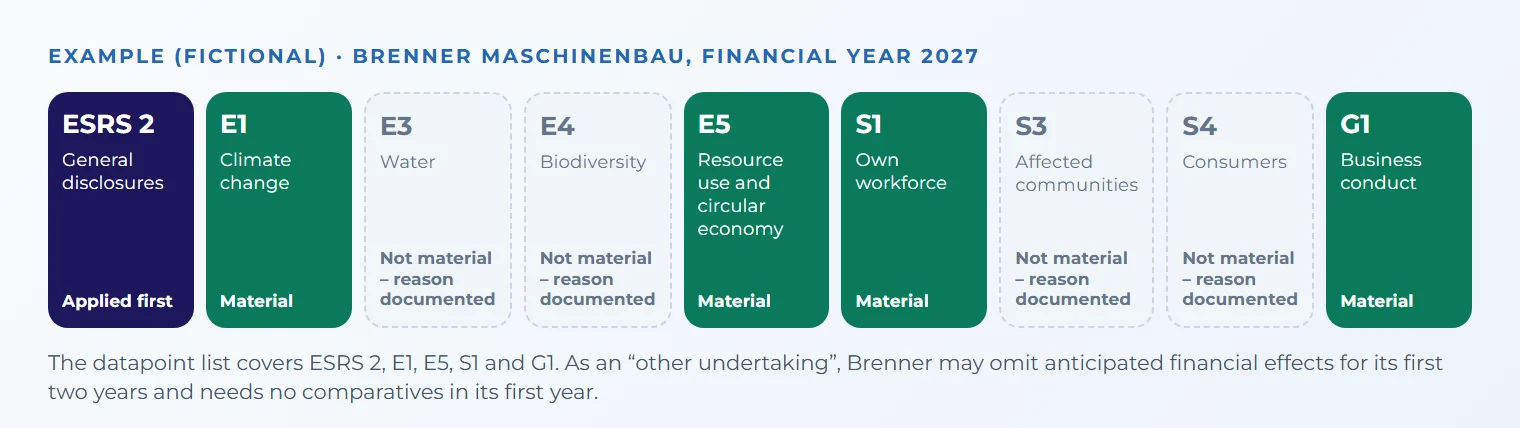
Its double materiality assessment finds climate (E1), resource use and circular economy (E5), own workforce (S1) and business conduct (G1) material. Water (E3), biodiversity (E4), affected communities (S3) and consumers (S4) are not.
The company therefore works from a datapoint list covering ESRS 2, E1, E5, S1 and G1, and it documents why E3, E4, S3 and S4 are out. As an “other undertaking” it may also omit anticipated financial effects for its first two years and need not give comparatives in its first year. For its steel suppliers it has no primary data, so it uses sector averages and discloses its efforts and plans for value-chain information in each of its first three years. The statement is shorter than a full-scope report, and every omission has a written reason.
The Brenner example: ESRS 2 is applied first, four topical standards are material, and the reasons for the others are documented.
Using EFRAG’s datapoint list to structure your report
EFRAG’s Excel list turns the legal text into a working register. It is not legally binding; the legal text is the annex of the regulation.
On 28 August 2026 EFRAG published its 2026 Draft List of Datapoints as an Excel workbook with an explanatory note. It is Secretariat support material and was open for “fatal flaw” comments until 23 October 2026, so expect a final version. Each row is one datapoint. According to the explanatory note, the columns you will use most are:
Column
Use it to
ID (prefix ESRS26_)
Give every datapoint a stable key in your data model
Disclosure requirement and paragraph
Map the row to the right place in the report
Data type (narrative, semi-narrative, numerical)
Decide the input format: text, yes/no or list choice, or number with unit
Disaggregations (mandatory ones marked)
Plan breakdowns, for example by site or country
Conditionality
Spot datapoints that apply only in a stated circumstance
EU legislation mapping (Appendix A)
See which datapoints feed other EU laws
Phase-in columns (wave one, other undertakings)
Filter out what you may omit for now
A second version of the file maps each row back to the 2023 ESRS paragraphs, which helps if you already report under the first set.
How to turn it into your report skeleton
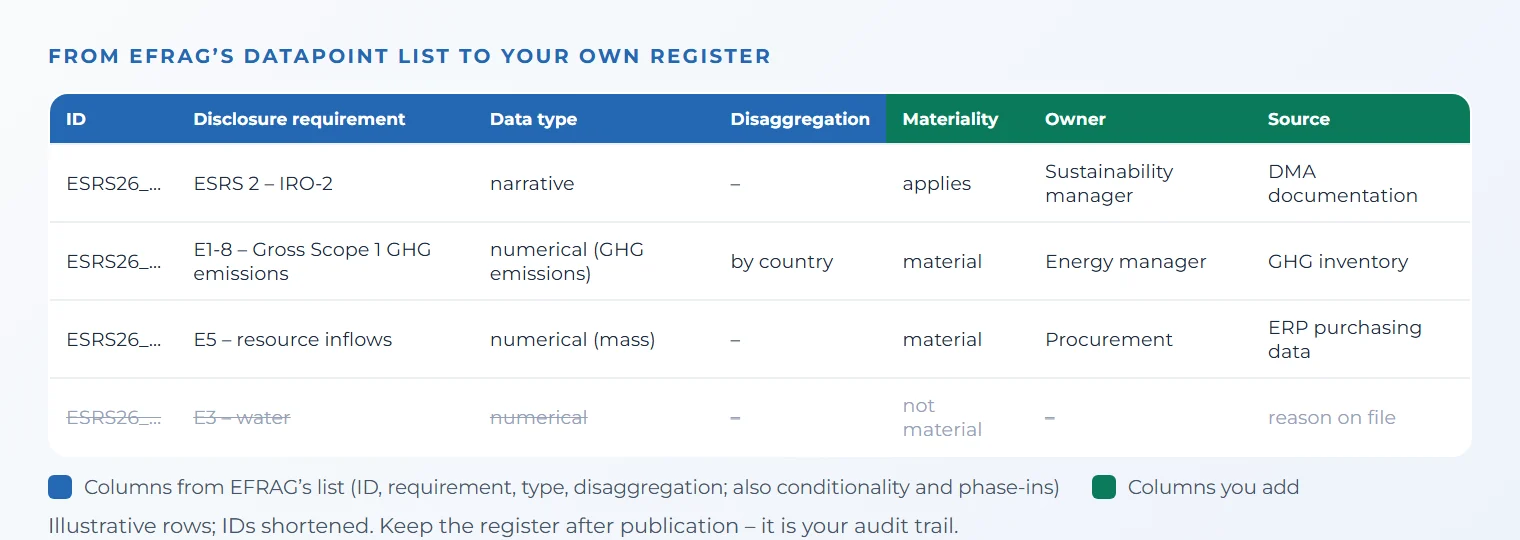
Copy the list into your own register and add columns for materiality outcome, owner, data source and reporting period.
Mark every topic that your double materiality assessment found immaterial and keep the reason.
Resolve conditions and phase-ins row by row.
Follow the order of the standards: general information first, then environment, social and governance.
In your basis for preparation (BP-1) state the version of the ESRS you applied and the reliefs you used.
Keep the register after publication. It is your audit trail.
EFRAG's datapoint list as a working register: EFRAG's columns plus your own for materiality, owner and source (illustrative rows).
What this means for you: the register is the real work. Once each datapoint has an ID, a unit, an owner and a source, the report, the tagging and the audit trail all draw on the same data.
XBRL: tagging, taxonomy and status
XBRL is a standard for machine-readable reporting. In Inline XBRL the tags sit inside the human-readable report file, so one document serves both readers and software. A taxonomy is the dictionary of tags. For sustainability reports, each datapoint becomes one tag (an XBRL element).
Is tagging mandatory?
Not yet. EFRAG states that digital tagging of ESRS disclosures is not yet mandatory and that the framework must still be set by ESMA and the Commission. ESMA said in its 2024 enforcement priorities that issuers need not mark up their sustainability statements until a digital taxonomy is adopted by amending the ESEF Delegated Regulation, Delegated Regulation (EU) 2019/815. The sequence is therefore:
EFRAG submits its final taxonomy to ESMA and the Commission, planned by the end of 2026.
ESMA develops the marking-up rules. Its December 2024 consultation proposed a phased approach for ESRS statements in three steps of two years each; this was a proposal, not a rule.
The Commission amends the ESEF Regulation.
No date for mandatory tagging appears in the sources we checked.
Where the draft ESRS taxonomy stands
EFRAG released its draft XBRL taxonomy for the revised ESRS on 17 September 2026 and consulted until 11 November 2026. It replaces EFRAG’s August 2024 taxonomy and contains the same datapoints as the draft list. According to the explanatory note to the draft, the design works like this:
ESRS datapoint
How the draft taxonomy represents it
Narrative datapoint
Text block
Semi-narrative datapoint (yes/no, enumeration, list, time horizon)
Boolean or menu option
Numerical datapoint
Numeric element with unit (integer, decimal, percent, monetary, mass, energy, GHG emissions, date)
Disaggregation
Dimension
Policies, actions and targets (GDR-P, GDR-A, GDR-T)
Linked to their topics through an identifier axis
Entity-specific metric
Generic “Metric value” element
The draft is not finished. Per the explanatory note, conditionality is not yet encoded, level-1 narrative elements are pending, and the list of substances of very high concern still uses a placeholder.
ESAP: where reports will become public
The European Single Access Point (ESAP) will make company disclosures publicly accessible. Regulation (EU) 2023/2859 requires ESMA to establish it by 10 July 2027. ESMA says public access follows by July 2027, with further information phases starting in January 2028 and January 2029. Check ESMA for the phase that covers sustainability statements.
What this means for you: do not wait for a legal deadline. Keep a datapoint ID, unit, period and disaggregation for every value in your register now, and ask your software vendor how they will map to the final taxonomy.
A disclosure requirement consists of one or more datapoints.
MDR vs GDR
Minimum disclosure requirements (2023 ESRS) became general disclosure requirements for policies, actions, metrics and targets (revised ESRS 2).
XBRL, Inline XBRL, ESEF, ESAP
XBRL is the tagging language, Inline XBRL embeds tags in the report, ESEF is the electronic reporting format, and ESAP is the public access platform.
How FIESDA can help with ESRS reporting
Your datapoint list still has to become a finished, tagged statement. FIESDA’s ESRS reporting software starts from an ESRS template that lists the disclosure requirements as data points, with integrated guidance on what each one asks and how to calculate complex metrics. In an editable copy you drop non-material datapoints and assign owners. You can then tag the report with the ESRS XBRL taxonomy and validate it, ready for when digital tagging applies. You decide what is material and which ESRS version you apply.
Frequently asked questions
How many datapoints will I have to report?
There is no fixed number. It depends on your material topics and on conditions, reliefs and phase-ins. The Commission describes the revision as cutting mandatory datapoints by over 60%, and EFRAG’s secretariat puts the final text at approximately 300 datapoints.
Can I rely on EFRAG’s datapoint list?
Use it as a working tool, but it is a Secretariat draft and not law. The legal requirements are in the annex of Delegated Regulation (EU) 2026/1563.
Do I have to tag my first sustainability statement in XBRL?
Not at present. Tagging becomes binding only once the ESEF rules for sustainability reporting are adopted.
Which ESRS version do I use for financial year 2026?
If you already report, you choose one of the three options in Article 2 of Regulation 2026/1563 and must state clearly in your sustainability statement which version you apply.
Do I report every datapoint of ESRS 2?
You always apply ESRS 2 (paragraph 29(a) of ESRS 1), but datapoints that are not material are not disclosed, so check each one against your materiality assessment and the conditions in the list.
How to plan ESG data collection for the revised ESRS or the voluntary standard (VSME): choose datapoints, assign owners, secure evidence, run a reliable reporting year.
How to collect ESG data from suppliers and customers, when estimates are allowed, and what the value-chain cap means for your data requests from financial year 2027.