How to plan ESG data collection for the revised ESRS or the voluntary standard (VSME): choose datapoints, assign owners, secure evidence, run a reliable reporting year.
easy4pro editorial team·Last reviewed: ·11 min read
Key takeaways
The Commission says the revised ESRS cut mandatory datapoints by more than 60% and total datapoints by more than 70% compared with the 2023 version (EFRAG: 61% fewer mandatory datapoints). Material topics still need many of them.
The revised ESRS say you must not report a prescribed datapoint that is not material (ESRS 1, paragraph 24). Your datapoint list follows from your materiality assessment.
The revised ESRS apply to financial years starting on or after 1 January 2027. For financial year 2026, companies already in scope choose between three options – decide which one your data collection follows.
Every datapoint needs an owner, a source, a calculation method and evidence – that is what a limited-assurance provider will ask for. Collecting data during the year and running a trial relieves the reporting team and the assurance provider in spring.
From financial year 2027, the value-chain cap limits what CSRD reporters may ask companies with up to 1,000 employees to a defined list of essential datapoints from the voluntary standard – for their CSRD reporting only.
A sustainability report is only as good as its data. And that data is rarely in one place: energy with facility management, headcount in payroll, purchasing data in accounting. Whoever starts collecting in January ends up under time pressure – and creates exactly the gaps an assurance provider will find later.
This guide answers three questions: which data you actually need under the revised ESRS or the voluntary standard, how to document every datapoint so that a third party can follow it, and how to run the year so that nothing is left to January.
Example (fictional)
A Bavarian automotive supplier with 2,400 employees and €780m net turnover is in CSRD scope and applies the revised ESRS from financial year 2027. Until now, its sustainability manager has sent around 40 spreadsheets by email every January. The replies come back in different units, values are missing and there is hardly any evidence.
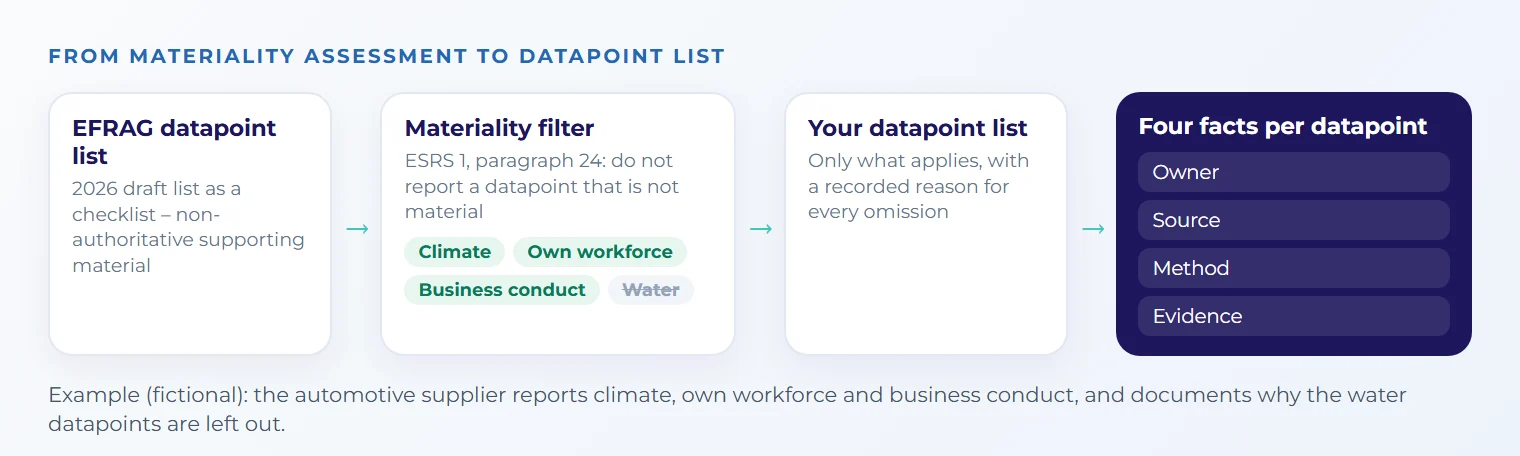
For financial year 2027 the team changes course. Its double materiality assessment found climate, own workforce and business conduct material, and water not material. It builds one datapoint list for exactly those topics from EFRAG's draft list and records why the water datapoints are left out. Every datapoint gets an owner, a source, a method and evidence. A trial run on half-year data in autumn exposes a unit error in the gas figures while there is still time to fix it. The assurance provider can later trace the electricity figure to the supplier invoices within minutes, and the annual figures are ready by mid-February.
Which standard applies to your data?
Settle this before you build a datapoint list: the standard decides the list. The answer depends on your size, your financial year and your position in a supply chain.
Your situation
Standard for your data
What it means for you
Undertaking in CSRD scope, financial year 2027 onwards
What this means for you: do not start collecting before you know which datapoint list applies. If you report on financial year 2026, make the choice between the three options now; for financial year 2027 onwards the revised ESRS apply.
From materiality assessment to datapoint list
According to the Commission, the revised ESRS (Delegated Regulation (EU) 2026/1563, in force since 10 November 2026) cut mandatory datapoints by more than 60% and total datapoints by more than 70%. EFRAG puts the reduction in mandatory datapoints at 61%. All voluntary “may disclose” datapoints are gone. Which datapoints you report follows from two things:
The materiality filter. Under the revised ESRS (ESRS 1, paragraph 24), you must not disclose a prescribed datapoint that is not material. Where your strategy, business model, sectors, geographies and value chain make the answer evident, you may conclude on materiality without further assessment (paragraph 27); where they do not, a specific assessment is required. Whether any general disclosure in ESRS 2 applies regardless of the outcome is worth confirming in the standard’s text with your assurance provider. Either way, document your reasoning for every ESRS 2 datapoint you leave out.
EFRAG’s 2026 Draft List of Datapoints (published on 28 August 2026) lists every datapoint definition. It is non-authoritative supporting material; the final version is expected before the end of 2026. Use it as a checklist, take over only what applies to you and record why a datapoint is omitted. You may also use reasonable and supportable information that is available without undue cost or effort. If you are outside the CSRD scope, the approach is the same – with the much shorter list of the voluntary standard.
What this means for you: a datapoint on the list is not automatically required, and a datapoint you leave out needs a reason that traces back to your materiality result.
From the EFRAG datapoint list to your own list: the materiality filter decides what you report, and every datapoint gets an owner, a source, a method and evidence.
Four facts for every datapoint
Field
Example: electricity consumption
Owner
Head of facilities, deputy in controlling
Source
Supplier invoices, grid operator portal
Method
Sum of all sites in kWh, calendar year
Evidence
PDF invoices and portal export, filed per month
This list is your most important tool. It shows gaps early, makes deputies possible and answers the assurance provider’s questions before they are asked. Two more things belong next to every datapoint: the boundary (which sites and entities are included – for greenhouse gases, financial control is the default and operational control or equity share may be used instead – kept the same year after year) and a flag for estimated values together with the estimation method. How the assurance of the sustainability statement works is covered in a separate guide.
Data from suppliers and the value chain
Many material datapoints sit outside your own sites: purchased goods, transport, product use. Under ESRS 1 your reporting extends to the value chain for material impacts, risks and opportunities, but not to every actor in it (paragraphs 62 and 64). Where data is missing, you may use estimates based on internal and external information such as sector averages, spend-based data or proxies (paragraph 65), and you use reasonable and supportable information available without undue cost or effort (paragraphs 93–95). Emissions of each significant Scope 3 category must be reported, as a total and per category, after you have screened all 15 categories – the GHG inventory guide shows how to build them.
For companies on the receiving end of requests, the value-chain cap applies from financial years starting on or after 1 January 2027. CSRD reporters may then ask value-chain companies with an average of up to 1,000 employees only for the datapoints listed in Annex II of the voluntary standard (Delegated Regulation (EU) 2026/1560), which the Regulation describes as essential datapoints; protected companies can decline requests that go further. The cap covers information gathered for the requester’s CSRD reporting only. It does not affect requests needed to comply with other EU or national law. The Regulation also encourages financial institutions to limit their requests to companies of up to 1,000 employees as far as possible.
Example (fictional)
A machinery manufacturer with 1,800 employees and €600m net turnover is in CSRD scope. For its financial year 2027 report it asks a 120-employee supplier for Scope 3 category data and a long list of social datapoints. The supplier is outside CSRD scope and protected by the cap: it provides the datapoints listed in Annex II of the voluntary standard and may decline the rest. If the manufacturer needs further data to meet a duty under another law, the cap does not apply to that request.
What this means for you: if you are a reporter, request only what your material topics need and use estimates where supplier data is missing, with the method documented. If you are a supplier, keep one dataset on the voluntary standard and check what each customer needs it for.
The reporting year
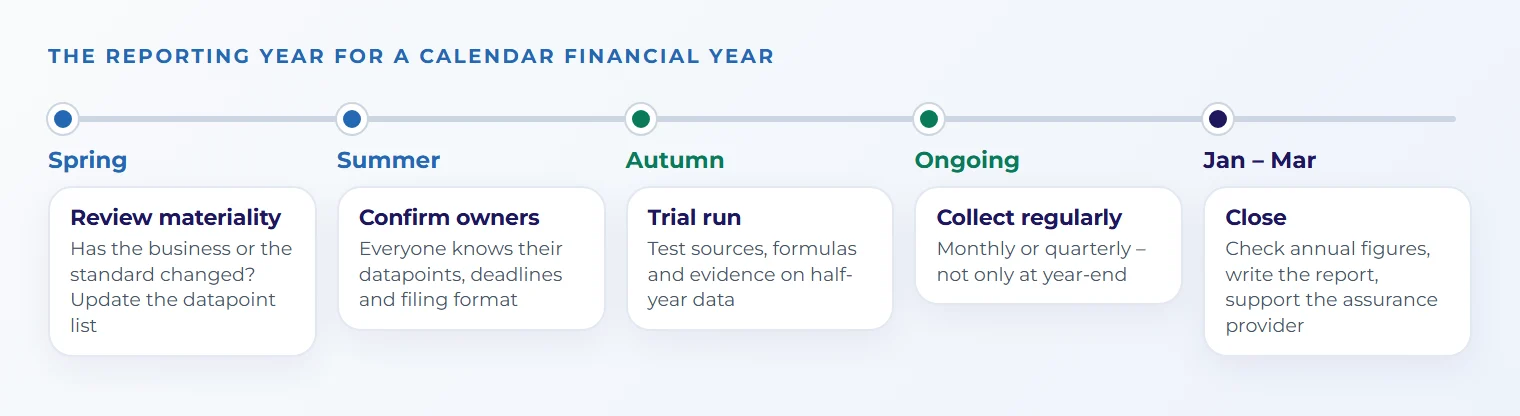
A company with a calendar financial year can run its year like this:
Spring: review materiality. Has the business or have the standards changed? Then update the datapoint list.
Summer: confirm owners. Everyone knows their datapoints, deadlines and filing format.
Autumn: trial run. Use half-year data to test whether sources, formulas and evidence work.
Ongoing: collect monthly or quarterly. What occurs regularly is entered regularly – not only at year-end.
January to March: close. Check the annual figures, write the report, support the assurance provider.
The reporting year for a company with a calendar financial year.
Simple checks with a big effect
Prior-year comparison: have deviations above a set threshold explained.
Plausibility: check figures against reference values, such as kWh per square metre or accidents per million hours worked.
Units: keep kWh, MWh and litres apart and convert them carefully – this is where most errors happen.
Four-eyes principle: whoever enters data does not approve it.
Versions: make corrections traceable instead of overwriting values.
Estimates: label estimated values and keep the method and a short data-quality note. The revised ESRS allow estimates, but an assurance provider will ask how they were derived.
How FIESDA can help with ESG data collection
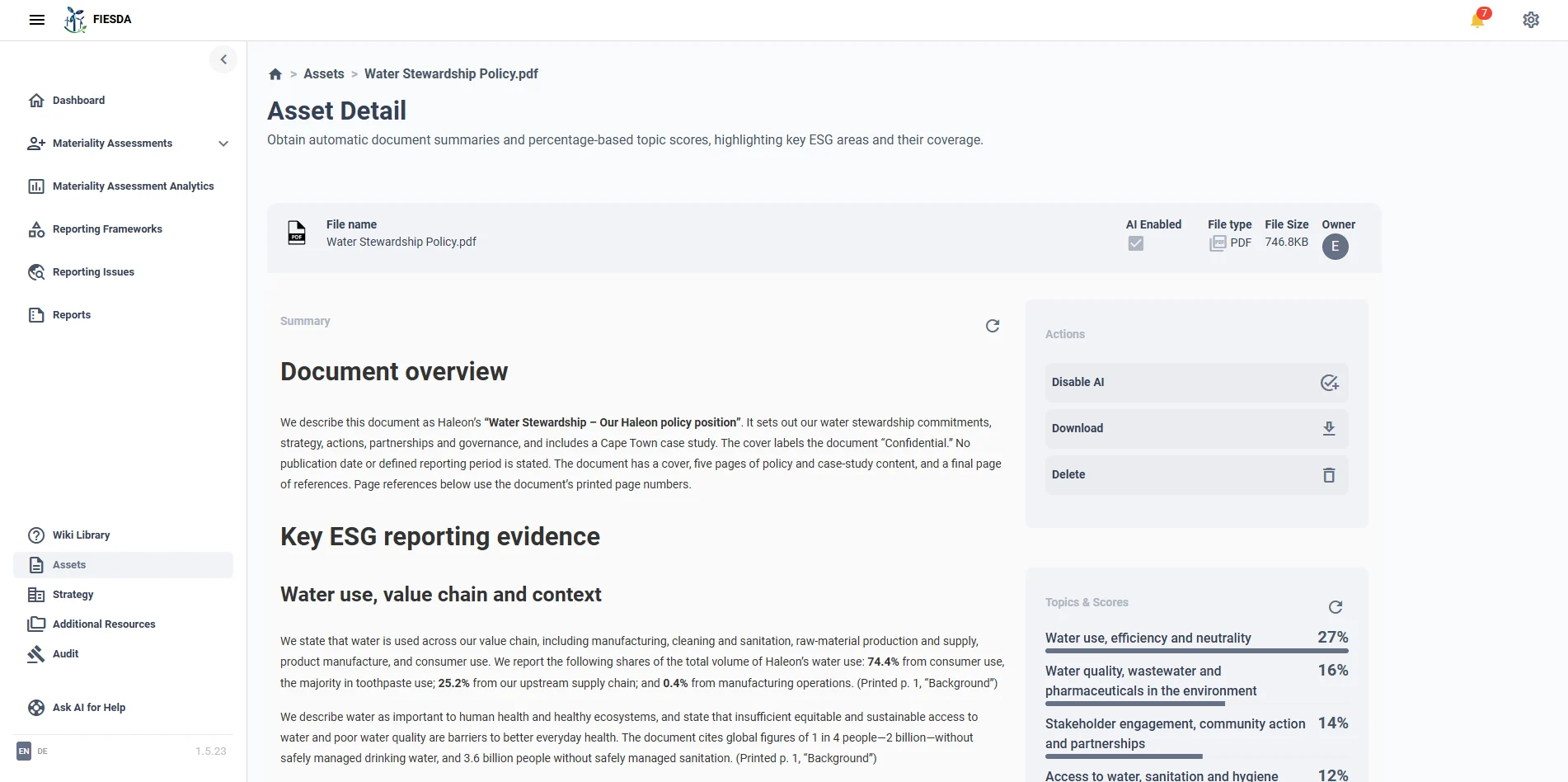
Each datapoint needs an owner, a source, a method and evidence. In FIESDA’s ESG data collection software you assign an owner and due date to every reporting issue, store the evidence files with it, and restore earlier versions from the action history. Uploaded documents get AI summaries and relevance scores by ESG topic, and the chatbot can extract figures from them. Treat extracted values as drafts: someone checks them against the source before they go into the report.
Illustration of the Assets section in FIESDA: an AI summary and ESG topic scores for an uploaded document.
What good data collection looks like
Good data lets you trace every figure in the report back to its source. Two developments make this more than good housekeeping.
Limited assurance stays. Omnibus I kept limited assurance, removed the path to reasonable assurance and requires the Commission to adopt a limited assurance standard by 1 July 2027. Until then, ask your assurance provider early which procedures and evidence it expects.
Digital tagging is coming. EFRAG consulted until 11 November 2026 on a draft XBRL taxonomy for the revised ESRS and plans to submit the final version to ESMA and the Commission by the end of 2026. Mandatory digital tagging for sustainability statements is not in force yet. Data kept in one structured list, one value and one unit per datapoint, will be easier to tag later. EFRAG bundles its taxonomies on its digital reporting with XBRL page; the technical explanatory note explains how datapoints map to XBRL elements, and the ESRS Knowledge Hub offers a digital template and an Excel-to-XBRL converter for the VSME.
Climate data is usually the most demanding part; the guide on the GHG inventory shows how to build it.
Frequently asked questions
Do I have to use the revised ESRS for financial year 2026?
Not necessarily. Companies already in scope choose between the existing ESRS, the existing ESRS with eight reliefs, or the revised ESRS in full, and must state which they applied. The revised ESRS become mandatory for financial years starting on or after 1 January 2027.
How many datapoints will I have to collect?
There is no single number. It depends on your material topics, and published counts differ between sources. Work from the EFRAG datapoint list and your materiality result, not from a headline figure.
Do I need a document as evidence for every datapoint?
The standards do not prescribe a filing format. Assurance providers test whether reported figures can be traced to a source and a method, so keep the evidence for every figure you report.
Can a customer ask my SME for all ESG data?
From financial year 2027, a CSRD reporter may ask companies with up to 1,000 employees only for the datapoints listed in Annex II of the voluntary standard, when the data is for its CSRD reporting. Requests based on other legal obligations are not limited by the cap.
Can I use estimates?
Yes. The revised ESRS allow estimates based on internal and external information, such as sector averages, spend-based data and proxies. Document the method and the data quality.
Is digital tagging mandatory yet?
Not yet. EFRAG’s draft XBRL taxonomy for the revised ESRS was out for consultation until 11 November 2026, and the final version is due to go to ESMA and the Commission by the end of 2026.
Which revised ESRS datapoints apply to you, how materiality, reliefs and phase-ins filter them, and how to use EFRAG’s Excel list and prepare for XBRL tagging.
How to collect ESG data from suppliers and customers, when estimates are allowed, and what the value-chain cap means for your data requests from financial year 2027.