How to assess the physical and transition climate risks of your sites – with scenarios, free hazard data and a simple scoring scheme that fits ESRS E1 and IFRS S2.
easy4pro editorial team·Last reviewed: ·9 min read
Key takeaways
If climate change is material for you, the revised ESRS require you to classify each material climate risk as physical or transition and to explain how you assessed the exposure of your assets and activities over the short, medium and long term (ESRS E1-2).
Scenario analysis is optional under ESRS E1 but required under IFRS S2. If you use it for the ESRS, say whether at least one high-emission scenario was used for physical risks and a 1.5 °C scenario for transition risks.
Physical risks are assessed per site: hazard, exposure and vulnerability together make up the risk – including the locations of key suppliers.
Free tools give a first view: HORA in Austria, GIS-ImmoRisk Naturgefahren in Germany and the Copernicus Climate Change Service for future scenarios across Europe.
From your first report, disclose the carrying amount of assets at material physical risk and the share covered by adaptation actions; most other financial-effect data may be phased in.
The floods of September 2024 showed how quickly climate risks turn into business interruptions. Between 13 and 20 September, flooding affected almost the whole of Lower Austria; Austrian insurers expected record claims of €600m to €700m. Flooded halls, cut-off supply routes and staff unable to get to work hit companies directly. Banks, insurers and investors therefore increasingly ask how well a company is prepared for such events.
This guide answers: What do ESRS E1 and IFRS S2 actually require? How do you assess physical risks site by site? Which scenarios and time horizons make sense? Where do you get the data for free? And what goes into the report?
Example (fictional)
A logistics company with 800 employees and seven warehouses in Austria and Bavaria checks every site with HORA and GIS-ImmoRisk Naturgefahren. Two warehouses lie in zones with an increased flood hazard, one of them holding the central spare parts stock; a key packaging supplier is also located in a flood zone. The analysis leads to three actions: high-bay racks in the exposed area are rearranged, an alternative site for the spare parts stock is secured by contract and a second packaging supplier is qualified. The insurer takes this into account at the next renewal.
Two kinds of climate risk
Kind
Type
Examples
Physical risks
acute
floods, heavy rain, storms, hail, heatwaves
Physical risks
chronic
rising average temperatures, water stress, changing precipitation, lack of snow
Transition risks usually affect the whole company and are assessed centrally. Physical risks, by contrast, depend heavily on location – which is where the site analysis starts.
What ESRS E1 and IFRS S2 require
Topic
ESRS E1 (revised ESRS)
IFRS S2
Who applies it
Companies in the CSRD scope for which climate change is material
Companies reporting under the ISSB standards (voluntary in the EU)
Risk identification
E1-2: classify each material risk as physical or transition; disclose the method used to assess exposure and sensitivity of assets and activities in own operations and the value chain over the short, medium and long term
Identify climate-related risks and opportunities that could affect the company’s prospects
Scenario analysis
Optional. If used: range of scenarios (high-emission for physical, 1.5 °C for transition risks), scope, key assumptions, timing (paragraph 17)
Required to assess climate resilience, with an approach commensurate with the company’s circumstances (paragraph 22)
Resilience
E1-3: results, significant uncertainties and capacity to adapt; not required every year unless the risk assessment is updated (AR 9)
Assessment of climate resilience of strategy and business model
Financial effects
E1-11: e.g. carrying amount of assets and net revenue at material physical risk, share of assets addressed by adaptation actions
Current and anticipated financial effects
Under the revised ESRS (Delegated Regulation (EU) 2026/1563), you do not have to assess every possible risk everywhere. Focus on areas where material risks are likely, and for the value chain you may use regional or sector data instead of asking each partner (ESRS 1, paragraphs 32–33).
Assessing physical risks per site
A proven scheme combines three questions:
Hazard: which climate-related hazards exist at the site, today and in the future, and how likely, strong and long-lasting are they?
Exposure: what is there – buildings, equipment, stock, people – and what is it worth?
Vulnerability: how hard would an event hit operations, and are there alternatives?
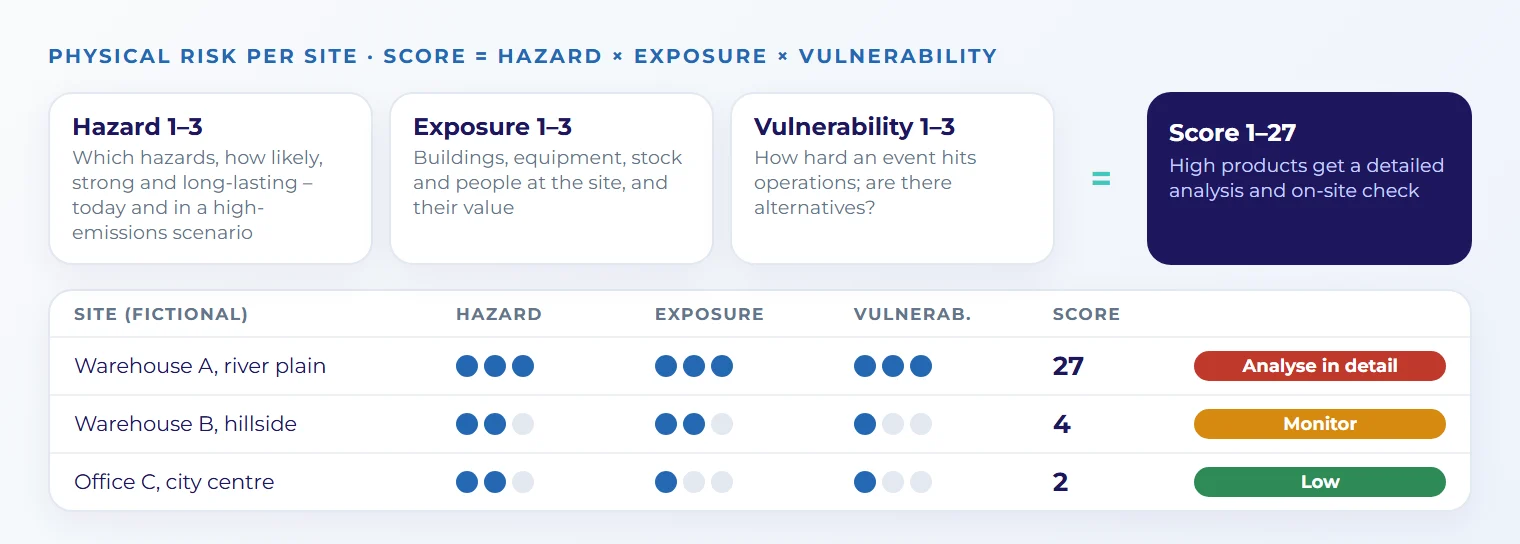
Rate each question on a simple scale from 1 to 3 and multiply the scores (1 to 27). Sites with high products are where you look more closely. ESRS E1 expects you to consider likelihood, magnitude and duration of hazards and the locations of your assets and of business dependencies in your value chain (ESRS E1, AR 6).
Site (fictional)
Hazard
Exposure
Vulnerability
Score
Warehouse A, river plain
3 (flood)
3 (central stock)
3 (no alternative)
27 – analyse in detail
Warehouse B, hillside
2 (heavy rain)
2
1
4 – monitor
Office C, city centre
2 (heat)
1
1
2 – low
Site scoring from the table above: hazard, exposure and vulnerability are rated 1–3 and multiplied; Warehouse A (27) gets a detailed analysis.
Scenarios and time horizons
IFRS S2 requires a scenario analysis of climate resilience whose depth may match the company’s circumstances. Under ESRS E1 it is optional – but if you use one, the ESRS ask whether at least one high-emission scenario was used for physical risks. To get started, these are usually enough:
two scenarios: a pathway with strong climate action and a high-emissions pathway, for example from the scenarios of the Intergovernmental Panel on Climate Change (IPCC);
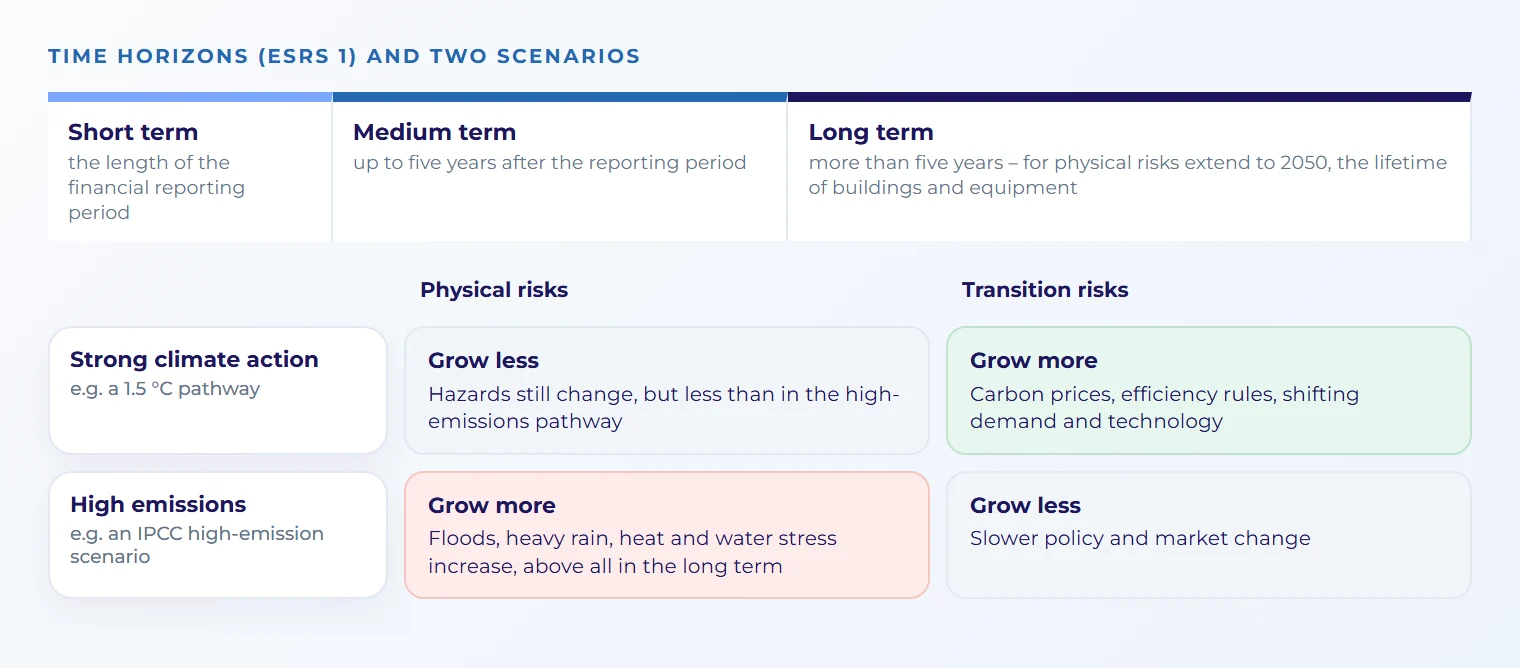
three time horizons: ESRS 1 (paragraph 79) defines short term as the length of your financial reporting period, medium term as up to five years after that, and long term as more than five years. For physical risks, extend the long horizon to 2050 – in line with the lifetime of buildings and equipment; ESRS 1 asks for additional long-term breakdowns where effects are expected beyond five years.
Physical risks grow more in the high-emissions pathway, transition risks in the climate-action pathway. Together they show the range the company has to prepare for.
The ESRS 1 time horizons and two scenarios: physical risks grow more in the high-emissions pathway, transition risks in the climate-action pathway.
Freely available data
HORA (Austria): the federal natural hazard platform shows eight hazards per address – flood, avalanche, earthquake, landslide, storm, lightning, hail and snow – and summarises them in a HORA-Pass. A heat layer was added in 2026. hora.gv.at
GIS-ImmoRisk Naturgefahren (Germany): the web tool of the Federal Institute for Research on Building, Urban Affairs and Spatial Development (BBSR) assesses hazards such as winter storm, hail, heavy rain, forest fire and heat per location, including their future development. gisimmorisknaturgefahren.de
Copernicus Climate Change Service (C3S): free data and projections on temperature, precipitation and extreme events across Europe through the Climate Data Store. climate.copernicus.eu
Your own loss data: past damage, downtime and insurance claims per site.
Insurers: many offer risk reports for sites – often free of charge as part of the policy.
These tools give a first screening. Local conditions – a protective wall, a basement, a raised floor – can change the risk considerably, so check high-scoring sites on the spot.
Six steps to the analysis
List your sites. Address, function, asset values, staff and dependencies – including key suppliers and logistics hubs. The master data from the guide on several sites is the basis.
Identify hazards. For each site, screen the relevant hazards today and in the high-emissions scenario, using the Taxonomy hazard list as a checklist.
Score. Rate hazard, exposure and vulnerability on the scale and prioritise.
Estimate the financial effect. For the main risks: assets and revenue at risk, possible damage, downtime costs and investment needs, as ranges.
Derive actions. Structural protection, emergency plans, alternative sites and suppliers, insurance cover.
Under ESRS E1, describe the method (E1-2), the scenarios and time horizons if you used scenario analysis, the results of your resilience analysis (E1-3), your adaptation actions (E1-5) and the anticipated financial effects (E1-11). The phase-ins in ESRS 1 (paragraphs 125–127) matter here:
From the first report: the carrying amount of assets at material physical risk and the percentage addressed by adaptation actions, and the equivalent figures for transition risks (E1-11, paragraphs 39(a)–(b) and 40(a)–(b)).
Phased in: companies reporting for the first time from financial year 2027 may omit the other information on anticipated financial effects for their first two years and the other quantitative information for their first four years. Wave-one companies may omit them for financial years before 2028 and 2030 respectively.
Asset locations: where relevant, include the location of assets at material physical risk, aggregated so that it represents the risk faithfully (E1, AR 32).
If you report under the ISSB standards or supply data to a parent company, the guide on IFRS S1 and S2 shows how this fits with the other disclosures. If you report EU Taxonomy-aligned activities, the same site analysis supports the climate risk and vulnerability assessment the Taxonomy requires.
How FIESDA can simplify climate risk assessment reporting
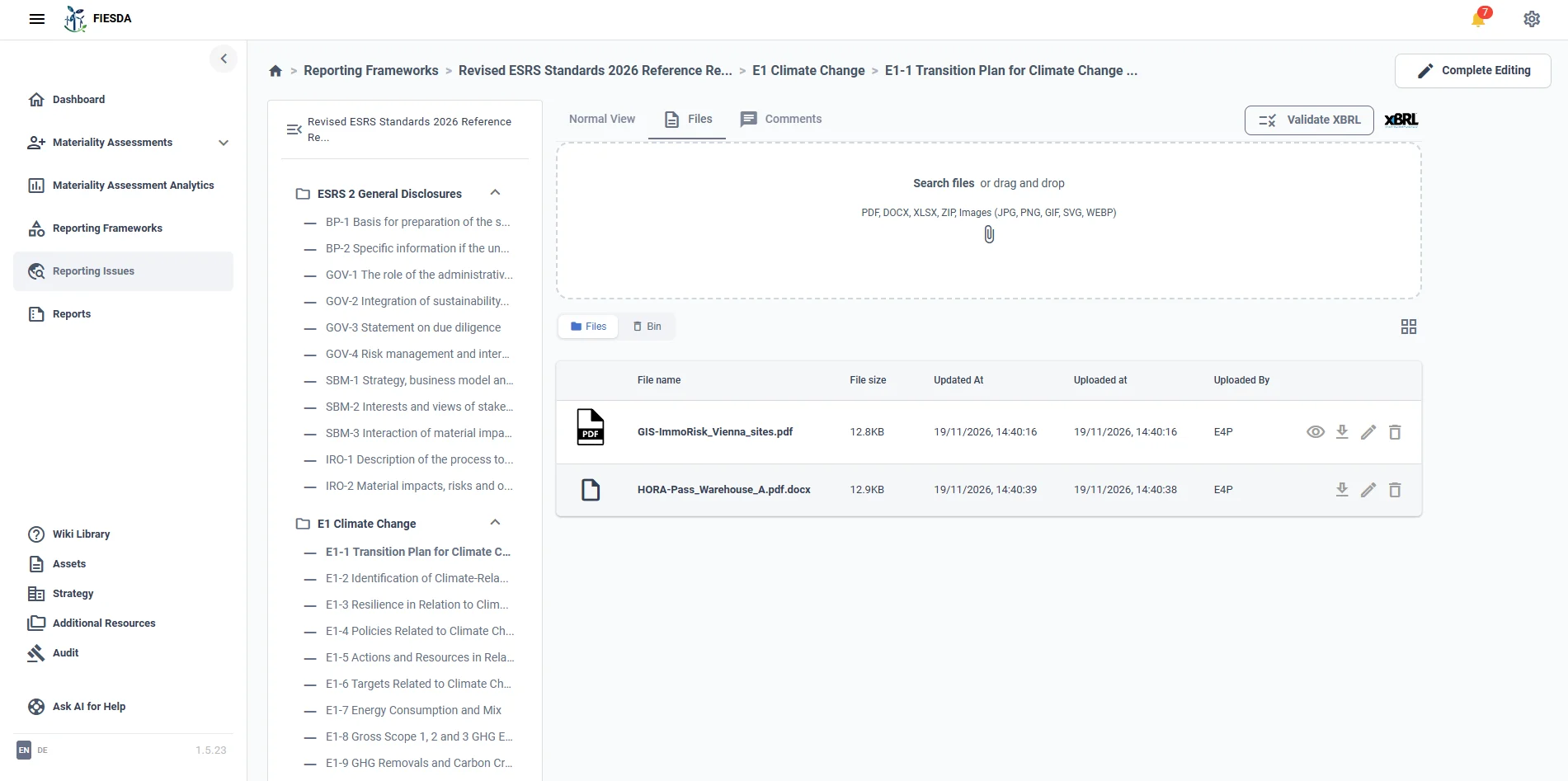
After the site analysis, the results become disclosures: ESRS E1-2, E1-3, E1-5 and E1-11 and, if you also report under the ISSB standards, IFRS S2. FIESDA’s ESRS and IFRS S2 reporting software includes reference templates for the ESRS and for IFRS S1 and S2, with every disclosure requirement as a data point and integrated guidance. Store hazard maps and insurer reports with the reporting issue they support, and save a disclosure once to reuse it where the two standards overlap. You tailor the templates to your materiality results.
Example illustration of an ESRS E1 reporting issue in FIESDA, with hazard maps and the insurer report stored as files (example data).
Frequently asked questions
Is scenario analysis mandatory under the ESRS?
No. ESRS E1 allows it but does not require it. If you use it, disclose the scenarios, scope, key assumptions and timing. Under IFRS S2, scenario analysis is required.
Do we have to repeat the analysis every year?
Not necessarily. Under ESRS E1 you do not have to perform a resilience analysis every year, but you must update it when you update your assessment of climate-related risks.
Which time horizons does the ESRS use?
Short term is the length of your financial reporting period, medium term up to five years after that, long term more than five years. You may define the medium and long term differently where the standard definitions would give non-relevant information, for example because of long investment cycles in your sector.
What must we disclose on financial effects in our first report?
At least the carrying amount of assets at material physical and transition risk and the share addressed by adaptation or mitigation actions. Most other figures may be phased in.
Is HORA enough as an analysis?
It is a good first screening for Austrian sites. For high-scoring sites, add on-site checks, insurer reports and future scenarios, for example from Copernicus.
Which revised ESRS datapoints apply to you, how materiality, reliefs and phase-ins filter them, and how to use EFRAG’s Excel list and prepare for XBRL tagging.
How to plan and report your climate transition under the revised ESRS E1-1, the voluntary standard (VSME) and IFRS S2, and what Omnibus I changed for transition plans.