What sustainability policies, action plans and KPIs are, how they work together, and how to turn a policy into actions and track progress, with examples.
easy4pro editorial team·Last reviewed: ·13 min read
Key takeaways
A sustainability policy states what a company commits to. An action plan sets out who does what, by when and with which resources. KPIs show whether the plan is carried out and whether it works.
The three work as one cycle. The energy management standard ISO 50001 follows the same steps: policy, targets and objectives, measurement, review and continual improvement.
Track implementation (milestones) and impact (the KPI) separately: a completed action is not yet a target met.
OKRs are an optional management practice. They turn multi-year targets into quarterly priorities.
The ESRS set out how undertakings report on their policies, actions, targets and progress. Public claims about future environmental performance need a detailed, realistic implementation plan (Directive (EU) 2024/825).
An environmental policy, a supplier code of conduct or an energy policy is quickly written. Showing what it has changed is harder. The question comes up when a customer asks for results, when management asks whether a target is still within reach, or when marketing wants to promise “climate neutral by 2035”.
This guide explains what sustainability policies, action plans and key performance indicators (KPIs) are, and how the three work together. A worked example and a set of best practices then show how to turn a policy into actions and how to track whether they work.
What is a sustainability policy?
A sustainability policy is a company’s commitment on a sustainability topic: what it wants to prevent, reduce or achieve, where the commitment applies and who is responsible for it. Management or the board usually approves it. A policy sets the direction. It does not yet say how much, by when or how.
Typical sustainability policies include:
Environmental policy: emissions, energy, waste, water and pollution prevention.
Energy or climate policy: energy efficiency, renewable energy and greenhouse gas emissions.
Supplier code of conduct: what the company expects from suppliers on human rights, working conditions and the environment.
Policies for the company’s own workforce: for example health and safety, diversity and inclusion, or training.
A useful policy answers five questions:
Element
Question it answers
Example: energy policy
Commitment
What do we want to prevent, reduce or achieve?
Use less energy per tonne of product and expand renewable energy
Scope
Which sites, activities and parts of the value chain does it cover?
All three plants; purchased electricity, gas and heat
Responsibility
Who is accountable, and who approved it?
Board member for operations; approved by the management board in 2025
Targets
Which measurable targets put the commitment into numbers?
442 kWh per tonne of product in financial year 2028
Review
When, and by whom, is it reviewed?
Once a year in the management review
What this means for you: a policy without targets and a review date is a statement of intent. Adding both is the first step towards putting it into practice.
What is an action plan?
An action plan turns a policy and its targets into work. For each key action it records what will be done, who is responsible, by when, with which resources and what effect is expected. Milestones split longer actions into steps that can be checked.
A common practice is to keep one sheet per key action. These fields are usually enough:
Field
Example
Policy and target
Energy policy; 442 kWh per tonne in financial year 2028
Action
Heat recovery at plant 2
Owner and deputy
Plant manager, plant 2; deputy: energy manager
Deadline and milestones
Order Q1 2027, installation Q3 2027, in operation Q4 2027
Budget
€420,000 capital expenditure (investment plan line “Plant 2 – energy”)
Expected effect
−30 kWh per tonne at plant 2 (supplier’s estimate)
KPI
Energy use per tonne, monthly, from meter and production data
Status and next review
On schedule; next review on 15 January 2027
Two fields deserve particular care. The owner should be a named person with a deputy, not a department. The budget should be agreed with controlling and included in the capital expenditure (CapEx) or operating expenditure (OpEx) plan. Without both, the action has to compete with day-to-day business for time and money.
What is progress and performance tracking?
Tracking answers two questions: is the plan being carried out, and is it working? It uses a few terms that are easily confused:
Term
What it is
Example
Metric
A measured value
Energy use in kWh per month
KPI
A metric you steer by, usually linked to a target
Energy use per tonne of product (kWh per tonne)
Baseline
The value of the KPI in the base year
520 kWh per tonne in financial year 2025
Target
A measurable result to reach by a set date
442 kWh per tonne in financial year 2028
Milestone
A step in carrying out an action that can be checked
Heat recovery in operation by Q4 2027
Implementation and impact
The two questions call for different measures:
Implementation: is the action on schedule? You measure it with milestones such as “order placed” or “in operation”. These are leading indicators: they move before the result does.
Impact: is the KPI moving towards the target? You measure the outcome, for example kWh per tonne. This is a lagging indicator: it shows the effect only once the action takes hold.
An action can be fully implemented and still have no effect. If you only track implementation, you notice too late. The quick check shows what to do in each case:
KPI moves towards the target
KPI does not move
Milestones on schedule
On track: keep going.
The action is not working as planned: check settings, assumptions and the data.
Milestones late
Other factors are helping: find out which, and do not rely on them.
Escalate: owner, budget and priority need a decision.
Defining a KPI
For each KPI, write down the formula, unit, boundary (which sites and activities it covers), data source, owner, update frequency and how gaps are estimated. Also decide whether the KPI is absolute, such as total kWh per year, or an intensity, such as kWh per tonne. An intensity can fall while total consumption rises, for example when output grows faster than efficiency improves, so it often makes sense to track both. The guide on managing ESG metrics all year covers ownership, update rhythm and target ranges.
How policies, action plans and KPIs work together
Each element answers one question. Together they form a chain from commitment to measurable progress.
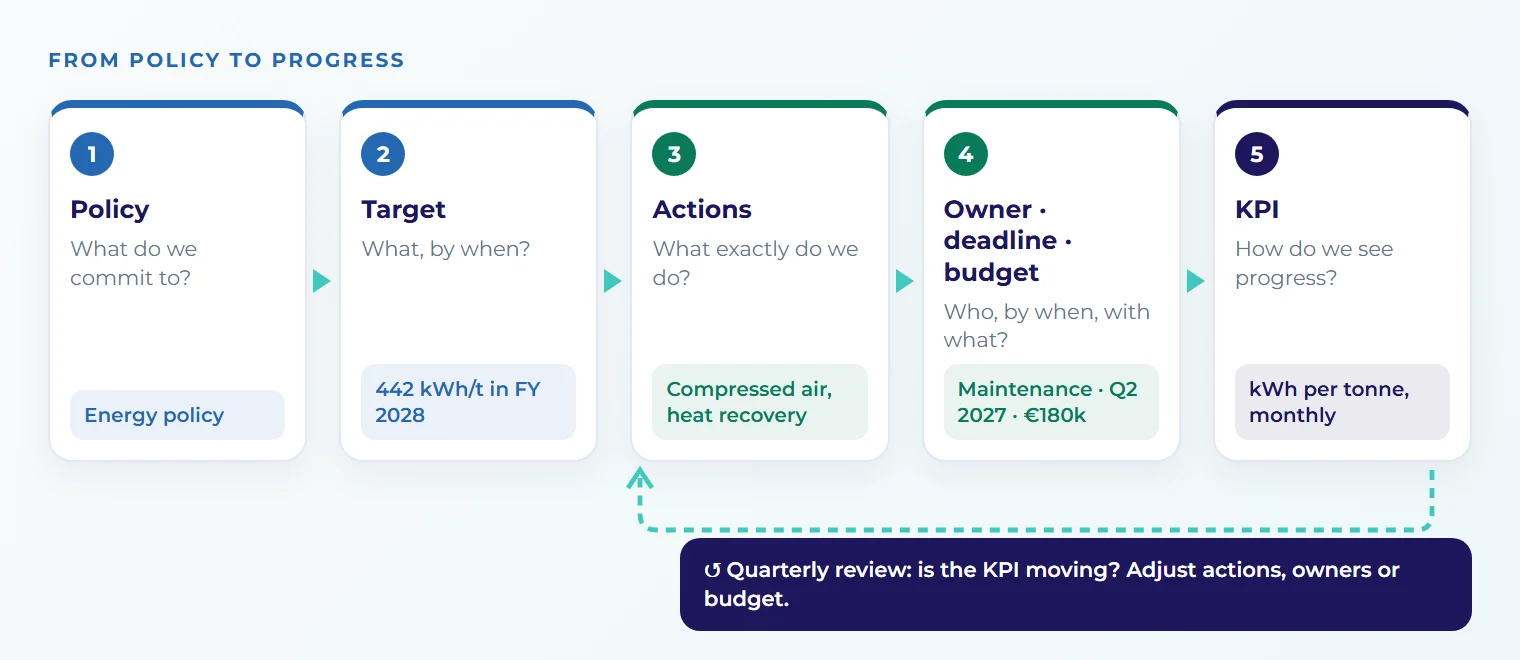
From policy to progress: target, actions with owner, deadline and budget, and a KPI. The review closes the loop.
Level
Guiding question
Example
Policy
What do we commit to?
Energy policy: use less energy, expand renewable energy
Target
What do we want to achieve by when?
442 kWh per tonne in financial year 2028 (−15 % against 2025)
Action
What exactly do we do?
Repair the compressed-air network; heat recovery at plant 2
Owner, deadline, budget
Who, by when, with what resources?
Head of maintenance, Q2 2027, €180,000
KPI
How do we see progress?
kWh per tonne, monthly per plant
The chain closes in a loop. The review shows whether the KPI is moving. If it is not, the action plan is adjusted, and from time to time the policy and its targets are reviewed too. Management system standards are built on the same cycle. ISO 50001, the international standard for energy management systems, provides a framework to develop an energy policy, set targets and objectives to meet it, use data to make decisions, measure the results, review how well the policy works and continually improve. ISO 14001:2026, the standard for environmental management systems, lists environmental objectives and performance indicators, and monitoring, measurement and continuous improvement, among its key elements. Certification to either standard is voluntary.
What this means for you: check each policy for the full chain. Is there a measurable target? Are there actions with an owner, a deadline and a budget? Is there a KPI that shows progress, and a date for the next review? Each missing link is a gap to close first.
Example: an energy policy from commitment to review
Example (fictional)
Policy. A packaging manufacturer with 420 employees and three plants adopts an energy policy in 2025: use less energy per tonne of product and expand renewable energy.
Target. In the financial year 2025 the company used 520 kilowatt-hours (kWh) of energy per tonne of product. The board sets a target of 442 kWh per tonne for financial year 2028, a 15 % reduction (520 × 0.85 = 442).
Action plan. Three key actions follow: energy training for shift leaders (HR, Q1 2027), repairing the compressed-air network (head of maintenance, Q2 2027, €180,000) and heat recovery at plant 2 (plant manager, Q4 2027, €420,000).
Tracking. The KPI is energy use per tonne, updated monthly for each plant. Each action has milestones, and management reviews both every quarter.
Review. In Q3 2027 the repair was finished, but energy use has only fallen to 505 kWh per tonne, 2.9 % below the baseline (15 ÷ 520). The milestone is met; the KPI is not moving as planned. The cause: the compressed-air system runs at a higher pressure than the machines need. The team corrects the setting within a week instead of finding the problem in next year’s figures.
Best practices for putting policies into practice
Six steps from policy to progress
Review your policies. Which policies exist, who approved them and which topics do they cover? Check the scope: own operations only, or also suppliers and customers? If you have carried out a double materiality assessment, its result shows which material topics still lack a policy.
Derive targets. Give every policy at least one measurable target with a baseline value, base year, target value, unit and target year. Add interim milestones for targets that run longer than a year.
Plan a few effective actions. A few actions with a large effect beat a long list. Estimate the expected effect of each, for example in kWh or in tonnes of CO2 equivalent (tCO2e), so you can set priorities.
Assign an owner and a budget. Name a person and a deputy for each action, and agree the budget with controlling so that the figures match the investment and cost plans.
Define the KPI and the milestones. Write the KPI definition down as described above and set checkable milestones for each action.
Review regularly. A common practice is a monthly KPI update and a fixed quarterly slot with management: what is on track, what is stuck, what needs to change? An ESG dashboard should show both milestone status and the KPI against its target.
Linking OKRs to multi-year targets
Multi-year targets such as “−15 % by financial year 2028” are too far away for day-to-day work. Objectives and key results (OKRs) break them down into short cycles. They are a management practice, not a legal requirement.
A common way to link the two:
Target (multi-year): 442 kWh per tonne in financial year 2028.
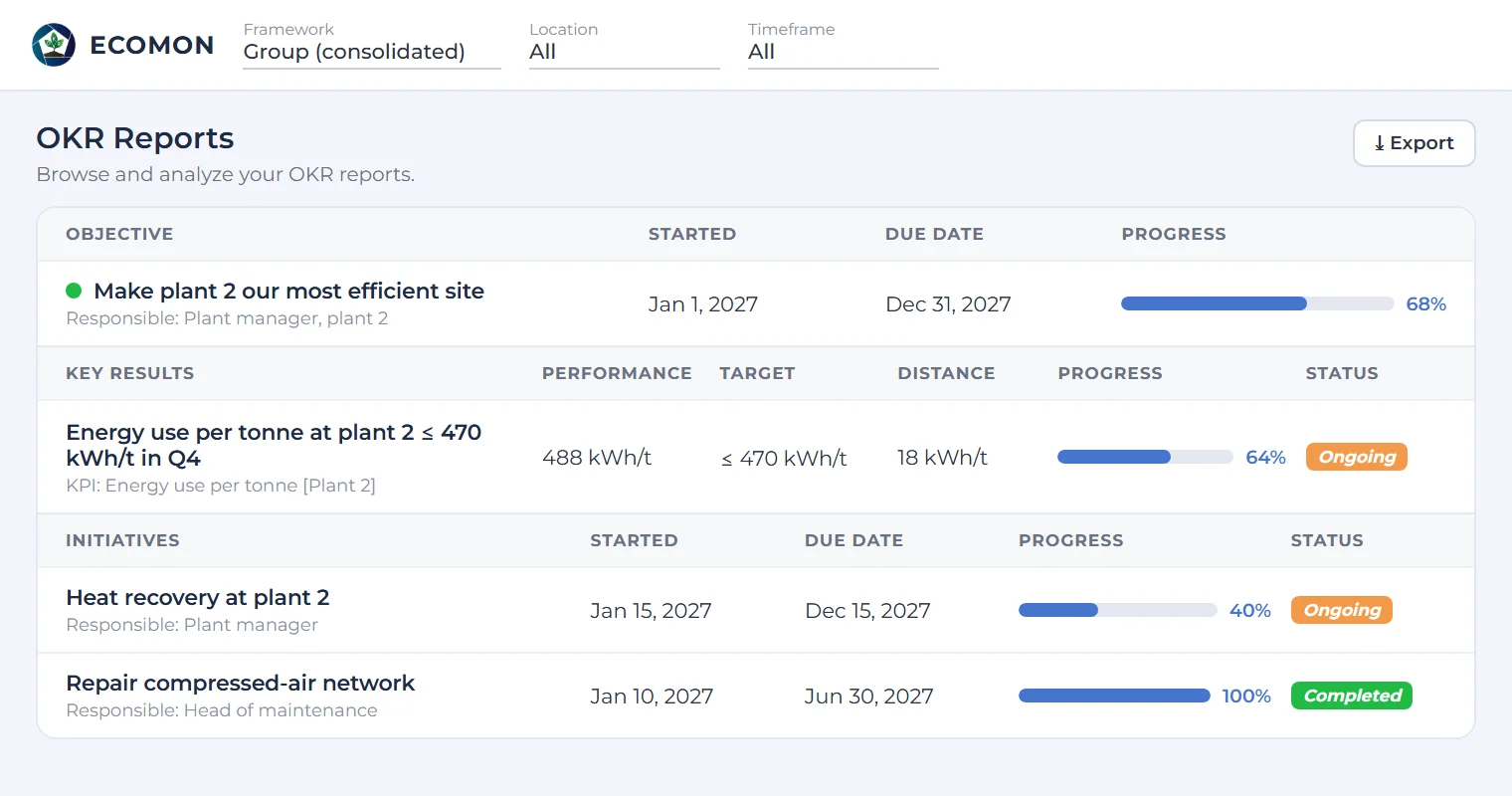
Objective (this year or quarter): “Make plant 2 our most efficient site.”
Key results: measurable and tied to the KPI, for example “470 kWh per tonne at plant 2 in Q4” and “heat recovery in operation by 15 December”.
Initiatives: the actions from your action plan.
Google’s re:Work guide on OKRs recommends three to five objectives with about three key results each and grades key results from 0 to 1.0, with 60–70 % as the “sweet spot” for ambitious OKRs. It also stresses that OKRs are not a tool for evaluating employees.
Common OKR mistakes:
Too many OKRs: the team spreads its effort too thin.
Activities posing as key results: “Install heat recovery” is an initiative; “470 kWh per tonne” is a key result.
Sandbagging: key results set so low that they are always met.
OKRs detached from the targets you report: internal steering and external reporting then use different numbers.
No budget: the action is planned but never funded.
A target without a baseline: progress cannot be measured.
Looking once a year: deviations show up only when the year is over.
No backing from management: without visible priority, actions stall.
Reporting on policies and action plans: the ESRS
Companies in the scope of the Corporate Sustainability Reporting Directive (CSRD) report under the European Sustainability Reporting Standards (ESRS). The revised ESRS, adopted as Delegated Regulation (EU) 2026/1563, set out how undertakings describe their policies, actions, targets and metrics for material sustainability topics, and the progress they make towards their targets. They apply to financial years starting on or after 1 January 2027 and may already be used for financial year 2026.
The ESRS are reporting standards: they say what to disclose, not how to manage. Their structure of policies, actions, targets and metrics follows the same chain as this guide, which makes them a useful checklist when you develop policies and action plans. The guide on disclosing policies, actions and targets shows how to present them in the sustainability statement.
When targets become public promises: green claims
Directive (EU) 2024/825 (often called the EmpCo Directive) tightens EU consumer-protection law on environmental claims. Its rules apply from 27 September 2026. Austria transposed them mainly through an amendment to the Unfair Competition Act (UWG), passed by the Nationalrat on 7 July 2026 and published as Federal Law Gazette I No. 58/2026.
A claim to consumers about future environmental performance, such as “climate neutral by 2035”, now counts as misleading unless it rests on clear, objective, publicly available and verifiable commitments in a detailed and realistic implementation plan. The plan must include measurable, time-bound targets and other elements such as the allocation of resources, and it must be verified regularly by an independent third-party expert whose findings are made available to consumers.
What this means for you: an action plan built as described in this guide is the core of such an implementation plan. Before a future claim goes into marketing, add the independent verification and agree the wording with your legal adviser. Claims to business customers fall outside the directive’s specific rules but can still be misleading under general unfair-competition law.
Frequently asked questions
What is the difference between a sustainability policy and a sustainability strategy?
A strategy sets the company’s overall direction and priorities on sustainability. A policy sets out the commitments for one topic, such as energy or suppliers. A strategy is usually put into practice through several policies, each with its own targets and action plan.
What is the difference between an action and a key result?
An action is something you do, such as installing heat recovery. A key result is a measurable outcome, such as 470 kWh per tonne. In OKR language, actions are called initiatives.
How often should we review progress?
There is no general rule. A common practice is to update KPIs monthly and to review actions and targets with management every quarter.
What if we have a policy but no measurable target yet?
Start by measuring a baseline, ideally over a full year, so that the target has a starting point. Until then, track the milestones of your actions and treat the missing target as a gap to close.
Do we need OKRs or a certified management system?
No. OKRs are an optional management method, and certification to ISO 14001 or ISO 50001 is voluntary. Both can help structure the work, but neither is required to put a policy into practice.
How ECOMON helps you put sustainability policies into practice
ECOMON is easy4pro’s AI-powered ESG performance and OKR management platform. It keeps the action plan from this guide live.
OKRs linked to KPI targets: set an objective per policy, link its key results to KPI targets and attach the actions as supporting initiatives.
Owners and deadlines at every level: assign responsibilities and due dates to objectives, key results and initiatives, with a full action history.
Notifications and reminders: get alerts when a KPI breaches its target range and when OKR deadlines are close or overdue.
Interactive OKR reports: see progress and KPI performance against targets in one view, exportable in multiple formats.
For the sustainability statement itself, FIESDA is easy4pro’s AI-powered ESG reporting platform.
Illustration of an ECOMON OKR report with example data.
How to set a credible climate target – boundary, base year, absolute or intensity, ambition – and track it monthly so you notice deviations while you can still act.
How to import electricity, gas, heat and fuel data automatically – from grid operator portals and invoices to sub-meters – and turn it into ESRS-ready energy figures.
How to move ESG data collection from emailed spreadsheets to automated workflows – with clean data structures, validation rules, AI extraction and an audit trail.