How to turn sustainability targets into steerable ESG KPIs and OKRs: base year, target value, benchmarks, review cycle, SBTi and ESRS rules, with a worked example.
easy4pro editorial team·Last reviewed: ·9 min read
Key takeaways
A target is steerable once baseline, base year, target value, scope, method, owner and review cycle are defined – largely what the revised European Sustainability Reporting Standards (ESRS) ask you to disclose.
Key performance indicators (KPIs) measure continuously; OKRs (Objectives and Key Results) turn a multi-year target into quarterly, measurable steps.
Benchmark against three references: your own past, your industry and a science-based (1.5 °C) pathway.
Under ESRS E1, climate targets are gross and disclosed in absolute values; intensity targets can only be added.
“Climate neutral by 2040” is in many reports. Rarely stated: who is responsible, what must be achieved this year and how you notice you are off course. This guide shows how to define targets, break them into KPIs and OKRs, benchmark them and report them under the revised ESRS and the voluntary standard (VS).
Objective, metric, key result – the terms
OKR (Objectives and Key Results) is a goal-setting and management system created by Andy Grove at Intel and popularised by John Doerr (WhatMatters). Each cycle, usually a quarter, a team sets a few qualitative objectives, each with a small number of measurable key results. OKRs move KPIs; they do not replace them.
Term
What it is
Example
Metric
A measured value with unit and frequency
Litres of diesel per month
KPI
A metric chosen to steer a material topic, with an owner
Fleet Scope 1 emissions in tonnes of CO2 equivalent (tCO2e)
Target
A KPI value to reach by a date, from a baseline
−50% by 2030 compared with 2024
Milestone
An interim value on the way
≤ 9,000 tCO2e in 2027
Objective
A qualitative direction for one cycle
Our urban fleet runs cleaner
Key result
A measurable outcome by the end of the cycle
Diesel per 100 km from 31.0 to 29.1 litres
Initiative
Work that moves a key result
Eco-driving training
Quick check: measured continuously for years → KPI; a change by a date in this cycle → key result; work to be done → initiative. Annual emissions are a lagging indicator; fuel per 100 km is a leading one you can steer weekly.
Start with materiality and a KPI tree
Set targets for the topics your double materiality assessment identifies as material. The ESRS do not oblige you to set targets, but if you have none for a material topic you must say so (ESRS 2, paragraph 52).
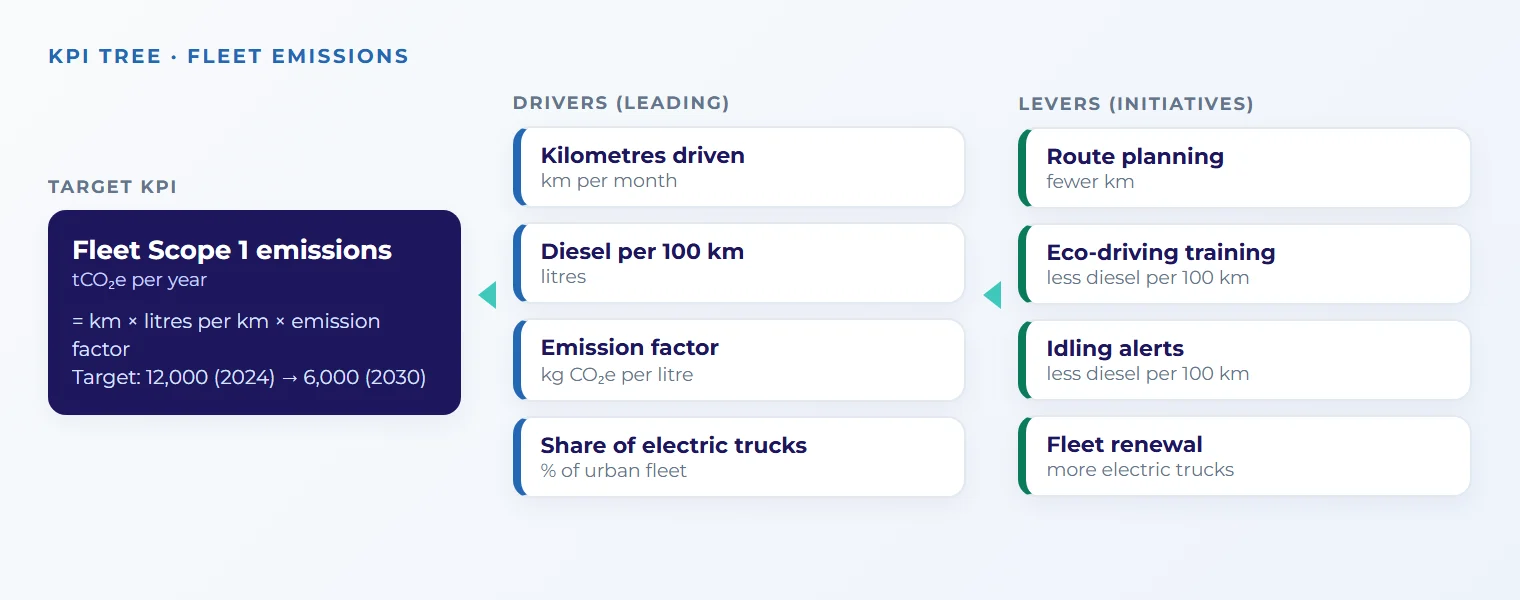
A KPI tree links each target to its drivers: fleet emissions (target KPI) = kilometres × litres per km × emission factor, plus the share of electric vehicles (drivers), moved by route planning, eco-driving and fleet renewal (levers). Keep the steering set to a handful of KPIs per topic.
KPI tree for fleet emissions: the target KPI, the drivers you can steer and the initiatives that move them.
Five building blocks of a steerable ESG target
Baseline and base year: a recent, representative year, measured with the same method as progress. Under ESRS E1, change it only after key changes in the target or boundary (application requirement (AR) 14).
Target value and year: absolute or intensity, unit, target year, milestones; per cent or percentage points.
Scope and method: sites, scopes, gases; for GHG, the GHG Protocol and the same boundary as your inventory (AR 16). Credits and removals do not count (AR 12).
Owner and budget: someone with budget and decision-making power.
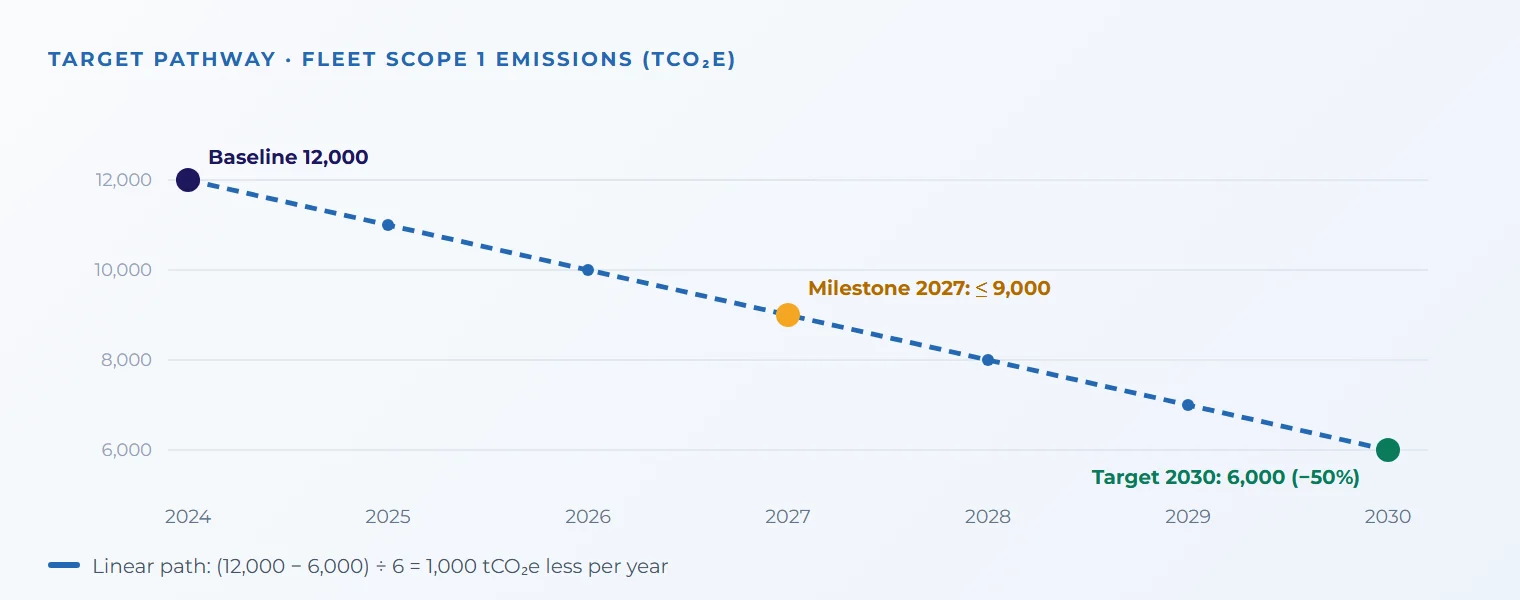
Target pathway from the KPI definition sheet: baseline 12,000 tCO2e (2024), milestone 9,000 tCO2e (2027), target 6,000 tCO2e (2030).
Absolute or intensity target?
Absolute target
Intensity target
Measures
Total tCO2e
tCO2e per unit of output (e.g. per €m revenue)
Risk
Looks worse in growth years
Emissions can rise while intensity falls
ESRS E1
Disclosure basis (paragraph 24(a))
Optional; absolute values still disclosed (AR 13)
Rule of thumb: steer on absolute targets; use intensity to explain why the absolute figure moved.
Science-based targets: what changes in 2027
Validation by the Science Based Targets initiative (SBTi) is voluntary, but ESRS E1 asks whether your targets are science-based and 1.5 °C-compatible (paragraph 24(c)). The SBTi Corporate Net-Zero Standard V2.0 takes effect on 1 February 2027:
near-term targets cover five years (C9.2);
the base year is the most recent year with complete data (C4.1);
base-year recalculation above a 5% significance threshold (C8.3);
annual progress reporting (C36).
An example OKR set
Example (fictional)
A logistics company with 400 trucks wants to halve fleet Scope 1 emissions from 12,000 tCO2e (2024) to 6,000 tCO2e (2030): (12,000 − 6,000) ÷ 6 = 1,000 tCO2e less per year, so the 2027 milestone is 9,000 tCO2e. Its OKR for the first quarter of 2027:
Level
Wording
Baseline → target
Objective
Our urban fleet runs noticeably cleaner
–
Key result 1
Share of electric trucks in urban delivery
8% → 15%
Key result 2
Diesel consumption per 100 km
31.0 → 29.1 litres (−6%)
Key result 3
Average idle time per truck and day
45 → 30 minutes
Initiatives
Eco-driving training; idling alerts; 20 new urban trucks
–
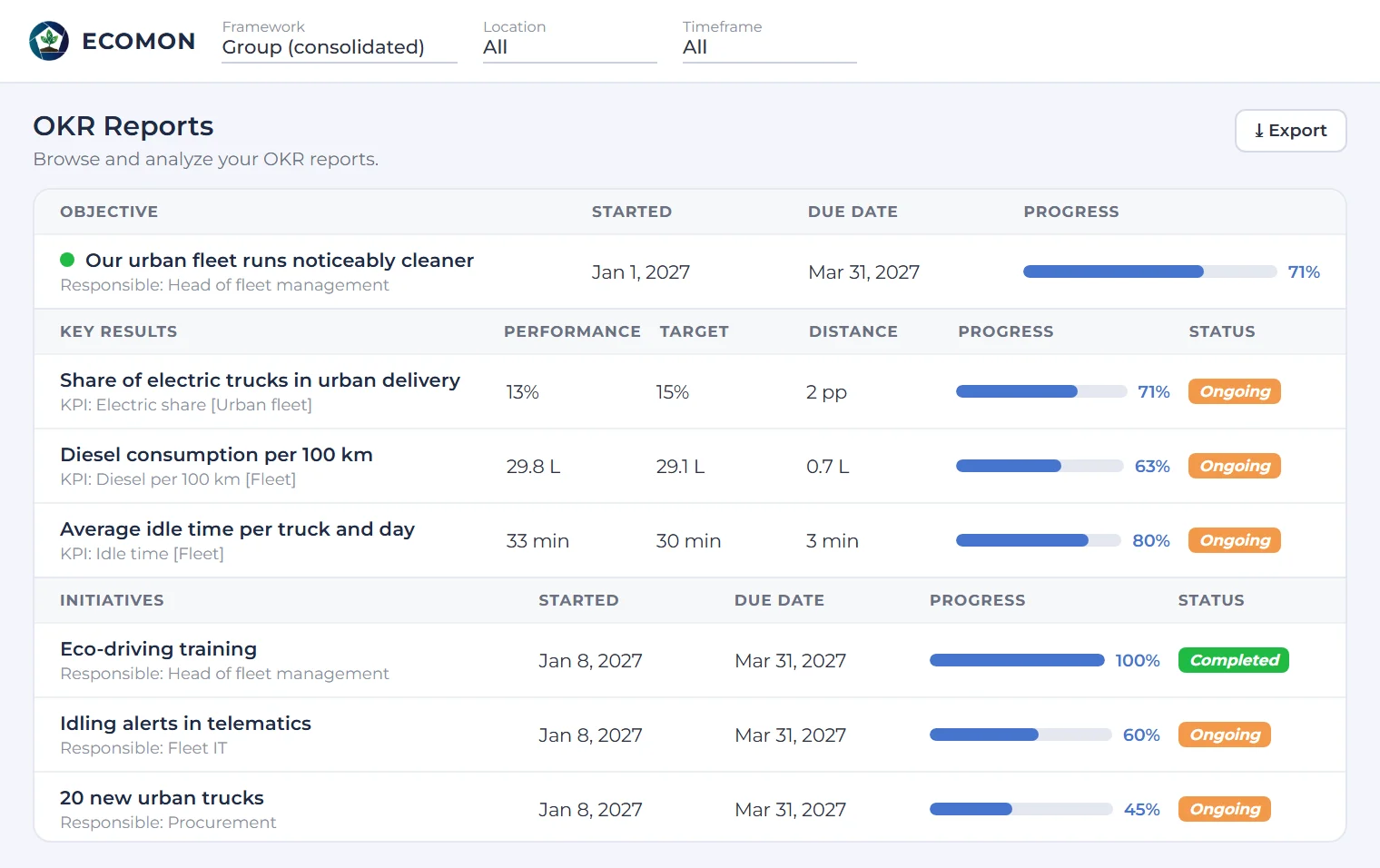
Scoring: progress achieved ÷ progress planned. Electric share 13% (5 of 7 percentage points: 0.71), diesel 29.8 litres (1.2 of 1.9: 0.63), idle time 33 minutes (12 of 15: 0.80); objective score (0.71 + 0.63 + 0.80) ÷ 3 = 0.71. Google’s re:Work guide treats 0.6–0.7 as the sweet spot for ambitious OKRs and recommends around three key results per objective.
Benchmarking: internal, industry and science-based
A KPI only tells you something next to a reference. Use three:
Benchmark
Question it answers
Where to find it
Internal
Are we improving year on year and across sites?
Your own data, measured with one method
Industry (peer)
How do we compare with companies of similar sector, size and region?
Peers’ sustainability statements (ESRS E1 from financial year 2027), sector associations
Make benchmarks comparable: match scopes, boundary, year and method, and normalise to a common denominator (e.g. tCO2e per €m revenue or per tonne produced). Use only peer figures with a named, dated source. The science-based benchmark is also your answer to ESRS E1’s question on 1.5 °C compatibility.
A common split: controlling owns data quality, the sustainability team owns methods and targets, the management board owns budget and trade-offs. If board pay is linked to sustainability targets, ESRS 2 asks how (GOV-2, paragraph 14) – link pay to verified KPIs, not OKR scores.
The link to the ESG report
Under the revised ESRS (Delegated Regulation (EU) 2026/1563, financial years from 1 January 2027), each target is disclosed under GDR-T (ESRS 2, paragraph 51): target value and unit, absolute or relative, scope, baseline and base year, target year and milestones, methods and assumptions, and whether it rests on scientific evidence. Progress is reported with the metrics (paragraph 49(d)).
Companies outside the Corporate Sustainability Reporting Directive (CSRD) can use the VS (Delegated Regulation (EU) 2026/1560; “VSME” is EFRAG’s earlier draft name). Its module C3 covers GHG targets: target and base year, values, units and scopes. OKRs are internal – no regulation requires them – but they produce exactly the data you disclose.
Common mistakes
Activities as key results: “launch a training” is an initiative.
Too many key results: around three per objective is enough.
Sandbagging: ambitious key results that always score 1.0.
Intensity-only climate targets that hide absolute growth.
No benchmark: a 3% reduction means little without an industry and a 1.5 °C reference.
Looking once a year: too late to correct course.
How ECOMON helps you make ESG targets measurable
ECOMON turns this guide’s five building blocks into a live steering system.
KPI trees, optional targets: build target KPIs from driver metrics such as litres per km; track them alone or add target ranges once the baseline is set.
Benchmarks per KPI: as many as you need – your own past, industry peers or a science-based pathway.
Central data, automated updates: one repository for values, comments and files, fed by imports or scheduled no-code workflows.
OKRs with owners and deadlines: link key results to KPI targets and initiatives; progress updates automatically from KPI data.
Notifications: alerts on target and benchmark breaches, KPI updates and OKR deadlines, so you notice early when you are off course.
KPIs and targets can be configured to align with ESRS and the VS; for the report itself, see FIESDA. Contact us for a demo.
Illustration of the example OKR set in an ECOMON OKR report, with the scores from the worked example (example data).
Frequently asked questions
What is the Objectives and Key Results (OKR) system?
A goal-setting system created by Andy Grove at Intel and popularised by John Doerr: each quarter you set a few qualitative objectives, each with around three measurable key results that are scored at the end of the cycle.
What is the difference between a KPI and an OKR?
A KPI is tracked continuously; an OKR changes a KPI within one cycle. The KPI shows where you are, the OKR what you change this quarter.
Do the ESRS require OKRs?
No. They require disclosures on targets and progress; how you steer is up to you.
What is a science-based benchmark?
The reduction pace a 1.5 °C pathway requires for your sector, for example from the SBTi’s sector pathways. It shows whether your target is ambitious enough, not just better than peers.
Do we need SBTi validation?
No law requires it; ESRS E1 asks whether your targets are science-based, and validation is one way to show it.
How to set a credible climate target – boundary, base year, absolute or intensity, ambition – and track it monthly so you notice deviations while you can still act.
How to import electricity, gas, heat and fuel data automatically – from grid operator portals and invoices to sub-meters – and turn it into ESRS-ready energy figures.