How to set a credible climate target – boundary, base year, absolute or intensity, ambition – and track it monthly so you notice deviations while you can still act.
easy4pro editorial team·Last reviewed: ·12 min read
Key takeaways
A climate target needs five building blocks: boundary (which scopes, sites and gases), base year, target value, target year and type (absolute or intensity).
Under the revised ESRS, GHG reduction targets are disclosed in absolute values and as gross targets: carbon credits, removals and avoided emissions do not count towards them (ESRS E1-6, AR 12–13).
You must state whether your targets are science-based and compatible with 1.5 °C. The SBTi Corporate Net-Zero Standard V2.0 is the most widely used yardstick, but validation is voluntary.
Split the target into a yearly pathway and track it monthly with a forecast. A gap that shows up in September can still be closed; one found in March cannot.
Write the recalculation rule down before you need it: acquisitions and method changes otherwise blur real progress.
“Climate neutral by 2040” appears in many mission statements. Whether such a target changes anything comes down to three questions: is it measurable, is it ambitious enough, and is progress tracked during the year – or only when the report is due?
This guide answers the questions sustainability managers and controllers ask when they turn a climate ambition into a working target: What exactly does a target have to define? Absolute or intensity? How ambitious is ambitious enough? What do the revised ESRS and the voluntary standard (VS) expect you to disclose? And how do you track the pathway so that a deviation shows up in time to act?
The five building blocks of a climate target
A target is only steerable when each of these is fixed in writing:
Building block
Question it answers
Example
Boundary
Which scopes, sites and gases does the target cover?
Scope 1 and 2, all four bakeries and the delivery fleet, all seven GHGs
Every figure rests on a sound inventory: the guide on the GHG inventory under the GHG Protocol shows how to build it. If your Scope 3 is large, the Scope 3 guide explains how to screen the 15 categories before you set a target for them.
Which Scope 2 method? The GHG Protocol’s Scope 2 Guidance gives two numbers: location-based (grid average) and market-based (your contracts and certificates). A target can use either, but the revised ESRS ask you to say which one (ESRS E1, AR 12). A market-based target rewards renewable electricity contracts; a location-based one does not. Choose deliberately and keep the choice.
Absolute or intensity – and why the ESRS insist on absolute values
An absolute target reduces total tonnes. An intensity target relates emissions to output, for example tCO2e per tonne of product or per €m of revenue.
Absolute target
Intensity target
Measures
Total tCO2e
tCO2e per unit of output
Strength
Directly linked to what the climate sees
Shows efficiency independent of growth
Risk
Looks worse in growth years
Emissions can rise while intensity falls
Revised ESRS
Basis of disclosure for Scopes 1, 2 and 3 (E1-6, paragraph 24(a))
Allowed in addition; if you only have an intensity target, disclose the associated absolute values for target and interim years (AR 13)
Rule of thumb: steer on an absolute target and use intensity to explain movement. If output grows by 10% and absolute emissions stay flat, intensity shows that efficiency did the work – but the absolute target tells you whether that is enough.
What this means for you: if your board only knows an intensity target, translate it into absolute tonnes for the target year now. You will have to disclose them anyway, and the number often starts a useful discussion.
How ambitious is ambitious enough?
The revised ESRS do not require a particular level of ambition, but they require transparency. Under ESRS E1-6, paragraph 24(c), you state whether your GHG reduction targets are science-based and compatible with limiting warming to 1.5 °C, which framework and methodology you used, whether you used a sectoral decarbonisation pathway and the underlying scenarios. You also explain briefly how you considered future developments such as sales volumes, customer demand, regulation and new technologies.
The most widely used yardstick is the Science Based Targets initiative (SBTi). Its Corporate Net-Zero Standard V2.0, published on 11 June 2026, sets five-year near-term targets with separate Scope 1 and Scope 2 targets, uses the most recent year with comprehensive data as the base year and requires recalculation after significant changes. Validations under V2.0 open on 1 February 2027. Under the earlier criteria, the cross-sector absolute contraction approach implied at least 4.2% reduction per year for 1.5 °C; the SBTi updated this approach in April 2026 so that the required rate also depends on the base year. Take official values from the SBTi’s tools, not from rules of thumb. The guide on SBTi target setting walks through V2.0 step by step.
SBTi validation is voluntary. A target can be credible without it – but if your target is weaker than a 1.5 °C pathway, say so plainly instead of implying alignment.
Base year and recalculation
The base year is the anchor of every progress figure. Three rules keep it reliable:
Choose a recent, representative year with complete data. The revised ESRS keep the base year unless key changes occur in the target or the reporting boundary (ESRS E1, AR 14).
Write a recalculation policy before you need it. The GHG Protocol asks companies to set their own policy and significance threshold; typical triggers are acquisitions, divestments, outsourcing and changes in calculation method. The SBTi V2.0 uses a 5% significance threshold for recalculation (chapter 2).
Separate method effects from real reductions. When better data replaces an estimate, recalculate the base year or show the method effect separately – otherwise a spreadsheet change looks like climate action.
Example: if the company in the example below buys a bakery that emitted 900 tCO2e in 2025, that is 7.5% of base-year emissions. Above a 5% threshold, the base year is recalculated to 12,900 tCO2e and the 2030 target to 7,740 tCO2e, so that the acquisition neither helps nor hurts the pathway.
From target to pathway: yearly milestones
A target in 2030 is too far away to steer. Split it into milestones. The simplest pathway is linear: the same reduction, as a share of the base year, every year.
Year
Milestone (tCO2e)
Reduction vs 2025
2025
12,000
base year
2026
11,040
−8%
2027
10,080
−16%
2028
9,120
−24%
2029
8,160
−32%
2030
7,200
−40%
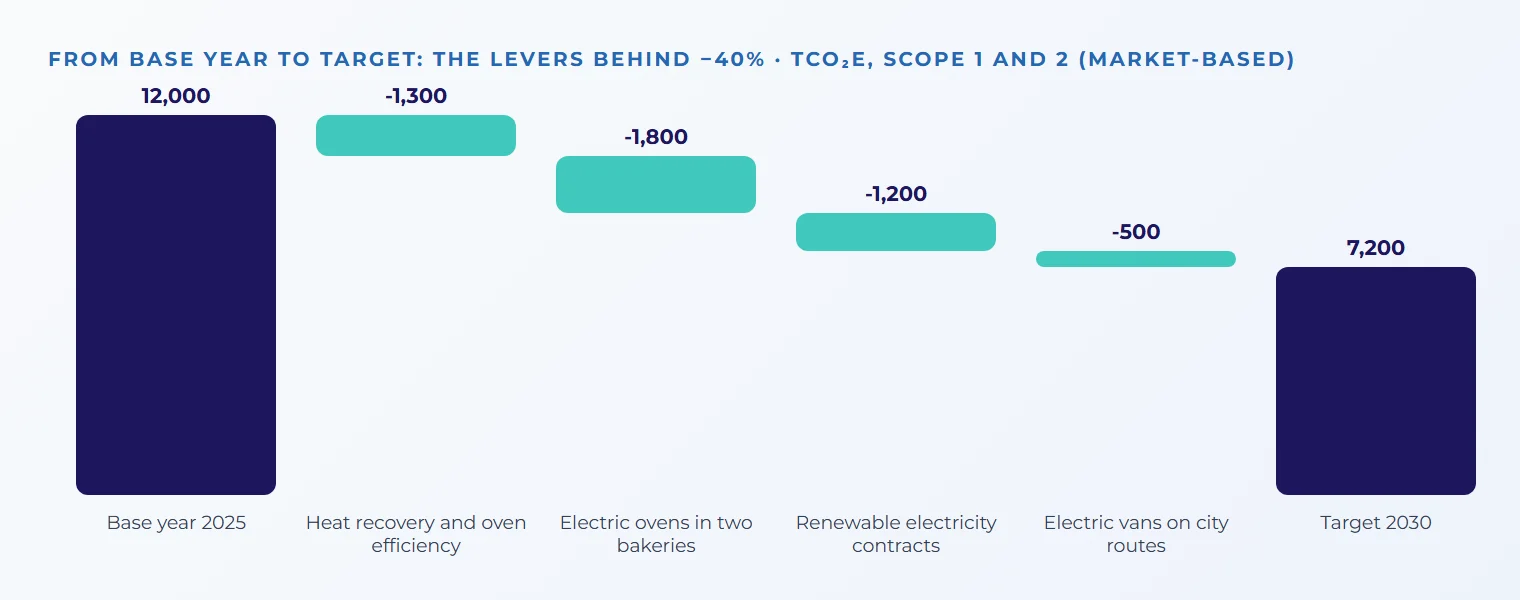
In practice reductions come in steps – a new furnace, a supply contract, a fleet replacement. Map each step to a lever with an expected effect, an owner and a date, so that the pathway is backed by actions rather than hope.
From base year to target: four levers, each with an expected effect, add up to −40% (fictional example).
Tracking the pathway during the year
An annual comparison comes too late: if you learn in March that last year’s milestone was missed, nothing can be changed. What works:
Monthly actuals for the big sources. Fuels and purchased energy make up most of Scope 1 and 2; the data is on meters and invoices anyway. The guide on capturing energy data automatically shows how to get it without retyping.
A monthly pathway, not just a yearly one. Emissions are seasonal – a bakery heats more in winter. Compare each month with its share of the yearly milestone.
A forecast for the year-end. Year-to-date actuals plus a forecast for the remaining months show whether the milestone is still reachable.
A quarterly review with owners. Decide what to change while it can still make a difference, and link actions to the target, for example as OKRs.
Example (fictional)
Bergbrot Backwaren GmbH, an Austrian bakery group with 950 employees and four bakeries, emitted 12,000 tCO2e in Scope 1 and 2 (market-based) in its base year 2025: gas ovens and heating, the delivery fleet, and purchased electricity and heat. The board sets an absolute target of −40% by 2030, backed by four levers: heat recovery and oven efficiency (−1,300 t), electric ovens in two bakeries (−1,800 t), renewable electricity contracts (−1,200 t) and electric vans on city routes (−500 t).
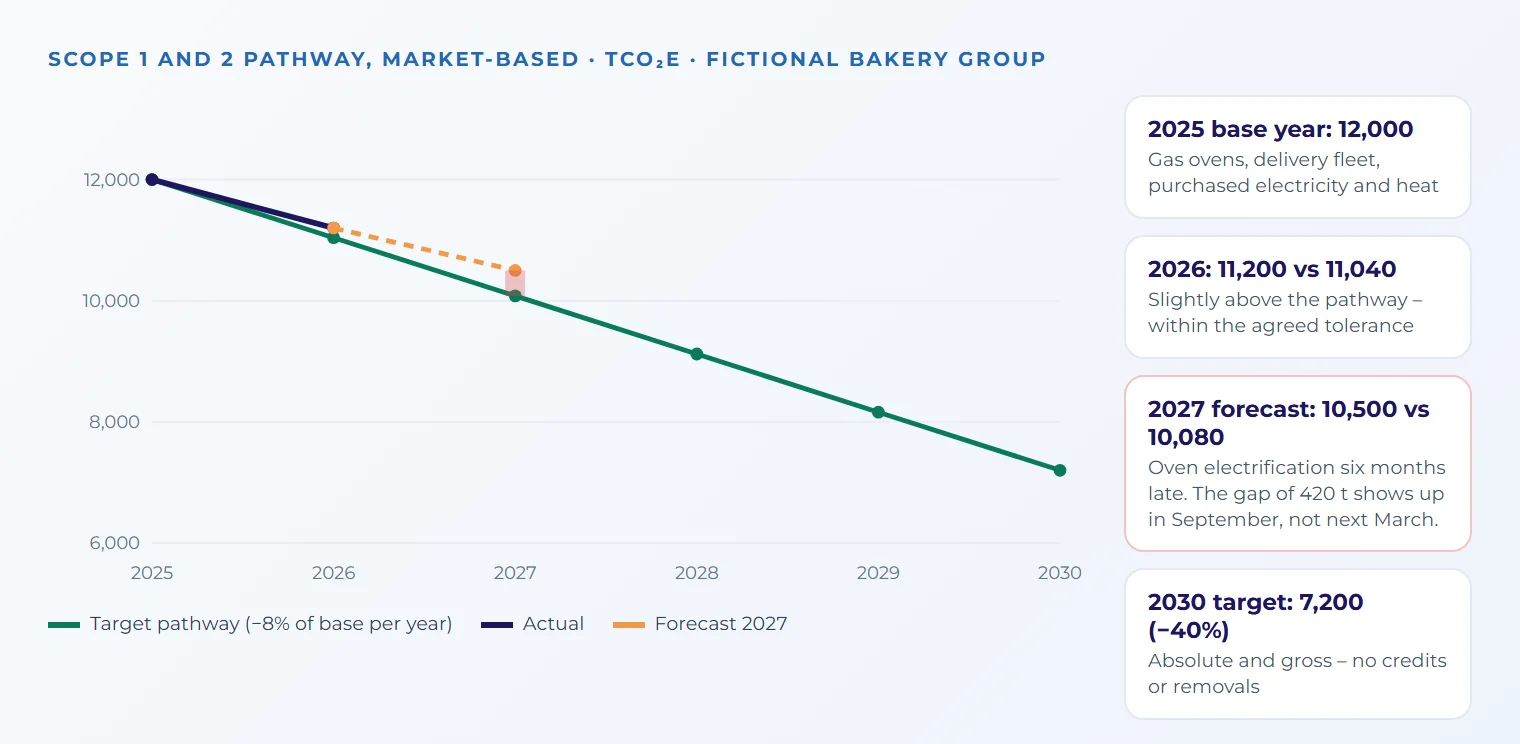
2026 closes at 11,200 t against a milestone of 11,040 t – slightly above, within the agreed tolerance. In September 2027 the monthly review shows 7,790 t year to date against a pathway of 7,400 t, and the forecast points to 10,500 t for the year against a milestone of 10,080 t. The cause: the grid connection for the electric ovens is six months late. The team brings forward heat recovery at the third bakery and extends the renewable supply contract to a second site. The gap and the response are documented for the progress disclosure.
The Bergbrot pathway: actual values, the 2027 forecast and the gap that shows up in September (fictional example).
What the revised ESRS and the voluntary standard ask for
Topic
Revised ESRS (CSRD reporters)
Voluntary standard (VS)
Legal basis
Delegated Regulation (EU) 2026/1563, ESRS E1-6 and ESRS 2 GDR-T; financial years from 1 January 2027
Climate change is material and you have set targets; if you have none, say so
If you have set GHG reduction targets; voluntary for undertakings with 10 employees or fewer
Content
Absolute targets for Scopes 1, 2 and 3 (separately or combined), coverage if the target scope differs from the inventory, and a statement on science-based and 1.5 °C compatibility (paragraph 24)
Absolute targets for Scope 1 and 2 (and significant Scope 3 if set): target year and value, base year and value, units, share of scopes covered, main actions
Rules
Gross targets: no removals, carbon credits or avoided emissions (AR 12); Scope 2 method stated; base year kept unless key changes (AR 14); net-zero targets explain how residual emissions are neutralised (AR 11)
–
Under ESRS 2, GDR-T, each target also needs its link to policies and actions, its scope, baseline and base year, milestones, methodology and assumptions. Progress is reported with the metrics. The guide on disclosing policies, actions and targets shows how the pieces fit together.
How to set and track a CO₂ target in six steps
Close the inventory for the base year. Scope 1 and 2 complete, Scope 3 screened; Scope 2 method chosen and documented.
Set boundary, target value and year. Absolute first; add an intensity metric for context. Check the ambition against a 1.5 °C pathway and record the result.
Write the recalculation policy. Triggers, significance threshold and who decides.
Back the target with levers. Each lever with an expected effect, owner, budget and date. The difference between the levers and the target is your planning gap.
Build the monthly pathway and forecast. Monthly actuals for the main sources, a seasonal pathway and a year-end forecast.
Review quarterly and adjust. Decide on corrective actions, document deviations and keep the evidence for the progress disclosure.
Common mistakes
A target without reliable base-year data: if the base year is estimated after the fact, every bit of progress can be challenged.
Intensity targets only: with growth, absolute emissions can still rise – and the revised ESRS ask for absolute values anyway.
Counting certificates as reductions: carbon credits do not count towards gross targets.
Ignoring Scope 3: if most emissions are in the supply chain, they need a target too.
Mixing Scope 2 methods: a market-based target tracked with location-based actuals produces phantom gaps.
No plan for recalculations: acquisitions then distort the pathway.
Looking once a year: too late to correct course.
How ECOMON helps you track CO₂ reduction targets
ECOMON turns a climate target into a pathway you can steer every month.
Emissions KPIs from source data: metrics for fuels, electricity and fleet roll up into metric groups and KPIs per site and for the group.
Health targets and benchmarks: set the yearly milestone as a target range on the KPI and add any number of benchmarks, such as the prior year or a 1.5 °C pathway.
Predicted values: ten selectable predictive models project the year-end from the data so far, so a gap shows up in the monthly chart.
OKRs linked to the target: key results tied to the emissions KPI, with initiatives, owners and deadlines for each lever.
Notifications and action history: alerts when a KPI leaves its target range or a deadline approaches, and a traceable record of every change.
KPIs and targets can be configured to align with the ESRS and the VS; for the sustainability statement itself, see FIESDA. Contact us for a demo.
Frequently asked questions
Do we need an absolute target if we already have an intensity target?
Under the revised ESRS, GHG reduction targets are disclosed in absolute values; if you only have an intensity target, you disclose the associated absolute values for the target year and interim years.
Can we count carbon credits towards our target?
No. Under ESRS E1, reduction targets are gross: removals, carbon credits and avoided emissions are not means of achieving them. You can report credits separately.
Do we need SBTi validation?
No law requires it. The ESRS ask whether your targets are science-based and compatible with 1.5 °C; validation is one way to show it.
Location-based or market-based Scope 2 for the target?
Either, as long as you state which and track progress with the same method. A market-based target reflects renewable electricity contracts; a location-based one does not.
When do we recalculate the base year?
When structural or method changes exceed the threshold in your recalculation policy, for example after an acquisition. Document each recalculation and its effect.
How often should we look at progress?
Monthly for the main emission sources, with a quarterly review against the pathway and a forecast for the year-end.
How to turn sustainability targets into steerable ESG KPIs and OKRs: base year, target value, benchmarks, review cycle, SBTi and ESRS rules, with a worked example.
How to import electricity, gas, heat and fuel data automatically – from grid operator portals and invoices to sub-meters – and turn it into ESRS-ready energy figures.