What the revised ESRS require on policies, actions, targets and metrics (GDR-P, GDR-A, GDR-M, GDR-T), and how to link your material topics to the numbers you report.
easy4pro editorial team·Last reviewed: ·9 min read
Key takeaways
For each material topic you disclose policies, actions, targets and metrics. The revised ESRS set this out in four general disclosure requirements in ESRS 2 (paragraphs 38–52): GDR-P, GDR-A, GDR-M and GDR-T – the successors of the minimum disclosure requirements (MDR) of the 2023 ESRS.
If a material topic has no policy, action or target, you must disclose that fact. Without measurable targets, explain whether and how you still track effectiveness.
Targets must be measurable, time-bound and outcome-oriented. For each, disclose the target value and unit, scope, baseline and base year (if defined), target year and milestones, methodology and whether the target is required by law.
ESMA’s enforcement priorities for 2026 annual reports of listed companies focus on connected information from impacts, risks and opportunities to policies, actions, targets and metrics – especially for climate (ESRS E1) and own workforce (ESRS S1).
The ESRS ask for more than numbers. For every material topic, readers want to know what the company has committed to, what it is actually doing, what it wants to achieve by when, and how progress is measured. Reviewers and enforcers check whether these pieces fit together.
This guide answers: What exactly do GDR-P, GDR-A, GDR-M and GDR-T require? Which version applies to your report? What if you have no policy or target yet? And how do you make the chain from material topic to metric visible?
Example (fictional)
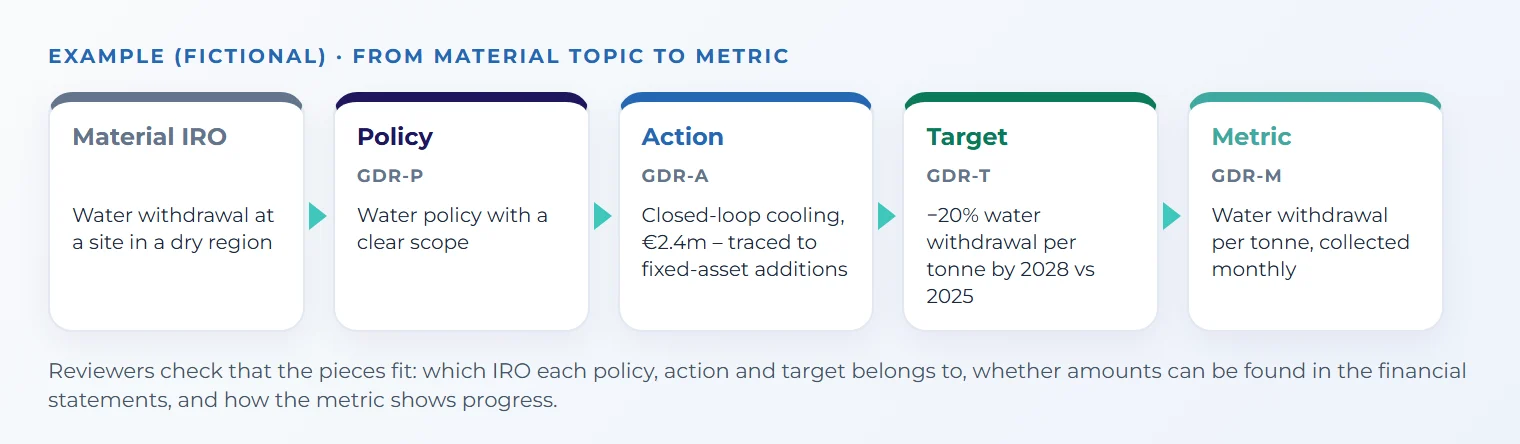
A food manufacturer with 1,600 employees assesses water withdrawal at a site in a dry region as material. The first draft of its statement has an environmental mission statement that mentions water only in passing, an action without a budget and no target. The team restructures it: a water policy with a clear scope, a closed-loop cooling project with an investment of €2.4m that can be traced to the fixed-asset additions in the financial statements, the target “reduce water withdrawal per tonne of product by 20 % by 2028 compared with 2025” and a metric collected every month. Now the chain from the material topic to the number can be followed.
The example as a chain: material IRO, policy (GDR-P), action with resources (GDR-A), target (GDR-T) and metric (GDR-M).
key contents and general objectives, the material impacts, risks or opportunities covered and changes during the year; scope or exclusions (own operations, upstream and downstream value chain, geographies, affected stakeholders); third-party standards the policy commits to; for social topics, how affected stakeholders’ interests were considered; whether an overarching human rights policy exists
Actions
GDR-A (paras 44–46)
key actions taken in the reporting year and planned, with timeframe, scope and expected outcomes; for significant financial resources (OpEx or CapEx): their type and any preconditions, the amount in the reporting period with the related line items in the financial statements, and an indicative range of future resources
Metrics
GDR-M (paras 47–49)
the metric, unit, calculation and estimation method, sources, significant assumptions and limitations; for value chain metrics, reliance on proxies and plans to improve data quality; contextual information; significant changes in performance, including progress towards targets
Targets
GDR-T (paras 50–52)
measurable, time-bound, outcome-oriented targets (qualitative or quantitative): link to policy objectives and actions, target value and unit (absolute or relative), scope, baseline value and base year if defined, target year and milestones, methodology and assumptions, whether required by law, scenarios and policy alignment where applicable, and for environmental targets whether they rest on conclusive scientific evidence
The four requirements always work together with the topical standards, such as ESRS E1 for climate change or ESRS S1 for the own workforce. Those standards refer back to the GDRs and add topic-specific items and metrics.
Two practical reliefs: if the same policy, action or target covers several topics, you may disclose it once and make its scope clear (AR 30). And the level of detail should be proportionate to the severity of the impact or the size of the risk or opportunity – avoid boilerplate (AR 32).
Which version applies to your report
Financial year
Standards you may use
Name of the requirements
2026
the 2023 ESRS as amended by the “quick fix” (Delegated Regulation (EU) 2025/1416), the revised ESRS, or the 2023 ESRS with the reliefs listed in Article 2 of Delegated Regulation (EU) 2026/1563
MDR-P, MDR-A, MDR-M, MDR-T (2023 ESRS) or GDR (revised ESRS)
What this means for you: for financial year 2026, state clearly which version you applied – ESMA stresses that the reliefs are exhaustive. The content of MDR and GDR is broadly similar, so a structure built now carries over to financial year 2027.
When something is missing
Not every company already has a policy, actions and targets for every material topic. The ESRS ask for honesty rather than filler:
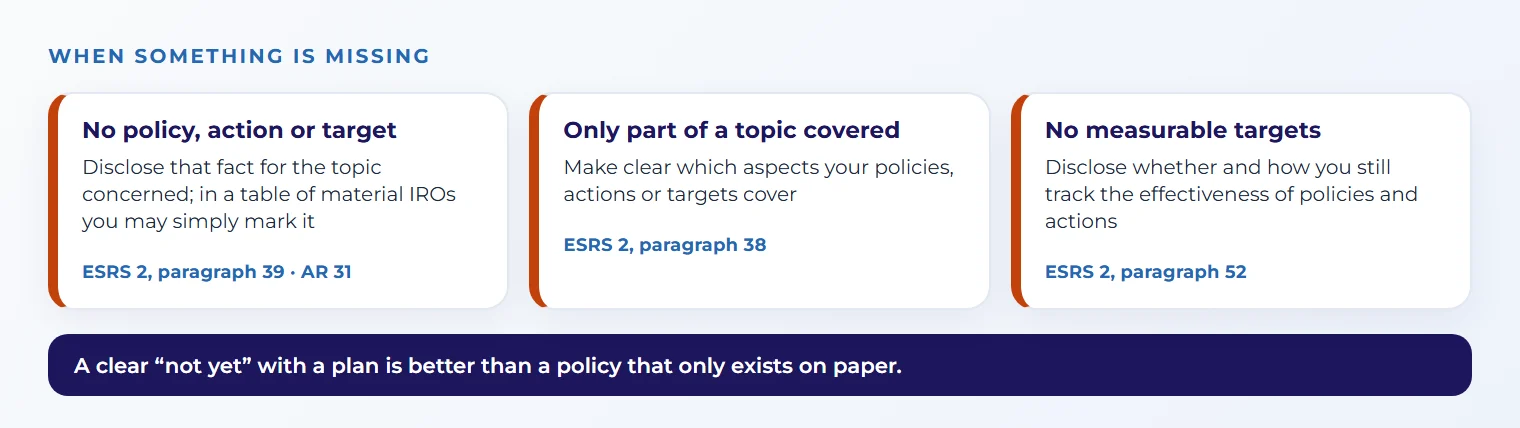
No policy, action or target: disclose this fact for the topic concerned (ESRS 2, paragraph 39). In a table of material impacts, risks and opportunities you may simply mark such topics (AR 31).
Only part of a topic covered: make clear in the presentation which aspects your policies, actions or targets cover (paragraph 38).
No measurable targets: disclose whether and how you nevertheless track the effectiveness of your policies and actions (paragraph 52).
Topic phased in: if you use a phase-in for a whole topical standard, you still disclose whether the topic is material and, if so, briefly describe policies, actions, targets and metrics (ESRS 2, BP-2, paragraphs 8–9).
What to disclose when a policy, action or target is missing or covers only part of a topic.
The link from materiality to metrics
In its statement on the European common enforcement priorities for 2026 corporate reporting of 13 October 2026, the European Securities and Markets Authority (ESMA) asks listed companies to provide connected information: from material impacts, risks and opportunities (IROs) through policies, actions and targets to the reported metrics. National enforcers will focus on climate change (ESRS E1) and own workforce (ESRS S1). ESMA expects issuers to:
state when there are no policies, actions or targets for a material IRO;
make clear when a target or policy covers only part of an IRO – for example only transition risks where the IRO also covers physical climate risks;
disclose the significant financial resources allocated to key actions;
set targets that are measurable, time-bound and outcome-oriented, and state clearly whether GHG targets are science-based and compatible with 1.5 °C;
disclose promptly if a target – many run to 2030 – can no longer be met.
This gives you good questions for your own review:
Which material IRO does each policy, action and target belong to?
What resources (capital and operating expenditure) go into the key actions, and can the amounts be found in the financial statements?
Is a target really a target, or only an intention without a value and a date?
Were earlier targets met, changed or dropped, and is that explained?
Climate targets: extra rules in ESRS E1
For climate, ESRS E1-6 adds specific requirements on top of GDR-T:
Absolute targets: disclose absolute GHG reduction targets for Scopes 1, 2 and 3 (separately or combined), and intensity values where relevant. If you only have an intensity target, disclose the associated absolute values for the target and interim years (AR 13).
Gross targets: GHG removals, carbon credits and avoided emissions may not count towards reduction targets (AR 12).
Science-based and 1.5 °C: state whether the targets are science-based and compatible with limiting warming to 1.5 °C, and which framework and methodology you used (paragraph 24(c)).
Base year: choose a recent and representative base year and do not change it unless the target or reporting boundary changes significantly (AR 14).
Net zero: if you disclose a net-zero target, explain how you intend to permanently neutralise residual emissions (AR 11).
Map existing policies. Environmental policy, code of conduct, supplier code, health and safety policy, human rights policy: which policy covers which topic, and how far does its scope reach?
Record actions with resources. Agree capital and operating expenditure with controlling so the amounts match the line items in the financial statements.
Sharpen the targets. Every quantitative target needs a target value, unit, baseline, base year and target year. A separate guide shows how OKRs make sustainability targets concrete.
Document the metrics. Method, source and assumptions belong to every number – your data point list is the basis.
Name the gaps openly. A clear “not yet” with a plan is better than a policy that only exists on paper.
Common weak spots
Generic mission statements with no visible link to the material topics.
Lists of actions without timeframe, scope or expected outcome.
Targets in the conditional: “We aim to reduce …” without a number or a year.
Changing methods: a metric is calculated differently from the prior year without explanation.
Amounts without a counterpart: investments in the sustainability statement that cannot be found in the financial statements.
Carbon credits counted as reductions: offsets presented as progress towards a GHG reduction target.
Disclosure is the end of the chain. A separate guide describes how to put policies into practice with owners, budgets and deadlines.
How FIESDA can help with ESRS and VS reporting
Linking each material topic to its policy, actions, targets and metrics is easier when the structure is already in place. FIESDA’s ESRS and VS reporting software provides:
Frameworks: ESRS and voluntary standard (VS) templates with the disclosure requirements as data points and integrated guidance, which you tailor to your materiality results.
Evidence: policy documents, CapEx figures and target calculations stored at each reporting issue; long policies summarised in Assets, with a person checking the summary.
Reports: a policy saved once and referenced under several topics, then exported as PDF or DOCX.
Frequently asked questions
What is the difference between MDR and GDR?
MDR (minimum disclosure requirements) is the term used in the 2023 ESRS; the revised ESRS call them general disclosure requirements (GDR-P, GDR-A, GDR-M, GDR-T) in ESRS 2. The purpose is the same: describe how you manage each material topic.
Do we need a policy for every material topic?
No. If you have none, disclose that fact. Readers and enforcers then see the gap – and whether you plan to close it.
Can one policy cover several topics?
Yes. You may disclose it once and make its scope clear, then cross-refer to it from other topics.
Must targets be quantitative?
No. Targets can be qualitative or quantitative, but they must be measurable, time-bound and outcome-oriented.
Do we have to disclose the budget of every action?
Only where significant financial resources have been or will be allocated to key actions. Then you disclose the amount, the related line items in the financial statements and an indicative range for the future.
How to plan and report your climate transition under the revised ESRS E1-1, the voluntary standard (VSME) and IFRS S2, and what Omnibus I changed for transition plans.
How to structure the sustainability statement under the ESRS, write it clearly and in a balanced way, and link it to the management report and financial statements.
Which revised ESRS datapoints apply to you, how materiality, reliefs and phase-ins filter them, and how to use EFRAG’s Excel list and prepare for XBRL tagging.