How to collect ESG data from suppliers and customers, when estimates are allowed, and what the value-chain cap means for your data requests from financial year 2027.
easy4pro editorial team·Last reviewed: ·8 min read
Key takeaways
Under the revised ESRS you may collect value chain data directly from business partners or estimate it – with sector averages, samples, peer data, spend-based data or other proxies.
From financial years starting on or after 1 January 2027, you may not require more from partners with on average no more than 1,000 employees than the datapoints listed in Annex II of the voluntary standard (VS) – the “value-chain cap”.
The cap list is short and depends on size: partners with 10 employees or fewer are not covered for energy, GHG, water or waste data at all.
You may still ask for more, but you must flag which questions go beyond the cap and that partners may decline. Contract clauses that require more are not binding.
For your first three reporting years, missing value chain data is acceptable if you explain your efforts, the reasons and your plan to close the gaps.
Many disclosures in the sustainability statement go beyond your own company: Scope 3 emissions, working conditions at suppliers, materials in purchased products. The data sits with others. Collect it without a plan and you send long questionnaires, get few answers – and annoy exactly the partners you depend on.
This guide answers three questions: When may you estimate instead of asking? What may you still request from smaller suppliers once the value-chain cap applies? And how do you build a request that suppliers actually answer?
Example (fictional)
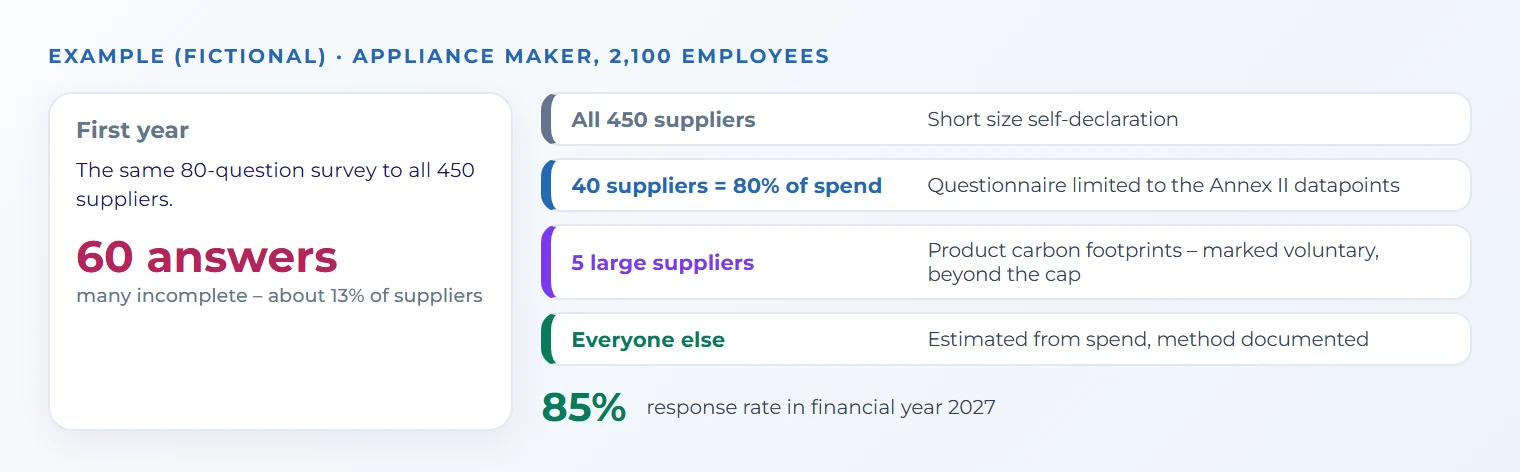
In its first year, an appliance maker with 2,100 employees and €700m turnover sends the same 80-question survey to all 450 suppliers. It gets 60 answers back, many incomplete. For financial year 2027 it changes course: it asks every supplier for a short size self-declaration, focuses on the 40 suppliers that make up 80 % of its spend and limits the questionnaire to the datapoints in Annex II of the voluntary standard. Five large suppliers are asked in addition for product carbon footprints – marked as voluntary and beyond the cap. Everything else is estimated from spend. The response rate rises to 85 %.
The appliance maker example: from one long survey to a targeted request based on size, spend and the value-chain cap.
Collect or estimate?
The revised ESRS allow both. Under ESRS 1, paragraph 65, you can obtain value chain information directly from business partners or estimate it, depending on how practicable and reliable the necessary inputs are. For estimates, ESRS 1 explicitly mentions:
data from indirect sources,
sector-average data,
sample analyses,
market and peer group data,
spend-based data and other proxies.
Three further rules keep the effort in proportion:
Only material information: you do not need information on every actor in the value chain, only material information (ESRS 1, paragraph 64).
Reasonable effort: use the reasonable and supportable information that is available without undue cost or effort (ESRS 1, paragraph 93).
Mostly own operations: the metrics in the topical standards cover your own operations – with the exception of GHG emissions (ESRS E1-8). Value chain metrics beyond that are only needed where an entity-specific metric is necessary (ESRS 1, AR 38).
For each value chain metric, state whether it relies on indirect sources or proxies and how you plan to improve data quality (ESRS 2, GDR-M, paragraph 49(b)). An estimate is no flaw – an undocumented one is.
The value-chain cap
Omnibus I (Directive (EU) 2026/470) introduced an upper limit on what companies in the CSRD scope may require from smaller partners for their sustainability statement (Article 19a(3) and 29a(3) of the Accounting Directive). The voluntary standard in Delegated Regulation (EU) 2026/1560 defines that limit. It applies to financial years beginning on or after 1 January 2027.
Question
Rule
Who is protected?
Undertakings in your value chain that, on their balance sheet date, do not exceed an average of 1,000 employees in the preceding financial year – inside and outside the EU (ESRS 1, paragraph 66).
How do I know their size?
You may rely on the partner’s self-declaration and do not have to verify it – unless you know or should know it is manifestly incorrect.
What is capped?
Only the datapoints in Annex II of the voluntary standard (Article 3(2) of Delegated Regulation (EU) 2026/1560) – not the full standard.
Which requests are covered?
Requests made for your CSRD sustainability reporting, directly or indirectly (for example through a tier-1 supplier).
May I ask for more?
Yes, but you must tell the partner which items go beyond the cap and that it has a statutory right to decline. Contract clauses requiring more information for CSRD reporting are not binding.
What is not covered?
Information shared voluntarily, and requests for other purposes – for example due diligence under EU law such as the CSDDD, or your own risk management.
If you report your value chain information without requiring anything beyond the cap, you are deemed to comply with the value chain reporting obligation. ESRS 1, paragraph 66, requires you to take the cap into account when collecting data.
What this means for you: the prohibition sits in the Accounting Directive and takes effect through national law – Member States must transpose Omnibus I by 19 March 2027. The list of capped datapoints is set directly by the voluntary standard. Check how your country has implemented the rule.
Datapoints covered by the cap
Annex II of the voluntary standard lists 23 datapoints from its basic module (B) and comprehensive module (C). Only “essential” datapoints are covered (Recital 4), and the list is shorter for the smallest partners:
Disclosure (voluntary standard)
Partners with 10 employees or fewer
Partners with more than 10 employees
B1 Basis for preparation: module chosen, individual or consolidated basis, general information
B7 Circular economy principles, total waste (hazardous and non-hazardous), share recycled or reused
–
yes
B8 Number of employees by contract type and by gender
yes
yes
B9 Number and rate of recordable work-related accidents
yes
yes
B10 Pay at or above minimum wage, collective bargaining coverage, average training hours
yes
yes
C1 Main products and services, markets and business relationships
–
yes
C5 Employee turnover rate
–
yes
C6 Code of conduct or human rights policy, complaints-handling mechanism
–
yes
C7 Confirmed incidents in the own workforce and involving value chain workers, communities or consumers
–
yes
What this means for you: Scope 3 emissions, product carbon footprints and material composition are not on the list. For protected partners you have to ask for them on a voluntary basis (with the notice above) or estimate them. Even within the cap, ask only for what you actually need (Recital 4).
Five steps to reliable data
Derive the need from materiality. Only ask for what your material topics require. Your data point list shows which disclosures concern the value chain.
Prioritise partners. Sort by spend, emission intensity of the industry and risk, for example for raw materials from high-risk countries. A few partners often cover most of it.
Ask consistently. Start with a size self-declaration, then a short questionnaire based on the Annex II datapoints, with clear units, periods and a deadline. Mark every question beyond the cap as voluntary. Partners that already have a report under the voluntary standard simply send that.
Estimate the gaps. Use spend-based or sector values for partners that do not answer and record the method. For Scope 3 this is the usual starting point – more in the guide on the greenhouse gas inventory.
Refine every year. Replace estimates with primary data from key partners and track the share of measured values. During your first three reporting years, document your efforts, the reasons for gaps and your plans (ESRS 1, paragraph 123).
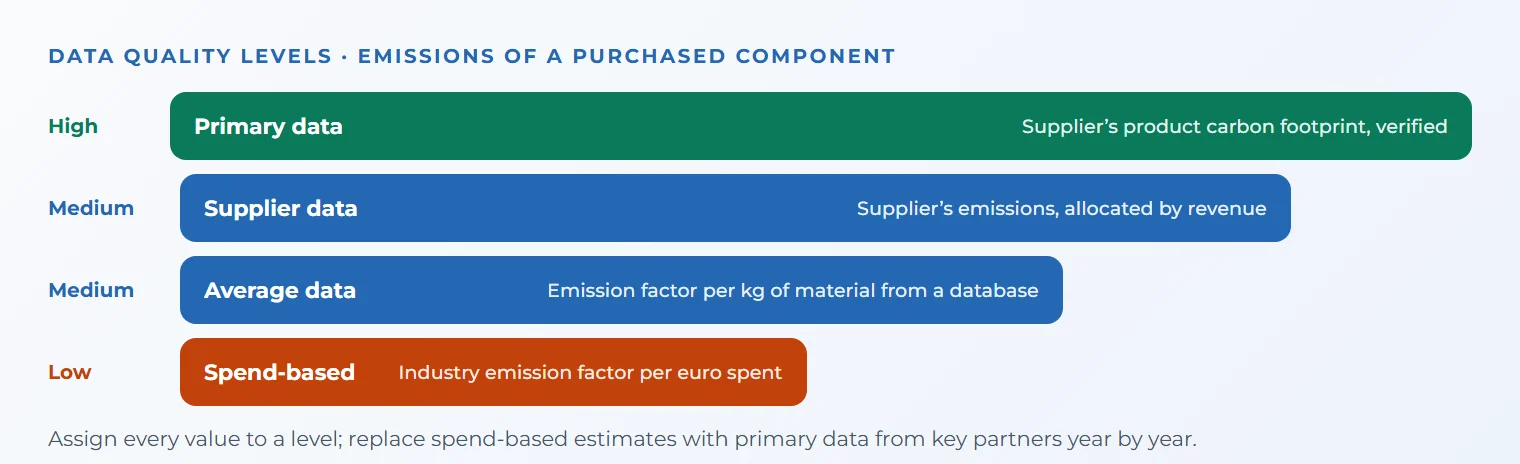
Make data quality visible
Quality level
Example: emissions of a purchased component
Reliability
Primary data
supplier’s product carbon footprint, verified
high
Supplier data
supplier’s emissions, allocated by revenue
medium
Average data
emission factor per kilogram of material from a database
medium
Spend-based
industry emission factor per euro spent
low
Assign every value to a level. That shows where follow-up pays off and lets you explain honestly in the report how robust your value chain disclosures are. If you can report a metric only for part of the value chain, say so and describe how you will increase coverage (ESRS 1, paragraph 91 – except for GHG emissions under ESRS E1-8).
The four data quality levels from the table above, from verified primary data to spend-based estimates.
Make it easy for suppliers
Ask briefly: explain for each question why you need the information.
Accept what exists: reports under the voluntary standard, CDP responses or EcoVadis results instead of your own forms.
Ask in time: with enough lead time before your own reporting deadline.
Give something back: share results or support data collection – it raises the response rate next year.
How FIESDA can help with value chain data collection for sustainability reporting
Collecting supplier ESG data means chasing answers, reading long documents and keeping evidence for every estimate. FIESDA’s flexible ESG reporting software supports data collection, storage and management for ESG reporting in the following way:
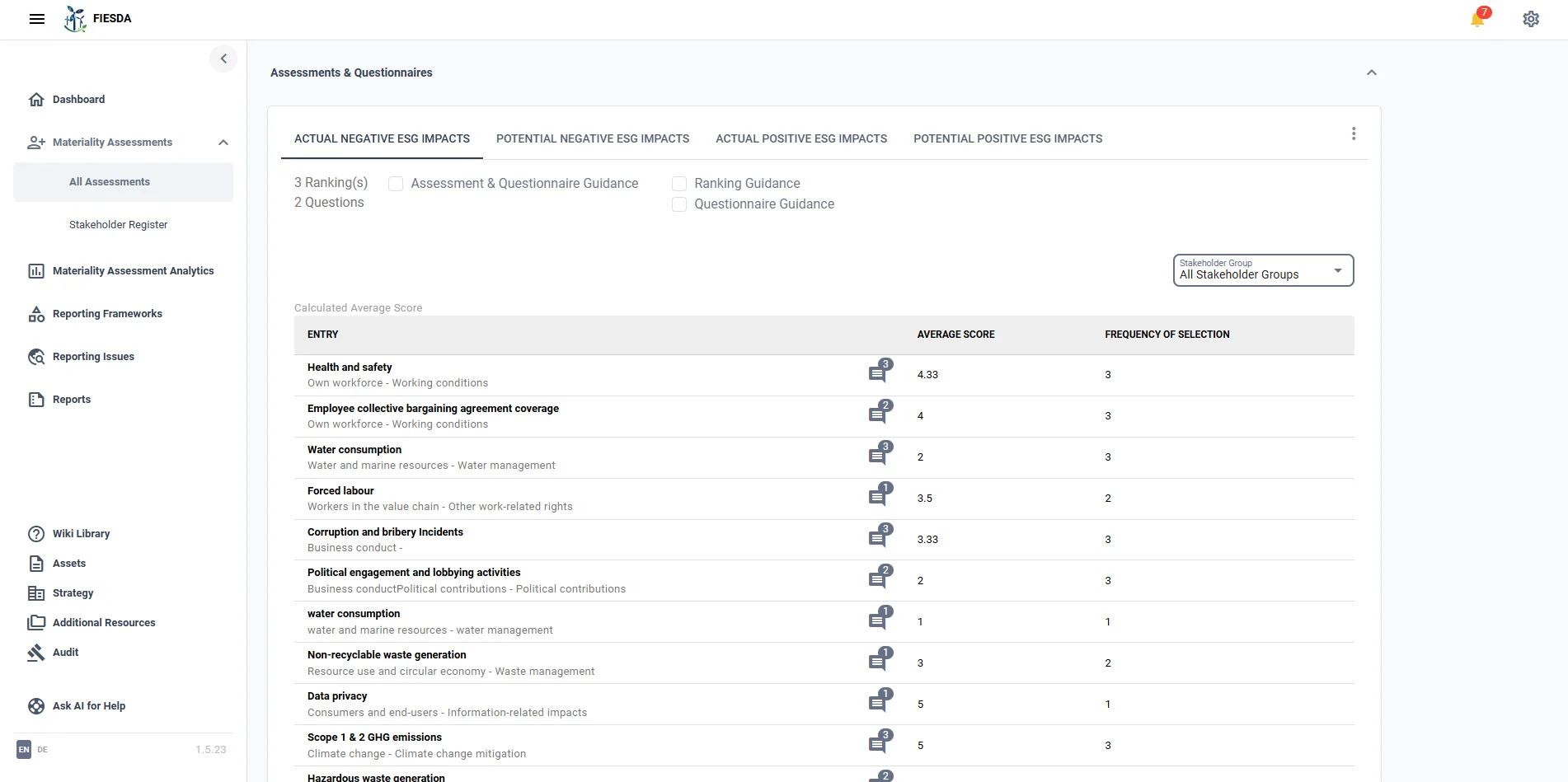
Ask: send suppliers a questionnaire by email link and see the answers consolidated per question; mark items beyond the value-chain cap as voluntary.
Analyse: upload CDP responses or VS reports to Assets for AI summaries and ESG topic relevance scores, and check the figures yourself.
Report: store answers and estimation methods at each reporting issue, then build and export the report from them.
Consolidated assessment results in FIESDA: average score, frequency of selection and comments per entry, filterable by stakeholder group – for example to see only your suppliers’ answers.
Frequently asked questions
Does the value-chain cap apply to my report for financial year 2026?
No. It applies to financial years beginning on or after 1 January 2027.
Do I have to check a supplier’s headcount?
No. You may rely on the supplier’s self-declaration, unless you know or should know that it is manifestly incorrect.
May I keep sending my existing long questionnaire?
Yes, but for protected partners you must flag the questions that go beyond Annex II and point out their right to decline. You cannot make that information a contractual obligation for CSRD purposes.
Does the cap limit supply chain due diligence requests?
No. Requests for other purposes, including EU due diligence obligations, are not covered by the cap.
What if suppliers do not answer at all?
Estimate the data and document the method. In your first three reporting years, also explain your efforts and plans; afterwards, use direct data or estimates as appropriate.
Which revised ESRS datapoints apply to you, how materiality, reliefs and phase-ins filter them, and how to use EFRAG’s Excel list and prepare for XBRL tagging.
How to plan ESG data collection for the revised ESRS or the voluntary standard (VSME): choose datapoints, assign owners, secure evidence, run a reliable reporting year.