Which Voluntary Standard (VS) datapoints SMEs need, what the value-chain cap protects and how to use EFRAG’s Digital Template and XBRL converter.
easy4pro editorial team·Last reviewed: ·10 min read
Key takeaways
The Voluntary Standard (Delegated Regulation (EU) 2026/1560) has a Basic Module (B1 to B11) and a Comprehensive Module (C1 to C9). Using it is optional.
It also acts as the value-chain cap: CSRD reporters may not require more from undertakings with an average of up to 1,000 employees, for their own sustainability reporting. The cap applies to financial years beginning on or after 1 January 2027.
Start with the Basic Module. Add the Comprehensive Module only for requests you actually receive.
EFRAG’s VS Digital Template (version 2.0.0, 4 November 2026) and its free converter turn a completed Excel file into a tagged Inline XBRL report, so you do not tag by hand.
If a bank, a customer or an investor sends you a sustainability questionnaire, the Voluntary Standard (VS) is the answer EU law now gives smaller companies: one standard report, and a cap on how much a CSRD reporter may demand from you. This guide shows which VS datapoints you need, what the value-chain cap protects, and how to use EFRAG’s Digital Template and the XBRL converter. Companies that must report under the CSRD follow the revised ESRS; see our companion guide on ESRS datapoints.
Does the Voluntary Standard apply to you?
The Voluntary Standard is written for undertakings that are not subject to mandatory sustainability reporting and that are protected by the value-chain cap. Use the table to place yourself.
Your situation
Framework
What it means for you
Not in CSRD scope, average of up to 1,000 employees
Voluntary Standard (optional)
You can answer customer, bank and investor requests with one report, and the value-chain cap protects you.
Not in CSRD scope, more than 1,000 employees
No CSRD duty
The cap does not protect you. The Voluntary Standard is written for undertakings protected by the cap, so it is not aimed at you.
In CSRD scope (for example more than 1,000 employees and more than €450m net turnover)
Revised ESRS
You report under the ESRS and must not ask protected suppliers for more than the cap allows. See our companion guide on ESRS datapoints.
What this means for you: if you are an SME with up to 1,000 employees, read on. If you are a CSRD reporter, the sections on the value-chain cap show what you may ask your suppliers.
Example (fictional)
Weber Verpackungen GmbH is a German packaging manufacturer with 85 employees. A large customer that reports under the CSRD sends a 70-question sustainability questionnaire and asks for a reply within a month. Weber is not in CSRD scope and is far below 1,000 employees, so the value-chain cap protects it for the customer’s CSRD reporting from financial year 2027.
Weber prepares the Basic Module once, from one full financial year of energy, emissions, workforce and conduct data, and sends it as its answer. With 85 employees it cannot use the relief for undertakings with 10 employees or fewer. When the customer asks for items beyond the cap for its CSRD reporting, Weber may decline them and the customer must say which items go beyond the limits. If a request rests on other laws or purposes outside sustainability reporting, the cap does not apply, so Weber checks the basis of each request. A year later a bank asks for climate transition and human rights data, so Weber adds the matching Comprehensive Module disclosures to the same report.
Voluntary Standard datapoints: Basic and Comprehensive Module
The Voluntary Standard (VS) in Delegated Regulation (EU) 2026/1560 is based on the VSME of Commission Recommendation (EU) 2025/1710 and keeps its two-module structure. It was adopted on 3 July 2026 and published in the Official Journal on 21 September 2026. Under Article 4 it enters into force on the third day after publication (24 September 2026), and the value-chain cap (Article 3) applies to financial years beginning on or after 1 January 2027. Its official title describes it as sustainability reporting standards for voluntary use by undertakings protected by the value chain cap. Unlike the recommendation, it is EU law, and using it is still optional. EFRAG’s Knowledge Hub publishes the text.
Module
Disclosures
Basic Module (minimum for all users, target approach for micro-undertakings)
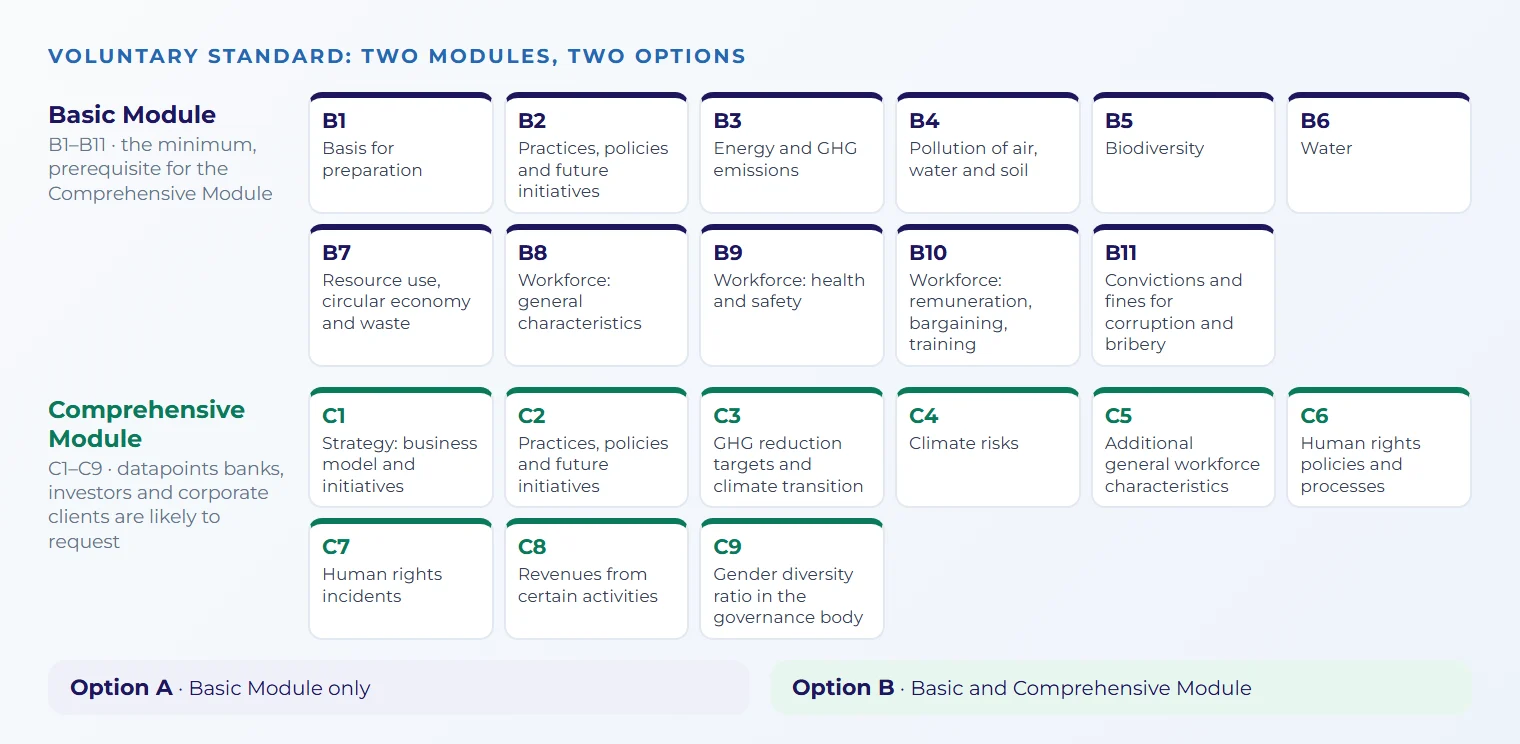
B1 Basis for preparation; B2 Practices, policies and future initiatives for transitioning towards a more sustainable economy; B3 Energy and greenhouse gas emissions; B4 Pollution of air, water and soil; B5 Biodiversity; B6 Water; B7 Resource use, circular economy and waste management; B8 Workforce: general characteristics; B9 Workforce: health and safety; B10 Workforce: remuneration, collective bargaining and training; B11 Convictions and fines for corruption and bribery
Comprehensive Module (adds datapoints that banks, investors and corporate clients are likely to request)
C1 Strategy: business model and sustainability-related initiatives; C2 Practices, policies and future initiatives; C3 GHG reduction targets and climate transition; C4 Climate risks; C5 Additional general workforce characteristics; C6 Human rights policies and processes; C7 Human rights incidents; C8 Revenues from certain activities; C9 Gender diversity ratio in the governance body
The Basic Module (B1–B11) and the Comprehensive Module (C1–C9), and the two reporting options.
You choose Option A (Basic Module only) or Option B (Basic and Comprehensive Module) and state your choice with an explicit statement of compliance. The Basic Module is a prerequisite for the Comprehensive Module. The standard distinguishes four categories of datapoints: essential ones that must be reported, ones needed only in specified circumstances under the “if applicable” principle, voluntary ones, and ones considered only for sector-specific reporting. Some essential datapoints, marked in square brackets, are voluntary for undertakings with 10 employees or fewer, for example in B3, B6 and B7 and in C1, C3, C4, C6 and C7.
What this means for you: if you are an SME, report the Basic Module first. It answers most questionnaires, and the Comprehensive Module is worth adding only when a bank or key customer asks for it.
The value-chain cap
The cap protects undertakings in the value chain that do not exceed an average of 1,000 employees in the preceding financial year (Articles 1 and 3 of Delegated Regulation (EU) 2026/1560). Reporting undertakings may not require more than the VS provides for, and protected undertakings may decline to provide more. The reporting undertaking must tell them which information goes beyond the limits. Contract terms that demand more are not binding. The cap covers only the datapoints specified in Annex II of the regulation, which, according to the Commission’s Q&A, are all disclosures marked “necessary” in both modules. The cap does not apply to due diligence or other purposes outside sustainability reporting.
What this means for you: as a protected SME, check the purpose of every request. For a customer’s CSRD reporting, the Annex II datapoints are the limit; for other legal obligations, the cap does not apply.
Using the VS Digital Template to structure your report
EFRAG’s Digital Template turns the legal text into a working register. It is not legally binding; the legal text is the annex of the regulation.
EFRAG’s VS Digital Template and XBRL Taxonomy page offers Digital Template version 2.0.0 (Excel, published 4 November 2026), a pre-filled example, the VS XBRL Taxonomy package version 2.0.0 and an explanatory note. EFRAG states it is built for undertakings not subject to mandatory sustainability reporting that report voluntarily, and words the size limit as fewer than 1,000 employees. The regulation itself uses an average of up to 1,000 employees, so rely on the regulation. The converter turns the completed template into a tagged Inline XBRL report with full XBRL validation. EFRAG describes it as free and its source code as open source under the MIT licence, so software providers can reuse it; the online tool’s own terms limit its use to personal and non-commercial purposes, so commercial users should integrate the published code instead. EFRAG developed the template in Microsoft Excel 365 and warns that other spreadsheet applications or older Excel versions may limit its functions. The release announcement mentions more translations and a faster path from reporting to digital disclosure.
How to use it
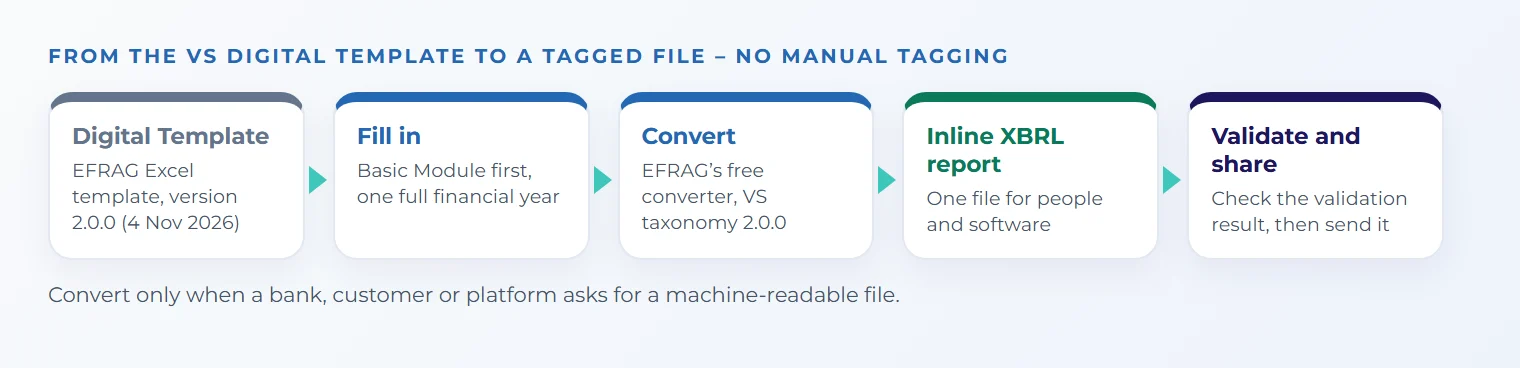
Start with the Basic Module and collect energy, emissions, workforce and conduct data for one full financial year.
Add Comprehensive Module disclosures only for requests you actually receive.
Convert to Inline XBRL if a bank, customer or platform asks for a machine-readable file.
Reuse the same report for every questionnaire and update it once a year.
What this means for you: the template is the real work. Once each datapoint has a value, a unit, an owner and a source, the report, the tagging and the answers to customer questionnaires all draw on the same data.
XBRL and ESAP for the Voluntary Standard
XBRL is a standard for machine-readable reporting. In Inline XBRL the tags sit inside the human-readable report file, so one document serves both readers and software. A taxonomy is the dictionary of tags.
The VS taxonomy exists in a finished version (package 2.0.0). EFRAG’s October 2025 explanatory note says the VSME taxonomy can be used as a template, which makes manual tagging unnecessary. A small company can therefore fill in the template and convert it.
The European Single Access Point (ESAP) will make company disclosures publicly accessible. Regulation (EU) 2023/2859 requires ESMA to establish it by 10 July 2027. ESMA says public access follows by July 2027, with further information phases starting in January 2028 and January 2029. Check ESMA for the phase that covers sustainability statements.
What this means for you: you do not need to learn XBRL. Fill in the template, run the converter and check the validation result before you share the file.
From EFRAG's VS Digital Template to a validated Inline XBRL file, without manual tagging.
Names that get confused
Term you may see
What it means
VSME vs Voluntary Standard (VS)
VSME is EFRAG’s standard, published as a Commission recommendation. The VS is the delegated regulation based on it and is EU law.
Basic Module vs Comprehensive Module
The Basic Module (B1 to B11) is the minimum. The Comprehensive Module (C1 to C9) is an optional addition.
Value-chain cap
The limit on what CSRD reporters may require from protected undertakings in their value chains. It is not a size limit for using the VS.
XBRL, Inline XBRL, ESAP
XBRL is the tagging language, Inline XBRL embeds tags in the report, and ESAP is the public access platform.
How FIESDA can help with VS datapoints and XBRL
Filling in the VS datapoints is easier when every disclosure comes with an explanation. FIESDA’s VSME report template lists the VS disclosures as data points with guidance on what each asks, so data owners can complete them without reading the regulation. Saved disclosures can be reused across questionnaires. For a machine-readable file, you can tag the report with the VS XBRL taxonomy in FIESDA, validate it and export it in XBRL. You still choose Option A or B.
Frequently asked questions
Is the Voluntary Standard mandatory?
No. Using it is optional. Its value is that one report can answer many customer, bank and investor requests, and that the value-chain cap limits what CSRD reporters may require from you.
Is a 2025 VSME report still useful?
Yes, as a starting point. The Voluntary Standard keeps the modular structure of the VSME, but check the differences and use the updated EFRAG template (version 2.0.0) before you call your report one under the Voluntary Standard.
Can a customer’s bank still ask me for more than the Voluntary Standard?
Yes, if the request rests on other laws or purposes outside sustainability reporting. The value-chain cap limits what CSRD reporters may require for their own sustainability reporting.
Does the cap protect me if I have 1,200 employees?
No. The cap protects undertakings that do not exceed an average of 1,000 employees in the preceding financial year.
Do I need to learn XBRL to use the template?
No. EFRAG’s October 2025 explanatory note says the taxonomy can be used as a template, which makes manual tagging unnecessary. You fill in the Excel file and convert it.
Which revised ESRS datapoints apply to you, how materiality, reliefs and phase-ins filter them, and how to use EFRAG’s Excel list and prepare for XBRL tagging.
How to plan ESG data collection for the revised ESRS or the voluntary standard (VSME): choose datapoints, assign owners, secure evidence, run a reliable reporting year.
How to collect ESG data from suppliers and customers, when estimates are allowed, and what the value-chain cap means for your data requests from financial year 2027.