What CSRD assurance covers, what Omnibus I changed, who may assure your report in Austria and Germany, and how to prepare for your first limited assurance engagement.
easy4pro editorial team·Last reviewed: ·9 min read
Key takeaways
Companies that must report under the CSRD need an external assurance opinion on their sustainability statement, at the level of limited assurance. Reports under the voluntary standard need no assurance.
Directive (EU) 2026/470 (Omnibus I) removed the planned step up to reasonable assurance. Limited assurance is now the permanent level for CSRD reports.
The Commission must adopt EU limited assurance standards by 1 July 2027. Until then national standards apply; ISSA 5000 is the international reference.
The opinion covers ESRS compliance, the materiality assessment process, the digital tagging (XBRL) requirement once it applies, and the EU Taxonomy disclosures.
You are well prepared if your materiality assessment, data flows, estimates and evidence can be followed by an outsider.
Unlike a voluntary ESG report, the CSRD sustainability statement is checked by an external assurance provider – much like the financial statements. For many companies it is the first engagement that looks not at accounting figures but at processes, estimates and data from many departments.
This guide answers the questions most teams start with: Do we need assurance, and from when? What does “limited” actually mean? What did Omnibus I change? Who may assure the report in Austria and Germany? And how do we prepare?
Example (fictional)
Six months before its first assurance engagement for financial year 2027, a logistics group with 1,400 employees and €600m turnover runs a dry run with its auditor. Result: the materiality assessment is well documented, but the Scope 3 commuting figure rests on an extrapolation nobody can explain any more. The team writes down the method, the survey sample and the emission factors. In the real engagement, the auditor can follow the figure – instead of the team improvising under time pressure.
Who needs assurance, and from when?
Assurance follows the reporting obligation. If your company has to publish a sustainability statement under the Accounting Directive as amended by the CSRD and Directive (EU) 2026/470 (Omnibus I), that statement must be assured. Companies that report voluntarily – for example under the voluntary standard (VS, formerly VSME) – are not obliged to seek assurance (Recital 5 of Delegated Regulation (EU) 2026/1560).
Who
First financial year under the new rules
Report and assurance
Wave-one undertakings (already reporting since financial year 2024)
Financial years 2024–2026; Member States may exempt those not exceeding €450m turnover or 1,000 employees for financial years 2025 and 2026
Each year, in the following year
Other EU undertakings with more than 1,000 employees and more than €450m net turnover
Financial years starting on or after 1 January 2027
From 2028
Non-EU groups with more than €450m EU net turnover and an EU subsidiary or branch above €200m
Financial year 2028
From 2029
What this means for you: if you first report for financial year 2027, your first assurance report will be issued in 2028 – but the processes it tests (materiality, data flows, controls) must be in place during 2027.
Limited and reasonable assurance
Assurance engagements come in two levels. The CSRD requires the lower one, but “limited” does not mean superficial.
Feature
Limited assurance
Reasonable assurance
Work performed
Mainly inquiries, analytical procedures and targeted tests of evidence
Extensive testing, comparable to a financial statement audit
Form of conclusion
Negative form: “nothing has come to our attention that causes us to believe …”
Positive opinion: “the statement complies …”
Status for CSRD reports
Mandatory
No longer foreseen after Omnibus I; can still be agreed voluntarily
Auditors still want to understand how each material figure comes about, and they ask for evidence. Expect walkthroughs of your processes, sample checks of source data and questions on every significant estimate.
What Omnibus I changed
The original CSRD built in a possible step up: the Commission was empowered to adopt reasonable assurance standards by 1 October 2028, after assessing whether this was feasible for auditors and companies. Directive (EU) 2026/470 (Omnibus I) removed that requirement to avoid higher assurance costs (Recital 5). The main changes for assurance:
Level: limited assurance is now the permanent level for CSRD reports.
EU standards: the deadline for the Commission’s limited assurance standards moved from 1 October 2026 to 1 July 2027 (Article 26a(3) of the Audit Directive 2006/43/EC, as amended).
Value-chain cap: Member States must ensure the assurance opinion fully respects the right of value chain partners with up to 1,000 employees to decline information beyond the voluntary standard (new Article 34(2a) of the Accounting Directive). An auditor cannot expect you to obtain data you are not allowed to require.
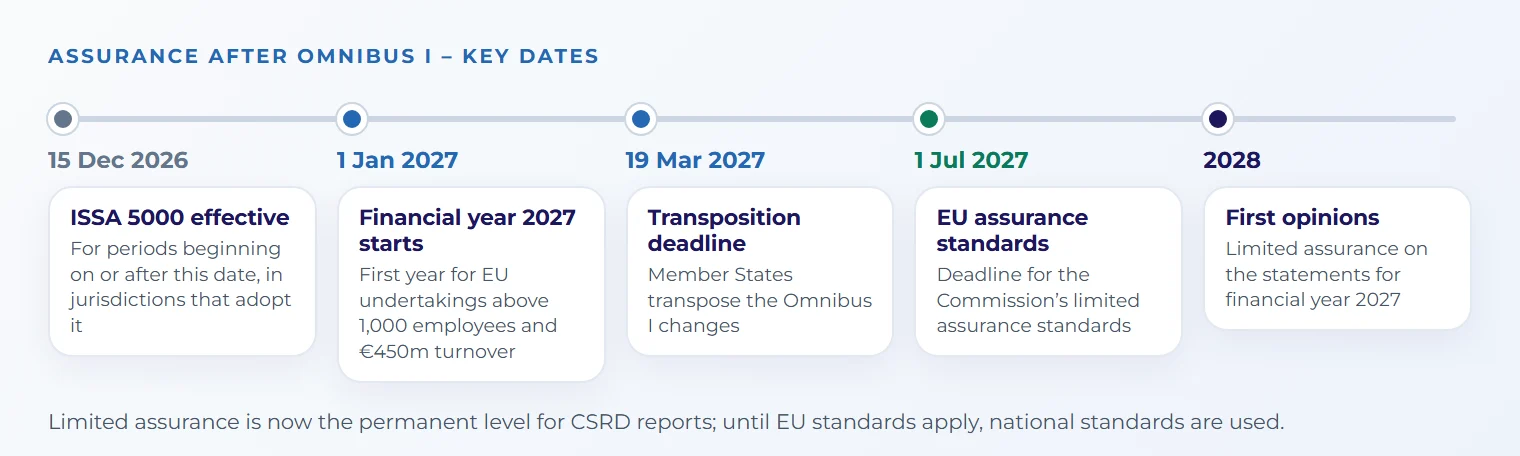
Transposition: Member States must transpose the changes by 19 March 2027. Until then, national law decides the details.
Until the EU standards apply, national assurance standards are used. Many practitioners refer to ISSA 5000, the IAASB’s international standard on sustainability assurance. It is effective for periods beginning on or after 15 December 2026 in jurisdictions that adopt it – for calendar-year companies, that is financial year 2027.
Key dates for CSRD assurance after Omnibus I, from ISSA 5000 to the first limited assurance opinions on financial year 2027.
What is assured
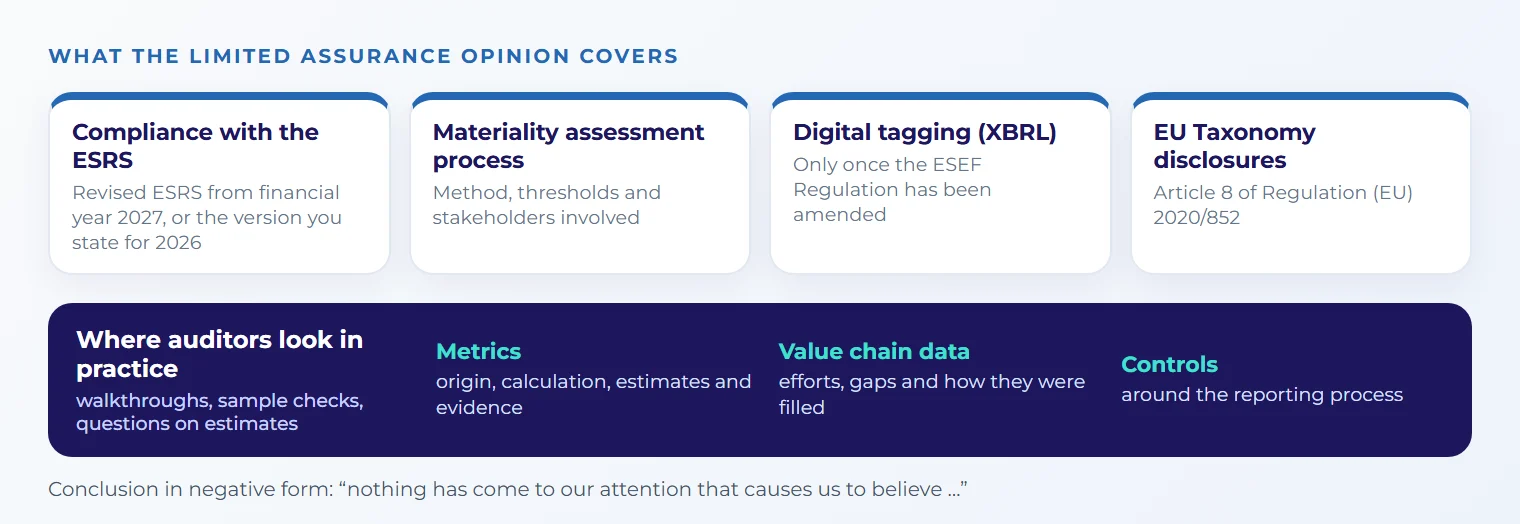
Under Article 34(1)(aa) of the Accounting Directive, as amended by Omnibus I, the assurance provider expresses an opinion based on a limited assurance engagement on:
compliance with the ESRS: the revised ESRS in Delegated Regulation (EU) 2026/1563 from financial year 2027, or the version you state you applied for financial year 2026;
the materiality assessment process: how you identified the information to report – method, thresholds, stakeholders involved;
digital tagging: compliance with the requirement to mark up the sustainability statement in XBRL (Article 29d of the Accounting Directive). In practice, this applies only once the Commission has amended the ESEF Regulation (Delegated Regulation (EU) 2019/815); until then, tagging ESRS disclosures is not mandatory, and EFRAG only consulted on a draft XBRL taxonomy for the revised ESRS until 11 November 2026;
In practice, auditors concentrate on your metrics (origin, calculation, estimates and evidence), on value chain data and on the controls around the reporting process. For the first three years of reporting, missing value chain information is acceptable if you explain your efforts, the reasons and your plans to obtain it (ESRS 1, paragraph 123).
The four parts of the limited assurance opinion under Article 34(1)(aa) of the Accounting Directive, and where auditors look in practice.
Who may assure: Austria and Germany
The CSRD lets the statutory auditor or another audit firm perform the assurance. Member States may also admit other auditors or independent assurance services providers. How this works depends on national law:
Austria: the Sustainability Reporting Act (NaBeG), Federal Law Gazette I No. 6/2026 of 18 February 2026, transposes the CSRD. The assurance is performed by the statutory auditor or another, separately appointed Wirtschaftsprüfer; rules that would let independent assurance providers do it are not yet in place. The obligation starts with financial years whose balance sheet date falls after publication of the act. The Omnibus I changes still have to be transposed by 19 March 2027.
Germany: the CSRD has not yet been transposed (as of autumn 2026), so the previous non-financial reporting rules of the CSR Directive Implementation Act (CSR-RUG) still apply. The government drafts foresee that only Wirtschaftsprüfer may assure the sustainability report.
What this means for you: agree early with your auditor which assurance standard will be applied and when the engagement starts. In Austria, a national interim standard of the profession (KFS/PE 28) is used until EU standards apply.
How to prepare
Involve the auditor early. Agree on a dry run or a preliminary meeting long before the report is finished, and fix the assurance standard and timeline in the engagement letter.
Document the materiality assessment. Method, thresholds, assessments and decisions must be traceable for outsiders – see the guide on the double materiality assessment.
Describe the data flows. For each metric: source, owner, calculation and controls – the datapoint list is the basis for this.
Justify estimates. Record assumptions, extrapolations and emission factors in writing, including why they are reasonable.
Document value chain efforts. Keep a record of which partners you asked, what you received and how you filled gaps.
File evidence centrally. Store invoices, meter readings, exports and approvals so they can be found for every figure.
Allow time. Follow-up questions, additional evidence and, once it applies, the XBRL tagging take weeks; build them into the reporting calendar.
Common pitfalls
Climate data without a method: especially Scope 3. How to build a traceable GHG inventory is covered in a separate guide.
Materiality without a trail: a result without documented method and thresholds is one of the most frequent findings.
Spreadsheets without version control: if nobody knows which file is valid, no figure can be evidenced.
Taxonomy as an afterthought: the Taxonomy disclosures are part of the assured scope, not an appendix.
Knowledge held by one person: if they are absent, explanations are missing. Plan for deputies.
How FIESDA can help with ESG and ESRS report assurance
Most findings in a CSRD assurance engagement come down to evidence nobody can find or figures nobody can trace. In FIESDA’s ESG flexible reporting software with audit support, your auditor gets a read-only account and marks each disclosure and data point with an audit check. Evidence files sit with the reporting issue they support, auditor comments stay in one place, and the action history shows who changed what and when. You still own the methods, the estimates and the answers to the auditor’s questions.
Frequently asked questions
Is reasonable assurance still coming for CSRD reports?
No. Omnibus I removed the Commission’s mandate to adopt reasonable assurance standards, so limited assurance is the permanent level. You can still agree a reasonable assurance engagement voluntarily.
Does a report under the voluntary standard need assurance?
No. Companies applying the voluntary standard are not obliged to seek assurance. Some do so voluntarily to increase credibility with banks or customers.
Which assurance standard will my auditor use?
Until the EU limited assurance standards are adopted (deadline 1 July 2027), national standards apply. ISSA 5000 is the international reference; in Austria the profession uses KFS/PE 28.
Can the auditor fault us for missing supplier data?
The assurance opinion must respect the right of partners with up to 1,000 employees to decline information beyond the voluntary standard. In your first three reporting years, you also have to explain your efforts and plans where value chain data is missing.
Who may assure our report in Germany?
This will only be settled by the German transposition act. The current drafts foresee that only Wirtschaftsprüfer may do it.
How to build an internal control system for sustainability data: identify risks, define controls, keep evidence – and what ESRS 2 requires you to disclose about it.
Which revised ESRS datapoints apply to you, how materiality, reliefs and phase-ins filter them, and how to use EFRAG’s Excel list and prepare for XBRL tagging.
How to plan and report your climate transition under the revised ESRS E1-1, the voluntary standard (VSME) and IFRS S2, and what Omnibus I changed for transition plans.