Under Omnibus I, the CSRD applies only to companies with over 1,000 employees and over €450m turnover. Thresholds, deadlines and the revised ESRS at a glance.
easy4pro editorial team·Last reviewed: ·12 min read
Key takeaways
Under Omnibus I (Directive (EU) 2026/470), the CSRD applies only to EU undertakings with more than 1,000 employees and more than €450m net turnover – both thresholds must be exceeded. Law-firm estimates put the reduction at around 90% of the companies originally expected to report (the Commission’s own estimate for its 2025 proposal was about 80%).
Most newly in-scope EU companies report for the first time in 2028 (financial year 2027), non-EU groups in 2029. The revised ESRS are mandatory from financial year 2027; for 2026, companies that already report can choose between the existing and the revised ESRS.
Austria transposed the CSRD with its Sustainability Reporting Act (NaBeG) in February 2026. The Omnibus changes must still be transposed into national law by 19 March 2027.
Companies that no longer have to report will still be asked for ESG data – as suppliers, borrowers or bidders. From 2027, the value-chain cap limits what reporting customers may ask of partners with up to 1,000 employees for their CSRD report.
Few EU rules have changed as much in as little time as the Corporate Sustainability Reporting Directive (CSRD). When it entered into force in 2023, around 50,000 companies in the EU were expected to report. After Omnibus I, law-firm estimates suggest that around 90% of them are out of scope. For those companies the obligation is gone – but the questions about sustainability data are not. For the rest, the rules have become lighter: far fewer datapoints, no sector-specific standards and limited assurance only.
This guide answers three questions: do you still have to report, when, and – if not – what should you do with the work you have already done?
Who has to report after Omnibus I
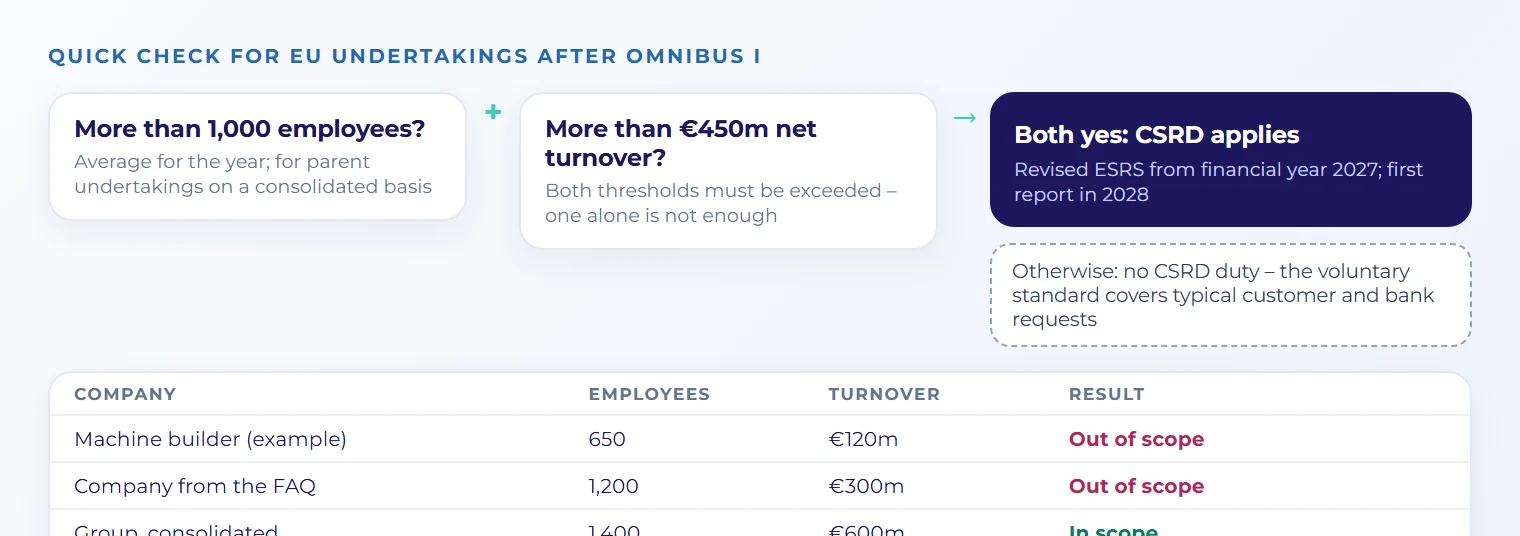
Directive (EU) 2026/470 redrew the scope of the CSRD. The reporting duty itself sits in Articles 19a and 29a of the Accounting Directive (2013/34/EU), as amended by the CSRD. The quick check has two questions: does your undertaking have an average of more than 1,000 employees and more than €450m net turnover? Only if the answer to both is yes does the CSRD apply – one criterion alone is no longer enough. For parent undertakings, both thresholds are tested at group level, on a consolidated basis.
A directive does not bind companies directly: your obligation depends on how your member state transposes it, which must happen by 19 March 2027. Until then, check which national rules currently apply to you.
Non-EU groups are in scope if the ultimate parent generated more than €450m net turnover in the EU in each of the last two consecutive financial years and the group has an EU subsidiary or branch with more than €200m net turnover. There is no employee test for non-EU groups, and they report later: the first reports, on financial year 2028, are due in 2029.
Criterion
CSRD before Omnibus I
After Omnibus I
Employees
more than 250 (large undertaking: two of three criteria)
more than 1,000
Net turnover
more than €50m
more than €450m (in addition to employees)
Balance sheet total
more than €25m
no longer a criterion
Listed SMEs
in scope
no longer in scope
Non-EU groups
more than €150m EU turnover, plus a large EU subsidiary or an EU branch above €40m
more than €450m EU turnover, plus an EU subsidiary or branch above €200m
Mid-sized companies, listed SMEs and many first-wave companies in particular drop out of the obligation. (The “before” figures are the inflation-adjusted size criteria of Delegated Directive (EU) 2023/2775.) For those that drop out there is the voluntary standard (Delegated Regulation (EU) 2026/1560), which also limits the data that reporting customers may request from them.
Quick check after Omnibus I: both thresholds must be exceeded. The machine builder from the example and the company from the FAQ are out of scope.
The timeline at a glance
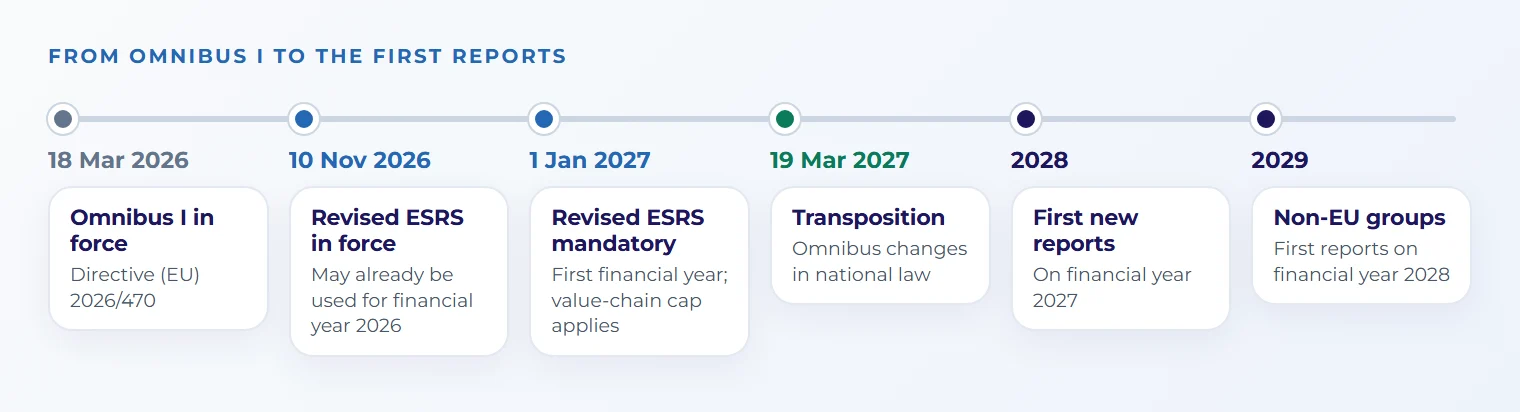
The short version: for most newly in-scope EU companies nothing has to be published before 2028 – but the data for financial year 2027 has to be collected from 1 January 2027 (for companies with a calendar financial year).
Commission presents Omnibus IProposal to simplify the CSRD, the CSDDD and the EU taxonomy.
“Stop-the-clock” Directive (EU) 2025/794Reporting for the second and third waves is postponed by two years.
“Quick fix” Delegated Regulation (EU) 2025/1416 publishedCompanies already reporting (first wave) may keep omitting certain ESRS disclosures for financial years 2025 and 2026.
Omnibus Directive (EU) 2026/470 publishedIt enters into force on 18 March 2026.
Revised ESRS and voluntary standard publishedDelegated Regulations (EU) 2026/1563 and (EU) 2026/1560. The voluntary standard enters into force on 24 September 2026.
Revised ESRS enter into forceCompanies reporting for financial year 2026 may already apply them.
First financial year with the revised ESRS mandatoryThe value-chain cap also applies from this financial year.
Transposition deadline for member statesThe Omnibus changes must be in national law by then.
Deadline for the EU limited assurance standardThe Commission has to adopt it by then; until then, auditors can refer to the CEAOB guidelines.
First reports on financial year 2027for in-scope companies that were not reporting before (the former “second wave”).
First reports of non-EU groupsfor financial year 2028.
Review clauseThe Commission must report on whether the CSRD scope should be extended, for example to large undertakings below the thresholds and to third-country undertakings without an EU subsidiary or branch. A first report on other points, including use of the voluntary standard, is due by 30 April 2029.
Key dates from Omnibus I to the first reports under the revised ESRS.
What the revised ESRS change
Delegated Regulation (EU) 2026/1563 replaces Annexes I and II of the original ESRS (Delegated Regulation (EU) 2023/2772) with a revised, simplified set. The revised ESRS are mandatory for financial years starting on or after 1 January 2027; the first reports under them are due in 2028. What changes – and what does not:
Stays: double materiality. You still assess impacts, risks and opportunities, and the topics are the same: climate, pollution, water, biodiversity, circular economy, own workforce, workers in the value chain, affected communities, consumers and business conduct.
Goes: a lot of datapoints. According to the Commission, mandatory datapoints are cut by more than 60% and total datapoints by more than 70%, because all voluntary datapoints are removed. Quantitative information takes priority over narrative text.
Goes: sector-specific standards. Omnibus I deleted the Commission’s power to adopt them.
Easier: the materiality assessment. A top-down approach is now explicitly allowed (see below).
Stays: limited assurance. The planned step up to reasonable assurance has been dropped.
Top-down in practice: you may reach materiality conclusions at topic level, based on your business model, sectors, geographies and value chain, instead of assessing every single impact, risk and opportunity. A food producer, for example, can start from the topics its business model makes obvious – such as packaging, water and its own workforce – rather than scoring dozens of items one by one. You will also see the revised standards called “simplified ESRS” or “ESRS 2.0” – not to be confused with ESRS 2 (General disclosures), which is one standard within the set.
For financial year 2026, undertakings that already report under the ESRS can choose to:
apply the existing ESRS with reliefs from the new regulation – for example the top-down materiality approach, the cap on value-chain analysis, the undue cost or effort rules and a separate presentation of Taxonomy disclosures – or
apply the revised ESRS in full.
The sustainability statement must state clearly which version was used. First-wave companies had already received relief for financial years 2025 and 2026 through the “quick fix” in 2025.
What applies in Austria
Austria transposed the CSRD with the Sustainability Reporting Act (Nachhaltigkeitsberichtsgesetz, NaBeG). The National Council passed it on 21 January 2026 and the Federal Council on 5 February 2026; it was promulgated on 18 February 2026 (BGBl. I Nr. 6/2026, in German). The reporting obligations themselves are set out in the Austrian Commercial Code (UGB). As a rule, the duty applies to companies whose balance sheet date falls after the promulgation – so a company with a calendar year ending on 31 December 2025 had no NaBeG reporting duty for 2025.
Because the Omnibus Directive only entered into force afterwards, Austria – like every member state – has to transpose the changes by 19 March 2027 and will need to amend the NaBeG and the UGB accordingly. Until then, the national rules as passed apply.
What this means for you: plan on the Omnibus scope – the Austrian legislator has to implement it by 19 March 2027 – but do not stop a CSRD project before your auditor has confirmed your status, your first reporting period and any transitional rules for first-wave companies.
No longer in scope – what now?
Companies that drop out of the obligation should not throw away the work they have done. The questions keep coming from four directions:
Reporting customers. They still need value-chain data. From 2027, the value-chain cap limits what they may ask partners with up to 1,000 employees for their CSRD report.
Banks and investors. They request ESG metrics for their risk management.
Large buyers under due-diligence rules. The Corporate Sustainability Due Diligence Directive (Directive (EU) 2024/1760) now applies only to EU companies with more than 5,000 employees and more than €1.5bn net turnover, with application from 26 July 2029. Those buyers may still ask suppliers about human-rights and environmental risks.
Tenders. Sustainability evidence increasingly counts in bids.
The most useful next step is usually a report under the voluntary standard: it is much smaller than the ESRS and covers the typical requests. The value-chain cap does not limit requests based on other EU or national law, for example due diligence obligations.
Example (fictional)
A Styrian machine builder with 650 employees and €120m turnover starts its CSRD project in 2024, expecting to report for 2025. Omnibus I takes it out of scope: it is far below 1,000 employees and €450m. The work is not wasted, though. Its largest customer stays in scope and still needs supplier data for its own CSRD report – but from 2027 may only ask for what the voluntary standard covers. Its bank also asks for energy and emissions figures, a request the cap does not limit. Instead of answering both separately, the company turns its CSRD groundwork into one report under the voluntary standard.
Companies that began reporting for financial year 2024 but now fall below the thresholds should also check their national law: member states may allow them to skip financial years 2025 and 2026, but only where national law actually grants this. Austria’s NaBeG, for example, already exempts first-wave companies at or below either the €450m turnover or the 1,000-employee threshold (§ 908 UGB).
Checklist: next steps
Check the thresholds. Determine the average number of employees and net turnover – on a consolidated basis for groups – for the relevant financial years, and check how your member state has implemented them.
Choose the version for 2026. Companies already reporting decide whether to use the existing ESRS, the ESRS with reliefs or the revised ESRS – and state the choice in the sustainability statement.
Update the materiality assessment. The revised standards are a good opportunity to streamline your double materiality assessment, for example with the new top-down approach.
Align supplier requests. Base CSRD data requests to partners with up to 1,000 employees on the voluntary standard – from financial years starting in 2027 the value-chain cap generally rules out asking for more (requests under other laws are not covered).
Plan the assurance early. The sustainability statement is subject to limited assurance; the step up to reasonable assurance has been dropped. The Commission has to adopt an EU limited assurance standard by 1 July 2027 – until then, agree processes and evidence with your auditor in good time.
Track the national law. Follow how your member state transposes Omnibus I by 19 March 2027, including any transitional rules for companies that were already reporting.
How FIESDA can help with CSRD reporting
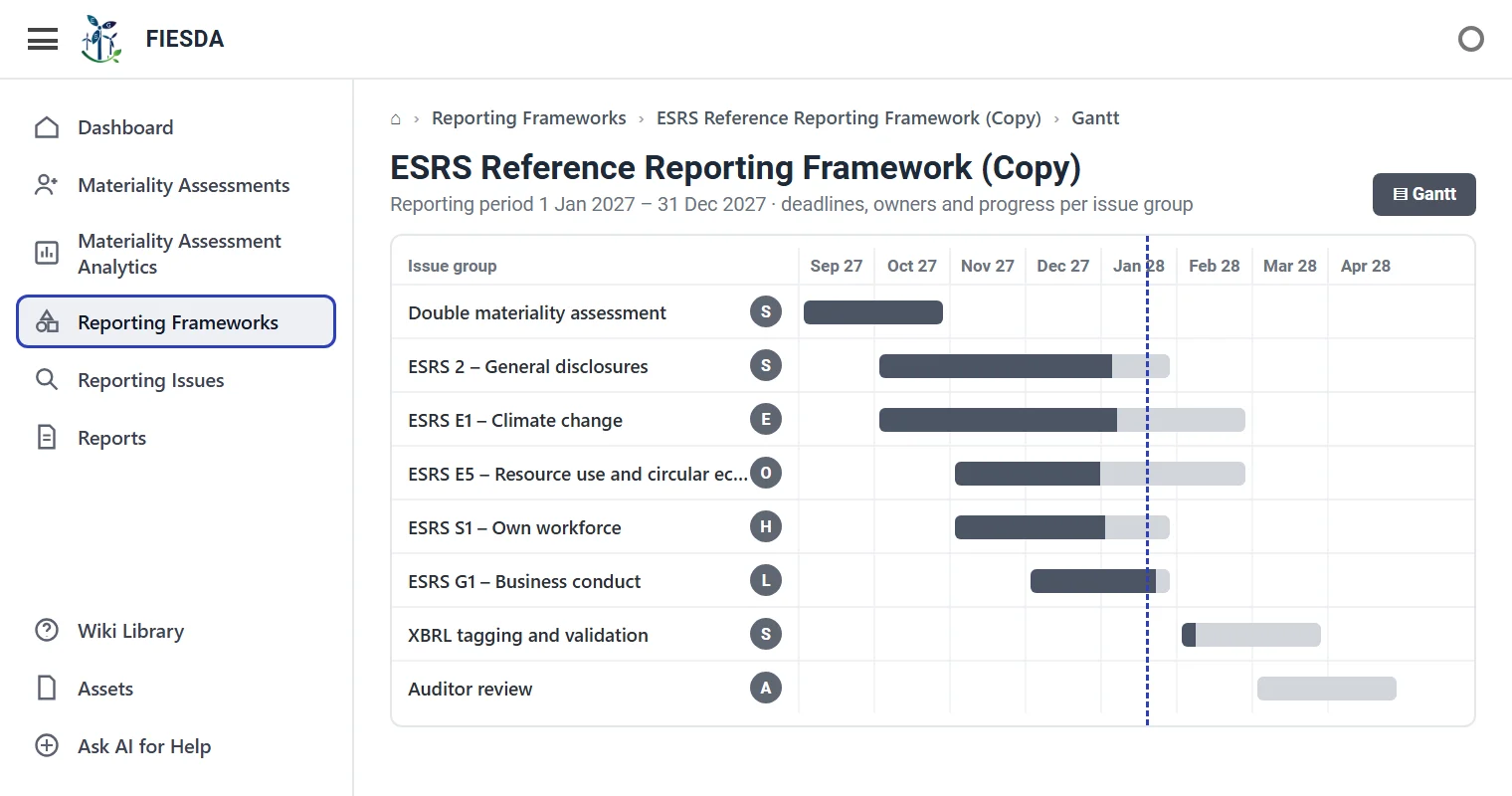
Once you know whether and when you report, the work becomes a project with owners and deadlines. FIESDA’s CSRD reporting software gives you editable ESRS and voluntary-standard templates with the disclosure requirements as data points and guidance on what each disclosure asks. You set owners and due dates, track progress in a Gantt view, and tag and validate the report in XBRL, ready for when digital tagging applies. You still tailor the template to your materiality results and the ESRS version you apply.
Illustration of the Gantt view in FIESDA: deadlines, owners and progress per reporting issue group for a first report on financial year 2027 (example data).
Frequently asked questions
Does the CSRD apply if I have 1,200 employees but €300m turnover?
No. Both thresholds must be exceeded: an average of more than 1,000 employees and more than €450m net turnover.
What is the difference between “stop-the-clock” and Omnibus I?Directive (EU) 2025/794 only postponed the start of reporting for the second and third waves by two years. Directive (EU) 2026/470 changed the rules themselves: much higher thresholds, no sector-specific standards, limited assurance only and the mandate for the revised ESRS.
Is the sustainability report still audited?
Yes. For companies in scope, limited assurance remains required and the planned move to reasonable assurance has been dropped. The EU limited assurance standard is due by 1 July 2027; until then, the CEAOB guidelines are a common reference.
Do non-EU companies have to report?
Only large non-EU groups: more than €450m net turnover in the EU in each of the last two consecutive financial years, plus an EU subsidiary or branch with more than €200m net turnover. The first reports, on financial year 2028, are due in 2029.
Could the thresholds change again?
Possibly. Omnibus I includes a review clause: the Commission has to report by 30 April 2031 on whether the scope should be extended, and then every three years. (The better-known date of 26 July 2031 is the review of the CSDDD.)
Is the voluntary standard mandatory?
No. The voluntary standard is optional, but it is the yardstick for the value-chain cap – and a practical way to answer many data requests with one report.
Which revised ESRS datapoints apply to you, how materiality, reliefs and phase-ins filter them, and how to use EFRAG’s Excel list and prepare for XBRL tagging.
How to plan and report your climate transition under the revised ESRS E1-1, the voluntary standard (VSME) and IFRS S2, and what Omnibus I changed for transition plans.