How to set science-based targets under the SBTi Corporate Net-Zero Standard V2.0 and turn them into KPIs, annual milestones and quarterly OKRs.
easy4pro editorial team·Last reviewed: ·9 min read
Key takeaways
V2.0 is final: the SBTi published the Corporate Net-Zero Standard V2.0 on 11 June 2026. Validations open on 1 February 2027; V2.0 is mandatory for submissions from 1 February 2028.
Near-term targets cover five years, with separate targets for Scope 1 and Scope 2; Category A companies also cover every Scope 3 category of 5% or more.
SBTi is voluntary; ESRS disclosure is law. CSRD undertakings must state whether their targets are science-based and compatible with 1.5°C (ESRS E1-6).
Deliver through a cascade: five-year target → annual KPI milestones → quarterly OKRs with owners and deadlines.
A science-based target is only as good as the system that delivers it. With the SBTi’s Corporate Net-Zero Standard V2.0, published on 11 June 2026, targets move to fixed five-year cycles with annual progress reporting and an end-of-cycle assessment.
This guide answers the questions sustainability managers, controllers and CFOs ask: Which version of the SBTi rules applies to us, and when? Are we Category A or B? Which targets must we set for Scopes 1, 2 and 3? And how do we turn a five-year target into KPIs, deadlines and quarterly OKRs that sites and teams actually work on?
SBTi V2.0 at a glance
V2.0 consolidates and replaces the Near-Term Criteria and earlier net-zero standard versions, and adds governance, transition planning, progress assessment and assurance. It remains a voluntary framework.
Date
What happens
31 January 2027
Last date to commit if you want to validate under the current rules
1 February 2027
V2.0 validations open
31 January 2028
Last date to submit under V1.3.1 and Near-Term Criteria V5.3.1
1 February 2028
V2.0 mandatory for new submissions
2035
Category A must start supporting carbon removals (1% of ongoing emissions, rising)
Topic
Before (V1.3)
V2.0
Scope 1 and 2
Combined target possible
Separate targets
Scope 3
Required if ≥ 40% of total; 67% coverage
Category A: every category of 5% or more
Near-term timeframe
5–10 years
5 years
Base year
Historical year possible
Most recent year with comprehensive data
Existing validated targets stay valid until the end of their timeframe or the five-year review, whichever comes first.
Category A or Category B?
Category A covers large companies everywhere and medium-sized companies in high-income countries; Category B covers small companies and medium-sized companies in lower-income countries. The SBTi assigns the category from revenue, employees, emissions and country income group.
Requirement
Category A
Category B
Near-term Scope 1 and Scope 2 targets
Required
Required
Near-term Scope 3 target
Required
Optional
Limited assurance of base-year inventory (CNZS-C7)
Required
Optional
Transition plan disclosure
Required (up to 15 months’ flexibility)
Optional
Carbon removals from 2035
Required
Optional
What this means for you: medium-sized companies in Germany or Austria (high-income countries) are Category A. Check the thresholds in the Standard before budgeting for assurance.
Step 1: Set the boundary and base year
The near-term base year is the most recent year with comprehensive data (chapter 2). Define organisational and operational boundaries (CNZS-C3), report a GHG Protocol inventory (CNZS-C5), obtain third-party assurance if you are Category A (CNZS-C7), and recalculate after significant changes (CNZS-C8). Targets use the physical inventory, with location-based Scope 2; renewable energy certificates and PPAs are recognised separately.
Absolute reduction on a straight line to the net-zero year; sector intensity pathway; asset transition (the last two also need a long-term Scope 1 target by 2050, Category A)
Scope 2
Reduce emissions and/or raise the share of low-carbon electricity
Scope 3
Overarching absolute reduction; supplier or customer alignment (a growing share of tier-1 partners with science-based targets); category- or activity-specific targets
Scope 3 exclusions must be justified. Allowed: categories below 5% of Scope 3, Category 3 if covered by Scope 1 or 2 energy targets, activities without practical influence, and activities covered by a sector standard such as FLAG.
Step 3: Calculate the annual path
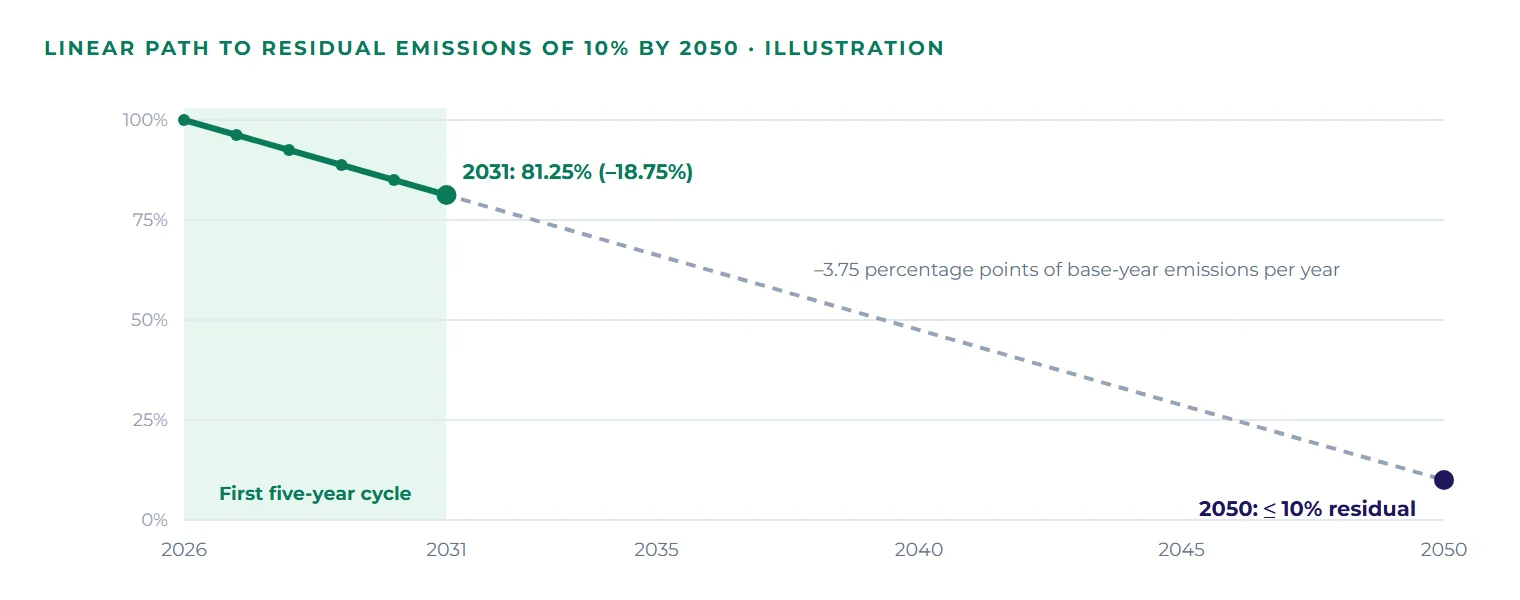
Use the SBTi’s own tools for official values. An overarching Scope 3 target follows a linear contraction to residual emissions of about 10% or less by 2050. To steer, turn the five-year target into annual milestones. Illustration, not an official SBTi calculation: with base year 2026, (100% – 10%) ÷ 24 years = 3.75 percentage points of base-year emissions per year, so –18.75% after five years.
Et = Ebase × (1 − r × (t − tbase))
Here E is emissions, r the annual reduction as a share of base-year emissions and t the year. Track an intensity KPI (for example tCO2e per tonne of product) alongside, so you can see whether progress comes from efficiency or from lower volumes. Higher emissions in the target year mean steeper reductions in the next cycle.
The first five-year cycle on a linear path to 2050. Illustration only – take official values from the SBTi tools.
Step 4: Validation and the five-year cycle
The SBTi assesses targets at Target Validation and at the End-of-cycle Assessment. Between the two, companies report progress annually (chapter 5) and set next-cycle targets before the current cycle ends. V2.0 adds board accountability (chapter 1), a transition plan for all companies, and from 2035 removal support for Category A (chapter 6). Targets are pursued on a best-efforts basis.
What this means for you: keep a year-by-year record of KPI values, actions and explanations that an assurance provider can follow.
Step 5: Turn targets into KPIs, deadlines and OKRs
The SBTi prescribes no management method, and no regulation requires OKRs. A common practice is to cascade the target:
Level
Horizon
Owner
Example
Science-based target
5 years
Management board
Scope 3 –18.75% by 2031 vs 2026
KPI milestone
1 year
Sustainability lead and controlling
2027: ≤ 57,750 tCO2e
OKR key result
1 quarter
Function or site head
Q3 2027: Category 1 ≤ 9,600 tCO2e
Initiative
Weeks to months
Project owner
Qualify a recycled-fibre supplier by 31 August 2027
KPI, target or key result? A KPI is measured continuously; a target is the value it must reach by a date; a key result is a measurable outcome chosen for this quarter. Something you do is an initiative, not a key result.
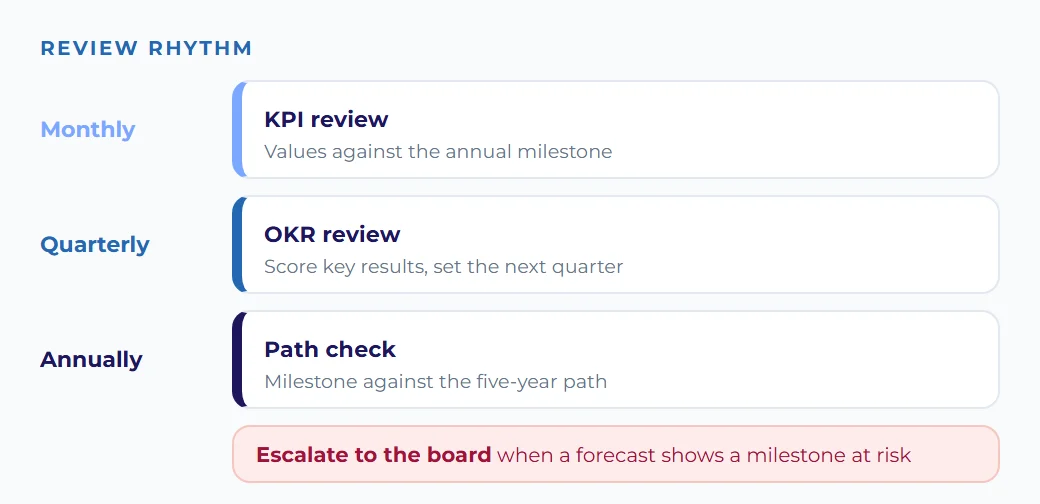
Common failures to avoid: too many objectives, activities posing as key results, key results always met while the annual milestone slips (sandbagging), and no single owner. A common rhythm is monthly KPI reviews, quarterly OKR reviews, an annual check against the five-year path, and escalation to the board when a forecast shows a milestone at risk. If variable pay is linked to targets, use the same figures as in external reporting.
A typical review rhythm.
Step 6: Report targets under ESRS and the voluntary standard
Under the revised ESRS (Delegated Regulation (EU) 2026/1563), ESRS E1-6 requires absolute GHG reduction targets for Scopes 1, 2 and 3 (paragraph 24(a)), their coverage (24(b)), and whether they are science-based and compatible with 1.5°C, with the method used (24(c), AR 17). Targets are gross: no credits or removals (AR 12). The base year stays unless key boundary changes occur (AR 14), and the boundary matches the E1-8 inventory (AR 16).
Reconcile with SBTi figures: the SBTi uses location-based Scope 2 and the most recent base year, while ESRS E1-8 reports location- and market-based Scope 2 on a financial-control boundary by default (AR 19). Explain differences in the disclosure.
Under the voluntary standard (“VSME”, Delegated Regulation (EU) 2026/1560), disclosure C3 applies if you have set targets: absolute Scope 1 and 2 targets, significant Scope 3 if set, base and target years and main actions (paragraph 53). C3 is outside the value-chain cap. For the ESRS statement itself, FIESDA is easy4pro’s AI-powered ESG reporting platform.
Example (fictional): from a five-year target to quarterly OKRs
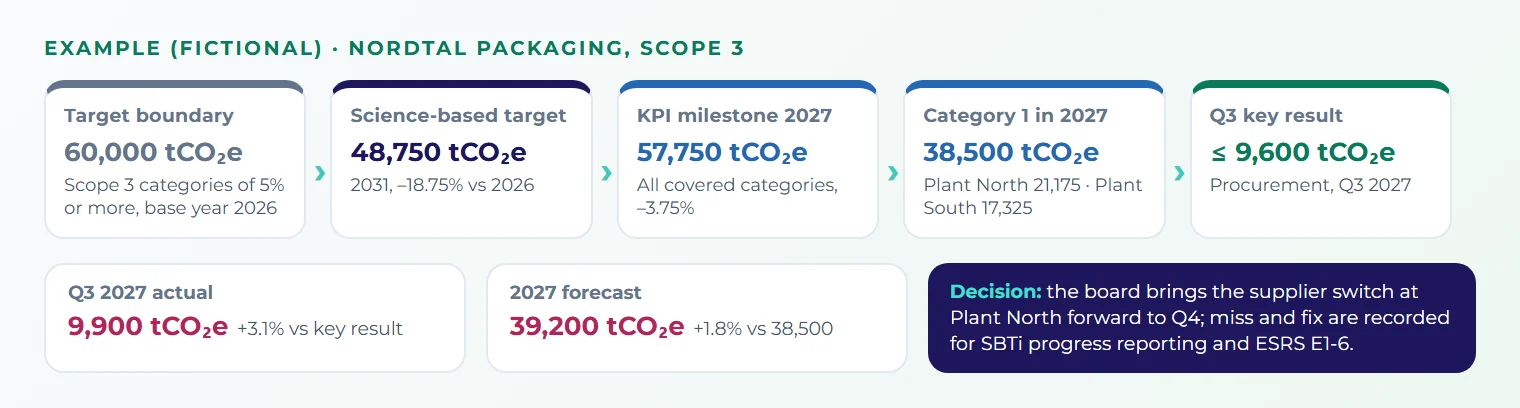
Nordtal Packaging AG (two German plants, 2,300 employees, €610m turnover) is Category A and validates under V2.0 with base year 2026. Scope 3 is 68,000 tCO2e; four categories of 5% or more (Categories 1, 4, 12 and 2) total 60,000 tCO2e (88.2%). Scope 1 and 2 targets come from the SBTi tools and are not shown.
Year
Scope 3 milestone (tCO2e)
vs 2026
2027
57,750
–3.75%
2029
53,250
–11.25%
2031 (target)
48,750
–18.75%
Category 1 (40,000 tCO2e) gets the same path: 38,500 tCO2e in 2027, or about 9,600 per quarter (Plant North 21,175, Plant South 17,325 for the year).
Q3 2027 OKR (procurement). Objective: put purchased-material emissions on the 2031 path. KR1: Category 1 ≤ 9,600 tCO2e. KR2: 60% of Category 1 on supplier-specific or hybrid data by 30 September 2027. KR3: 8 of the top 20 suppliers with committed or validated science-based targets. Initiative: qualify a recycled-fibre supplier by 31 August 2027.
Review: Category 1 came in at 9,900 tCO2e (+3.1%), and the forecast shows 39,200 against the 38,500 milestone (+1.8%). The board brings the supplier switch at Plant North forward to Q4, and the miss and the fix are recorded for SBTi progress reporting and ESRS E1-6.
Nordtal in numbers: from the 2031 target down to one quarter's key result – and what happened in Q3.
How ECOMON helps you manage SBTi targets with KPIs and OKRs
ECOMON turns your science-based targets into a steering system with owners, deadlines and early warnings.
OKRs linked to KPI targets: connect key results directly to emissions KPIs, with initiatives, responsibilities and deadlines at every level.
Targets and benchmarks per KPI: set annual milestones as target ranges and compare plants or peers.
Predictive analytics: forecast with 10 selectable models whether you will hit this year’s milestone.
Notifications and action history: get alerts on breaches and overdue deadlines, with a traceable record for progress reporting.
Is SBTi validation required by the CSRD?
No. ESRS E1-6 requires you to disclose targets and whether they are science-based; an SBTi validation is one way to support that.
Can we still use the old rules?
Yes: submissions under V1.3.1 and Near-Term Criteria V5.3.1 are accepted until 31 January 2028.
Do SMEs need Scope 3 targets?
Not if they are Category B. Medium-sized companies in high-income countries such as Germany and Austria are Category A.
What is the difference between an SBT and an OKR?
An SBT is a validated five-year emissions target; an OKR is an internal quarterly tool that breaks it into key results with owners and deadlines.
How to set a credible climate target – boundary, base year, absolute or intensity, ambition – and track it monthly so you notice deviations while you can still act.
How to turn sustainability targets into steerable ESG KPIs and OKRs: base year, target value, benchmarks, review cycle, SBTi and ESRS rules, with a worked example.
How to import electricity, gas, heat and fuel data automatically – from grid operator portals and invoices to sub-meters – and turn it into ESRS-ready energy figures.