What digital tagging of the sustainability statement means, which XBRL taxonomy applies, when tagging becomes mandatory and how to prepare for it now.
easy4pro editorial team·Last reviewed: ·10 min read
Key takeaways
Under Article 29d of the Accounting Directive, companies in the CSRD scope prepare their management report in the ESEF format and are to mark up their sustainability reporting with XBRL tags so machines can read it. The tagging itself is not required yet.
Tagging becomes mandatory only once the Commission adopts digital mark-up rules under the ESEF Regulation. ESMA drafts the technical standards on the basis of EFRAG’s final taxonomy; that step is still pending.
On 17 September 2026 EFRAG published a draft XBRL taxonomy for the revised ESRS. The consultation closed on 11 November 2026; EFRAG plans to submit the final version to ESMA and the Commission by the end of 2026.
For the Voluntary Standard (VS), EFRAG released an updated Digital Template, XBRL taxonomy and converter on 4 November 2026. Using them is voluntary.
Until now, sustainability statements have been read by people. XBRL lets software read them too: because every disclosure is tagged digitally, figures can be compared across many reports without copying them out of PDF files.
Short answer: not yet. No company has to tag its sustainability statement today. But EFRAG’s XBRL resources for the revised ESRS and the VS are already public, and anyone building a reporting process now can use them. This guide answers four questions: what XBRL is, which rules decide when tagging starts, which EFRAG resources exist, and what you can do now.
Example (fictional)
A bank reviews the sustainability statements of its 200 largest corporate clients every year. Today a team copies emission figures into a spreadsheet by hand and checks units and periods one by one. With tagged reports, a program reads the Scope 1 emissions directly – with unit, financial year and company.
What XBRL is
XBRL (eXtensible Business Reporting Language) is a standard for machine-readable company reports. In the EU, the ESEF Regulation specifies a single electronic format for annual financial reports: they are published as an XHTML file that reads like a normal page in the browser. Invisible tags inside it (Inline XBRL) can be processed by software.
Two terms matter:
Taxonomy: a digital dictionary. Every data point of a standard has an element with a definition, a data type and, where relevant, a unit.
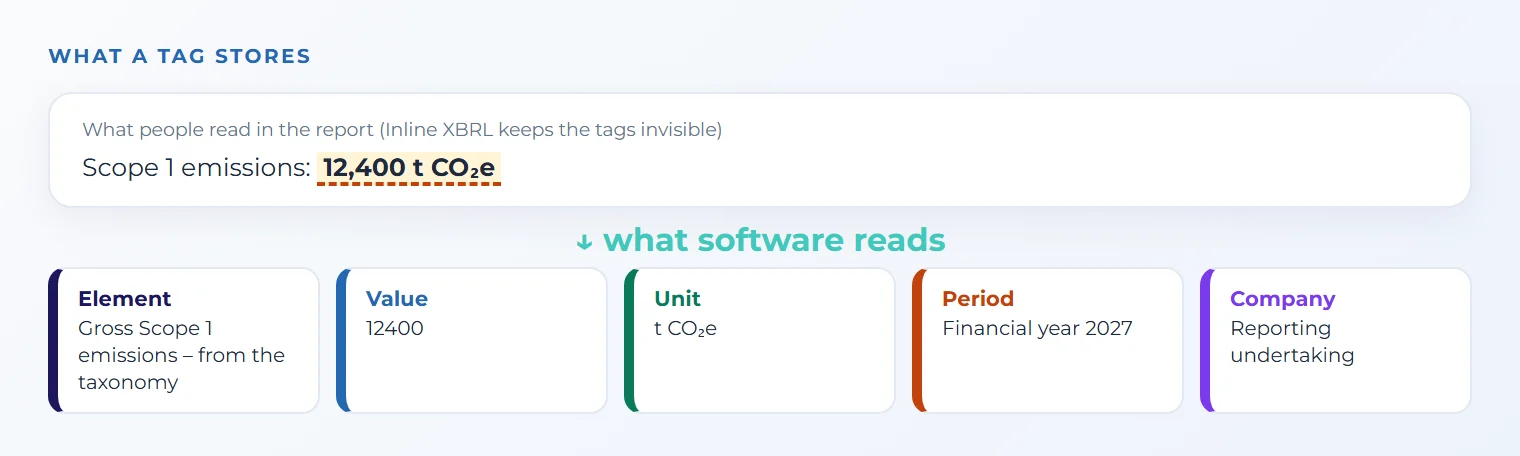
Tag: the mark-up in the report. It links a value to an element of the taxonomy, the period, the unit and the company.
What the report says
What the tag stores
“Scope 1 emissions: 12,400 t CO₂e”
element for gross Scope 1 emissions, value 12400, unit t CO₂e, financial year, company
One tagged figure: people read the value in the report, software reads the element, value, unit, period and company.
In EFRAG’s draft taxonomy for the revised ESRS, each datapoint is represented as an XBRL element (concept). The taxonomy contains the same datapoints as EFRAG’s Draft List of Datapoints and adds the technical attributes needed for digital reporting.
The legal position
Article 29d of the Accounting Directive, as replaced by Omnibus I (Directive (EU) 2026/470), requires undertakings subject to Article 19a to prepare their management report in the electronic reporting format specified in Delegated Regulation (EU) 2019/815 and to mark up their sustainability reporting, including the Article 8 Taxonomy Regulation disclosures, in line with that format. Parent undertakings under Article 29a do the same for the consolidated management report. The mark-up duty is deferred: until the mark-up rules are adopted by way of Delegated Regulation (EU) 2019/815, undertakings are not required to mark up their sustainability reporting. The CSRD (Directive (EU) 2022/2464) originally introduced Article 29d.
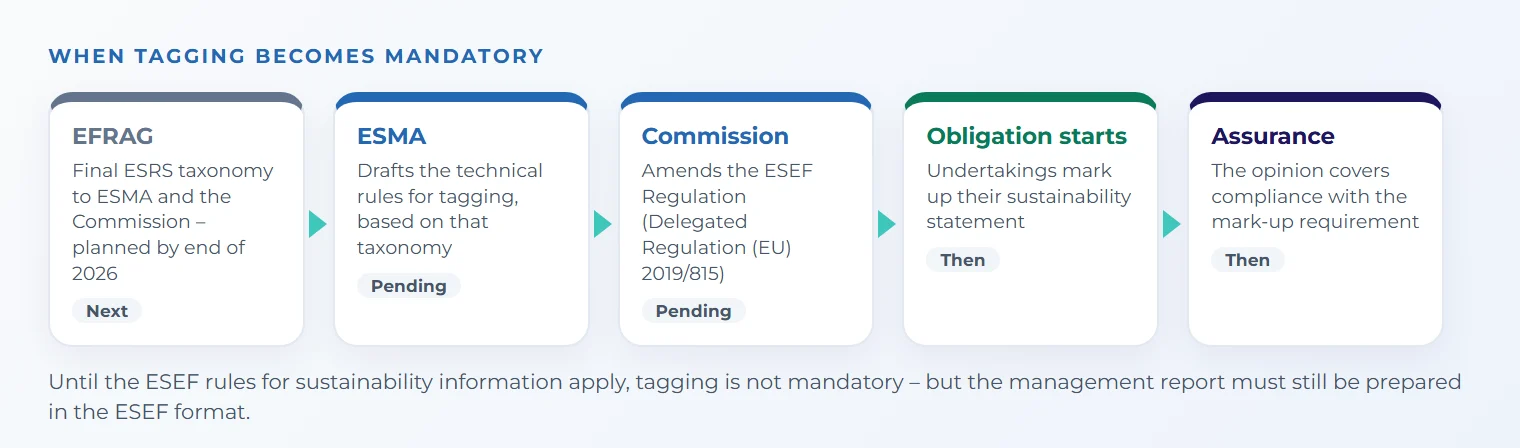
The ESEF Regulation therefore first has to be extended with rules for sustainability information. The route is: EFRAG delivers its final taxonomy, ESMA develops the tagging rules on that basis, and the Commission adopts them as a delegated act amending Delegated Regulation (EU) 2019/815. Until those rules apply, tagging is not mandatory. The statutory auditor’s assurance opinion on the sustainability reporting also refers to compliance with the mark-up requirement of Article 29d (Article 34(1)(aa) of the Accounting Directive).
The steps before tagging becomes mandatory, from EFRAG's final taxonomy to the amended ESEF Regulation.
What this means for you:
You report under the CSRD: there is no tagging duty today, but the management report that contains your sustainability statement must still be prepared in the ESEF format. Plan for tagging once the rules are adopted.
You are outside the CSRD scope: the CSRD does not require you to tag. If you report under the Voluntary Standard, tagging is optional (see below).
You supply a company that reports under the CSRD: customers may ask you for data. The VS tools described below produce a machine-readable report, but using them is optional.
The timeline
First ESRS taxonomyEFRAG publishes the XBRL taxonomy for the 2023 ESRS.
Revised ESRS enter into forceMandatory for financial years starting on or after 1 January 2027; optional for financial year 2026.
Consultation closedThe public consultation on the draft ESRS XBRL taxonomy ends.
Final taxonomyEFRAG submits it to ESMA and the European Commission.
ESEF rules for sustainability informationESMA drafts the technical rules and the Commission adopts them. Only then does the tagging obligation start.
Where to find the EFRAG XBRL resources
EFRAG publishes the XBRL resources in two places: the project page for the ESRS taxonomy and a separate page for the Voluntary Standard tools. The table lists what exists today. EFRAG’s overview of digital reporting with XBRL links to both.
Align your data point list with the taxonomy. EFRAG’s Draft List of Datapoints and the draft taxonomy contain the same datapoints. If your data collection follows these data points, later tagging is easier.
Keep units and periods clean. Every value needs a clear unit and reference period – exactly what each tag asks for.
Maintain values in one place. Copying figures from spreadsheets into text documents creates discrepancies. One central data source for the report and the tags avoids that.
Check your software for XBRL. Can it produce Inline XBRL, and does the vendor update promptly to new taxonomies, including the final one for the revised ESRS? More in the guide on choosing ESG reporting software.
Agree on it with your auditor. Clarify early how your auditor will check the tagging once it is mandatory.
How FIESDA can help with XBRL tagging
The checklist above asks whether your software can tag. In FIESDA’s XBRL tagging software a tag assistant finds ESRS and VS taxonomy concepts from a plain-language search, and built-in validation lists errors and warnings and keeps a validation history. You export the result as XBRL, or as HTML or DOCX to tag in third-party software. Tagging is not mandatory yet, so this prepares you for when it applies. You still review each tag’s context and unit.
XBRL for the Voluntary Standard (VS)
Smaller companies can make their data machine-readable too. For the Voluntary Standard (VS) – Delegated Regulation (EU) 2026/1560, in force since 24 September 2026 and building on the VSME Recommendation (Recommendation (EU) 2025/1710) – EFRAG offers a digital template (an Excel file), an XBRL taxonomy and a converter that turns the completed template into an Inline XBRL file. On 4 November 2026 EFRAG released an updated version (Digital Template version 2.0.0) aligned with the VS. It adds more translations and a merge function that combines the Inline XBRL report with PDF documents, and EFRAG releases all materials under an open-source licence. Using them is not mandatory. A machine-readable report can be processed by software without retyping. The EFRAG page for the VS digital tools lists the current version.
Example (fictional)
A machinery supplier with 180 employees receives sustainability questionnaires from several large customers. Instead of answering each form separately, it fills in the VS Digital Template once and uses EFRAG’s converter to produce an Inline XBRL report. Customers can process the figures with software. Because the supplier has no more than 1,000 employees, its customers may request only the information listed in Annex II to Delegated Regulation (EU) 2026/1560 (the value chain cap), which applies to financial years starting on or after 1 January 2027.
Whether your disclosures are in XBRL today or only later: if you manage data points, units and evidence carefully, you will be better prepared to tag them.
Frequently asked questions
Are the revised ESRS final?
Yes. The Commission adopted them on 3 July 2026, they were published in the Official Journal on 21 September 2026 as Delegated Regulation (EU) 2026/1563, and they entered into force on 10 November 2026. They apply to financial years starting on or after 1 January 2027.
Which ESRS can I use for financial year 2026?
Undertakings already reporting under the ESRS have three options under Article 2 of Delegated Regulation (EU) 2026/1563: the existing ESRS (as amended by Delegated Regulation (EU) 2025/1416), the revised ESRS, or the existing ESRS with eight listed reliefs. The sustainability statement must say which version was applied.
Do I have to tag my sustainability statement digitally today?
No. Undertakings are not required to mark up their sustainability reporting until the mark-up rules are adopted by amending Delegated Regulation (EU) 2019/815, and that has not happened yet. The management report itself must still be prepared in the ESEF format.
If the ESRS are final, why is the XBRL taxonomy still a draft?
The standards are law; their digital version is a separate step. EFRAG’s taxonomy for the revised ESRS is a draft: the consultation closed on 11 November 2026, and the final version is due to go to ESMA and the Commission by the end of 2026. Details may still change, so use the draft for planning, not as a final specification.
Do I have to report under the Voluntary Standard?
No, it is voluntary. It matters mainly as a reference for what customers can ask you for: from financial years starting on or after 1 January 2027, companies reporting under the CSRD may request from suppliers with up to 1,000 employees only the datapoints listed in Annex II to Delegated Regulation (EU) 2026/1560 (the value chain cap).
What is the difference between ESEF and XBRL?
ESEF is the EU’s electronic reporting format: an XHTML report that people read in a browser. XBRL is the tagging language used inside it (Inline XBRL). EFRAG’s digital template for the VS is optional and produces an XBRL report.
Which revised ESRS datapoints apply to you, how materiality, reliefs and phase-ins filter them, and how to use EFRAG’s Excel list and prepare for XBRL tagging.
How to plan and report your climate transition under the revised ESRS E1-1, the voluntary standard (VSME) and IFRS S2, and what Omnibus I changed for transition plans.